
The last four price ranges are planning estimates rather than fixed tariffs. Official merchandise, concert tickets and café sets vary considerably by artist and event.
K-Pop Attractions in Seoul
HiKR Ground: Best Free Introduction to Hallyu
HiKR Ground is one of the easiest places to include in a first Seoul itinerary. It is operated by the Korea Tourism Organization and combines tourism information with interactive media and Korean cultural content.
The K-Pop Ground area uses digital backgrounds and performance-style installations rather than functioning as a traditional museum. It is most useful for visitors who want an accessible introduction to Hallyu without committing to a paid tour or concert.
HiKR Ground is located at 40 Cheonggyecheon-ro, Jung-gu. Jonggak Station Exit 5 is the closest convenient subway access.
Most areas generally operate from 10:00 to 20:00, although floors may follow different weekly schedules. Some exhibition floors close on Mondays, while the first and fifth floors may remain open. Admission to the main facility is free, but separately announced programs can be paid.
Check the official HiKR Ground visitor information before visiting.
Allow approximately 60–90 minutes. Because of its central location, HiKR Ground can easily be combined with Cheonggyecheon Stream, Myeongdong or the historic centre of Seoul.
K-Pop Square Hongdae: Best for Albums and Temporary Displays
K-Pop Square is a specialized retail and cultural space in Hongdae. It offers albums, official merchandise, limited products and changing exhibitions or pop-ups.
The permanent store makes it more dependable than fan events discovered through social media, although the available artists and temporary displays still change.
It is located at 141 Yanghwa-ro, Mapo-gu, approximately 145 metres from Hongik University Station Exit 1. The published hours are 11:00–22:00, but check the current schedule before travelling across the city specifically for an exhibition.
See the official K-Pop Square information.
Hongdae is also one of Seoul’s main youth, music and nightlife districts. After visiting the store, you can continue through the pedestrian streets, cafés and independent shops. Our Seoul nightlife guide explains how the area changes after dark.
For albums and general shopping, compare Hongdae with Myeongdong before making large purchases. Prices and included preorder benefits can differ between retailers. See our Seoul shopping guide for a district-by-district comparison.
K-Star Road: A Short Gangnam Fan Walk
K-Star Road is a roughly one-kilometre route marked by GangnamDol sculptures representing different K-pop groups. The walk begins near Apgujeong Rodeo Station Exit 2 and continues towards the Cheongdam crossroads.
There is no admission fee, and the route normally takes 45–60 minutes. Allow longer if you plan to visit nearby shops or cafés.
The sculptures make the route easy to identify, but expectations should remain realistic. K-Star Road is an outdoor themed walk, not a working studio tour. Entertainment company buildings in the wider neighbourhood are private workplaces, and their locations can change.
Do not organize the visit around seeing an artist. Avoid blocking entrances, photographing employees or waiting outside non-public facilities.
Use the official K-Star Road overview to locate the route, but verify individual businesses separately because older guides may contain outdated agency information.
Olympic Park: Useful Mainly on Concert Days
Olympic Park contains major performance spaces, including KSPO Dome and Olympic Hall. It is therefore relevant to K-pop visitors primarily when they already have a ticket for an event.
The park itself is large and can be visited without a concert, but it should not be treated as a permanent K-pop exhibition. Venue access, merchandise booths and fan activities depend on the day’s event.
Olympic Park Station serves Lines 5 and 9. The best exit depends on the specific venue, so follow the organizer’s concert notice rather than a general map.
Arrive well before the published show time if you need to collect a ticket, verify an identity document, buy merchandise or locate a particular entrance. Large events may create queues before the venue opens.
See the official Olympic Park visitor page.
Do not confuse Olympic Park with Seoul Olympic Stadium in Jamsil. The stadium is undergoing renovation and is expected to reopen only after the scheduled work is completed.
K-Drama Filming Locations and Day Trips
Not every place shown in a drama remains recognizable after production. Restaurants close, shop interiors change and temporary sets are dismantled. For a dependable K-drama itinerary, choose preserved sets or established attractions rather than building an entire day around an unverified address from social media.
Dae Jang Geum Park: Best for Historical Drama Sets
MBC Dae Jang Geum Park in Yongin contains outdoor sets used for Korean historical productions. Its architecture includes palaces, houses, streets and administrative buildings designed to represent different periods.
The official site associates the location with productions including Dong Yi, Lee San and The Great Queen Seondeok. Current productions and access restrictions can change.
Published opening hours are:
- March–October: 10:00–18:00
- November–February: 10:00–17:00
- Last admission: one hour before closing
The official adult admission price is ₩7,000, with lower prices for teenagers and children. Costume and photography experiences are offered separately, with some options listed at ₩20,000.
Check current details on the official MBC Dae Jang Geum Park website.
The park is outside central Seoul and is less convenient than an urban attraction. Treat it as the main activity of the day. A guided transfer may be worthwhile if the available public transport connections would require several changes.
Optional organized tour: A Dae Jang Geum Park historical set tour can simplify transport from Seoul. Check the current meeting point, included admission and cancellation terms before booking.
Disclosure: The tour link above is an affiliate link. Explore Globe may receive a commission if you book through it, at no additional cost to you. Tour availability and itineraries are controlled by the provider.
Korean Folk Village: Best for a Broader Historical Experience
Korean Folk Village is a large recreated village in Yongin. It combines traditional architecture, performances, workshops and historical displays. It has also appeared in numerous films and television dramas.
Unlike a studio set, it functions as a general cultural attraction. This makes it suitable for mixed groups in which not everyone is travelling specifically for K-drama.
The official leaflet lists productions including My Love from the Star and Six Flying Dragons. Filming can occasionally restrict access to individual sections.
The standard listed admission is approximately ₩39,000, but online, weekday and late-entry promotions can reduce the price substantially. Check the official ticket page for the rate available on your date.
The address is 90 Minsokchon-ro, Giheung-gu, Yongin. Allow at least half a day, excluding travel from central Seoul.
See the current Korean Folk Village visitor information on VisitKorea for opening hours, facilities and transport details.
Nami Island: Best for Classic K-Drama History
Nami Island is strongly associated with Winter Sonata, one of the early dramas that helped expand the Korean Wave internationally. Some recognizable locations and references remain, but the island is now a broad scenic attraction rather than a dedicated television set.
Choose Nami Island if you are interested in classic Hallyu history and want a full-day excursion outside Seoul. It is less suitable if your priority is contemporary productions, K-pop shopping or an evening concert.
Travel time, transfers and ferry access mean it should not be combined with a packed central Seoul itinerary.
The Korea Tourism Organization provides a current Nami Island Hallyu overview.
A Central Seoul Alternative
If you do not want to spend most of a day travelling to Yongin or Gapyeong, create a central Seoul itinerary based on historical and urban atmosphere:
- Visit one of the main royal palaces in the morning.
- Walk through nearby traditional streets or Ikseon-dong.
- Continue towards Cheonggyecheon Stream.
- Finish at HiKR Ground or Myeongdong.
This will not reproduce one particular drama. It instead provides the types of palace courtyards, alleys, cafés and city views frequently used in Korean productions.
That distinction matters: label a location as a filming site only when it can be verified through a production company, tourism authority or the attraction itself.
How to Buy K-Pop Concert Tickets
Concert ticketing is one of the most time-sensitive parts of planning a K-pop trip. There is no single official seller for every artist. Depending on the event, tickets may be sold through NOL Ticket/Interpark, YES24 Ticket, Melon Ticket, Ticketlink or another authorized platform.
Follow this process:
1. Start with the Artist or Agency Announcement
Use the artist’s official website, fan platform or verified agency account to find the event announcement. It should identify the date, venue, ticket seller, sale schedule and any fanclub presale.
Do not begin with a reseller’s search result. Similar event names and unofficial packages can make it difficult to tell whether a listing is authorized.
2. Create the Required Account in Advance
Create and verify an account with the named ticket seller before sales begin. Check whether your account name must match your passport.
International visitors should use the global version of the seller when the event notice directs them there. Some platforms accept foreign payment cards, but authentication can fail depending on the bank or card issuer.
3. Read the Presale Rules
Fanclub presales can require a valid membership and a separate verification process completed before ticket sales open. Owning a membership does not necessarily register you automatically for the presale.
General sales may follow later, but availability is not guaranteed.
4. Check How the Ticket Is Delivered
Events may use:
- mobile tickets;
- physical tickets;
- venue collection;
- a combination of mobile verification and identity checks.
For NOL/Interpark mobile tickets, a screenshot is not accepted in place of the active ticket screen. The usable code becomes available through the booking account when entry begins. See the platform’s official mobile ticket guide.
5. Bring the Required Identification
The exact requirements vary by concert. Depending on the event, you may need:
- the passport used for booking;
- the booking confirmation;
- a fanclub membership card or digital membership;
- the payment card;
- an active mobile ticket.
Read the event-specific notice. A rule applied at one concert should not automatically be assumed for another.
6. Be Careful with Resale Tickets
Some Korean concerts use strict name matching or prohibit transfers. A resale ticket can therefore be genuine but still unusable by a different person.
Avoid unofficial resale unless the organizer explicitly permits transfer and provides a recognized method. Never send passport scans or account credentials to an unknown seller.
Pop-Ups, Birthday Cafés and Fan Events
Temporary events are an important part of K-pop fan culture, but they are also difficult to plan months in advance.
Birthday cafés may distribute cup sleeves, photocards or small gifts with a drink purchase. Pop-ups can sell limited merchandise or include themed photo zones. Most operate for a few days or weeks, and popular items may sell out before the event ends.
Search for current events shortly before your visit using:
- official artist and agency accounts;
- official venue or retailer accounts;
- notices on recognized fan platforms;
- the social account of the café itself;
- recent posts showing dates and participation rules.
Check whether the event requires a reservation, timed entry or minimum purchase. A reposted fan graphic may omit later schedule changes.
Budget approximately ₩5,000–₩15,000 for a drink or café set. Pop-up merchandise is additional.
Build temporary events around a permanent district visit. For example, combine a Hongdae birthday café with K-Pop Square rather than travelling across Seoul for one café that may have closed early.
A shopping-focused day can remain inexpensive if you mainly visit free attractions. Concert days are significantly more expensive once tickets, merchandise, food and cross-city transport are included.
Official merchandise prices change by artist and release. Treat the ranges above as a budgeting tool, not a promise of what a particular store or concert will charge.
Respectful Fandom and Photography
Public fan attractions can be enjoyed without treating private workplaces or individuals as exhibits.
Follow a few basic rules:
- Visit public stores, exhibitions and officially announced events.
- Do not enter private property or restricted office areas.
- Do not wait at staff entrances or follow vehicles.
- Do not photograph employees, performers or other visitors without permission.
- Follow photography restrictions at concerts and exhibitions.
- Keep pavements and building entrances clear.
- Do not assume that a café, house or restaurant welcomes visitors merely because it appeared on screen.
At filming locations, ordinary businesses may still be operating. Purchase something if you occupy a café table, and avoid recreating scenes in ways that interfere with staff or residents.
Which Hallyu Trip Should You Choose?
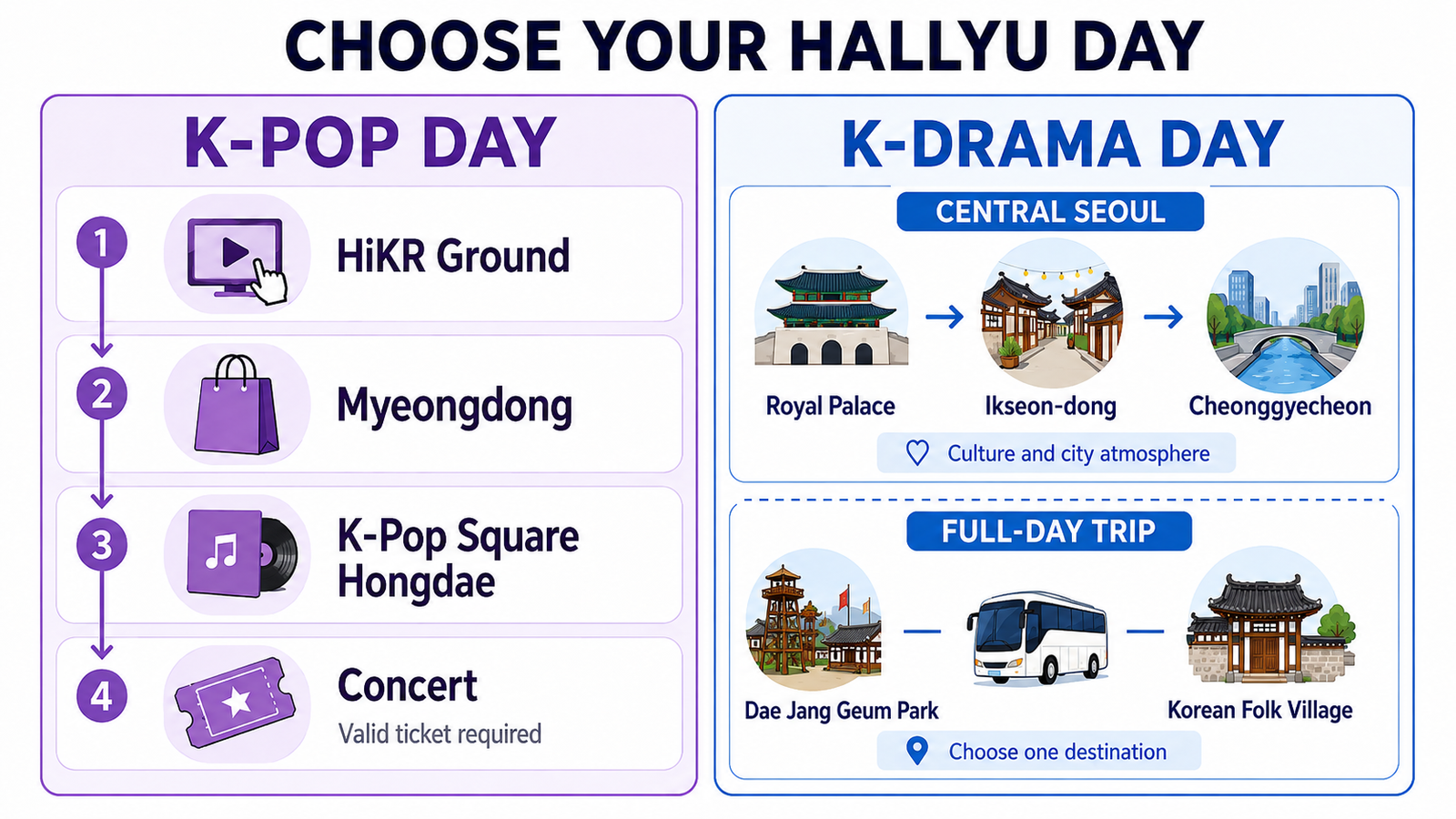
Choose HiKR Ground and Hongdae if this is your first visit and you want a simple K-pop day using public transport.
Choose K-Star Road if you are already visiting Apgujeong or Cheongdam and want a short, free themed walk.
Choose Dae Jang Geum Park if historical drama sets are your main interest.
Choose Korean Folk Village if you want a broader cultural attraction that also has verified filming connections.
Choose Nami Island for classic K-drama history and a scenic full-day excursion.
Choose a concert itinerary only after securing an official ticket. Plan the rest of that day around the venue rather than trying to complete a full sightseeing route first.
Temporary cafés and pop-ups should be treated as additions, not the foundation of a trip booked months in advance. Permanent attractions provide a reliable structure; current official announcements can then fill the remaining time.
If Hongdae, Myeongdong or Gangnam will be central to your itinerary, compare their accommodation, airport access and subway connections in our guide to where to stay in Seoul.
Related South Korea Guides
Continue planning with: