
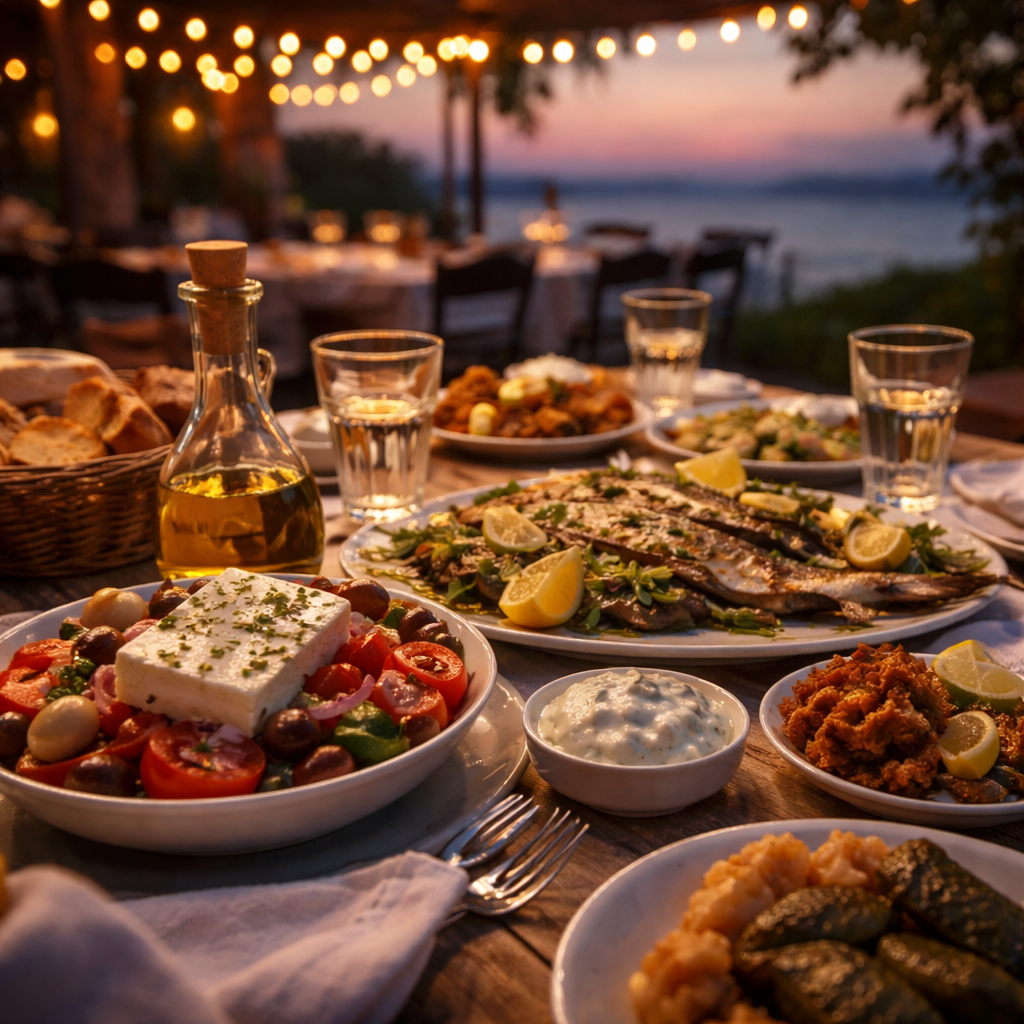
Greek food is often introduced through a few famous dishes, and while those dishes deserve their reputation, they are not the full story. A real meal in Greece is rarely about one headline plate. It is about rhythm, sharing, simplicity, and the way ingredients come together without trying too hard to impress you. Olive oil matters, bread matters, tomatoes matter, grilled fish matters, fried cheese matters, and so does the feeling of sitting at a table while the evening stretches a little longer than planned. Greece feeds people in a way that feels both generous and unpretentious, and that is exactly why travelers remember it so vividly.
The problem is that many food articles flatten Greek cuisine into a short tourist checklist: moussaka, souvlaki, tzatziki, done. That may be enough to recognize names on a menu, but it does not help someone understand how to actually eat well in Greece. A useful Greek food travel guide should explain how meals are structured, what to order in different settings, how regional identity changes the table, and how to avoid the trap of repeating the same three dishes for ten days. Greece is much more rewarding than that.
This guide is built for real travelers. It is for the person who wants to sit down at a taverna and order well, who wants to know what belongs on a beach day and what belongs in a mountain village, who wants to understand why a plate of tomatoes and feta can sometimes feel more memorable than a complicated restaurant meal. The goal is not to turn you into a food expert. The goal is to help you eat in a way that makes the country feel deeper, warmer, and more alive.
How Food Actually Works in Greece
Greek food culture is not built around tension. Meals are not usually designed to prove sophistication through complexity; they are designed to bring people together around freshness, balance, and enough variety to keep the table feeling alive. This is why many first-time visitors are surprised by how often the best meals are the simplest ones. A few grilled dishes, a salad, a spread, bread, wine, and something fried or baked can create an entire evening without anyone feeling like they are missing the “main event.” The table itself becomes the experience.
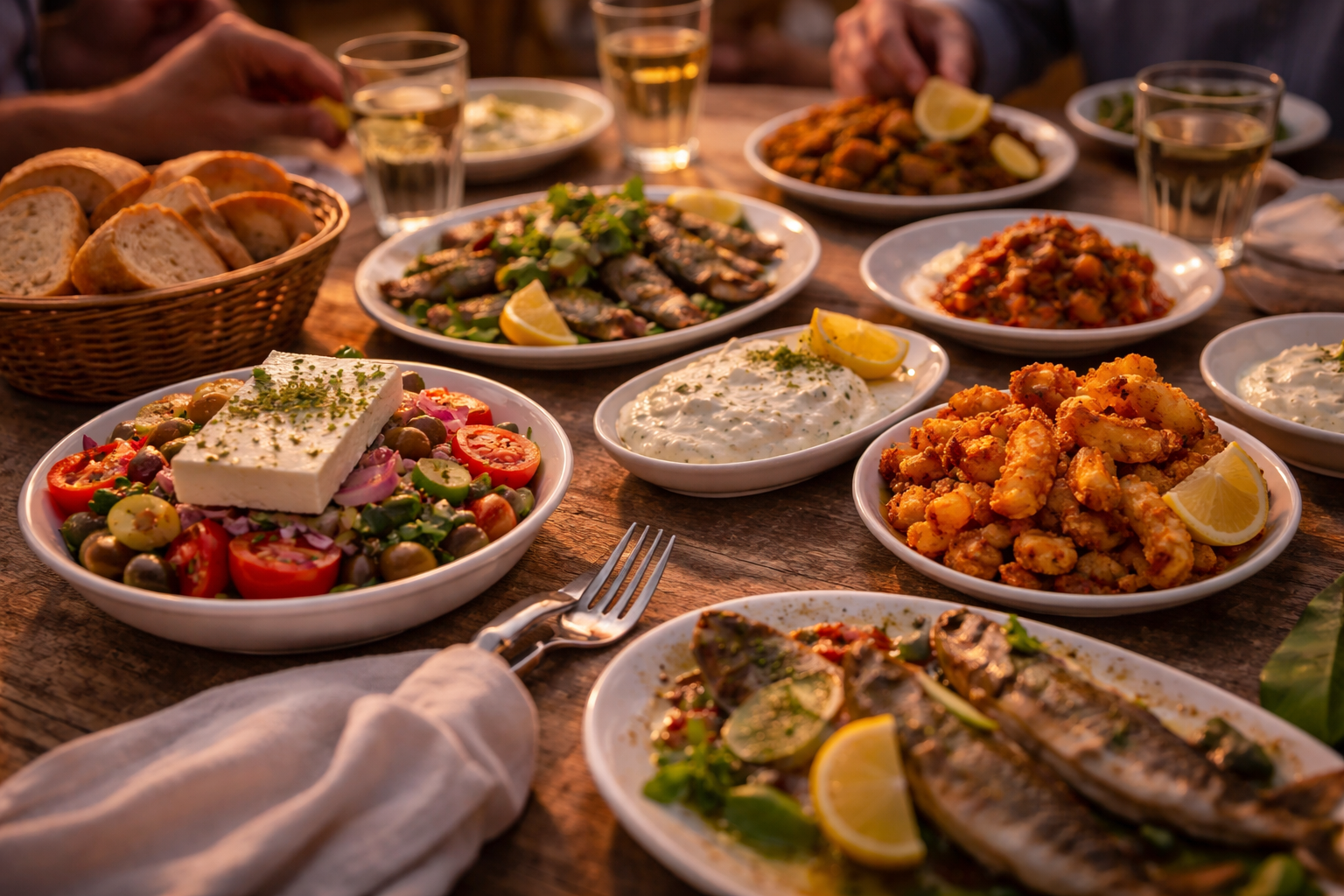
This is also why sharing matters so much. In many tavernas, the strongest meal is not one large personal plate but several smaller things spread across the table. You taste a little here, a little there, and suddenly the meal feels bigger than the sum of its parts. That is one of the central pleasures of Greek meze culture: the meal unfolds through conversation and contrast rather than through rigid sequencing. A traveler who understands this will almost always eat better than the one who orders one heavy dish and stops there.
The other important truth is that Greek food is deeply situational. What you want on a hot island afternoon is not the same thing you want after a mountain walk or on a cool evening in a city neighborhood. Good eating in Greece comes from matching the meal to the place, the time of day, and your own energy. Once readers understand that, the country stops feeling like a menu of iconic dishes and starts feeling like a real food landscape.
What to Eat in Greece First: The Dishes That Actually Matter
If someone asks what to eat in Greece, the smartest answer is not “everything famous.” It is “start with the foods that teach you how the table works.” Greek salad is one of those dishes, and not because it is simple. It matters because it shows the Greek relationship to ingredients: tomatoes that actually taste like tomatoes, cucumber for freshness, onion for bite, olive oil for structure, and feta for salt and softness. A good Greek salad is not filler. It is one of the fastest ways to understand why the cuisine works.
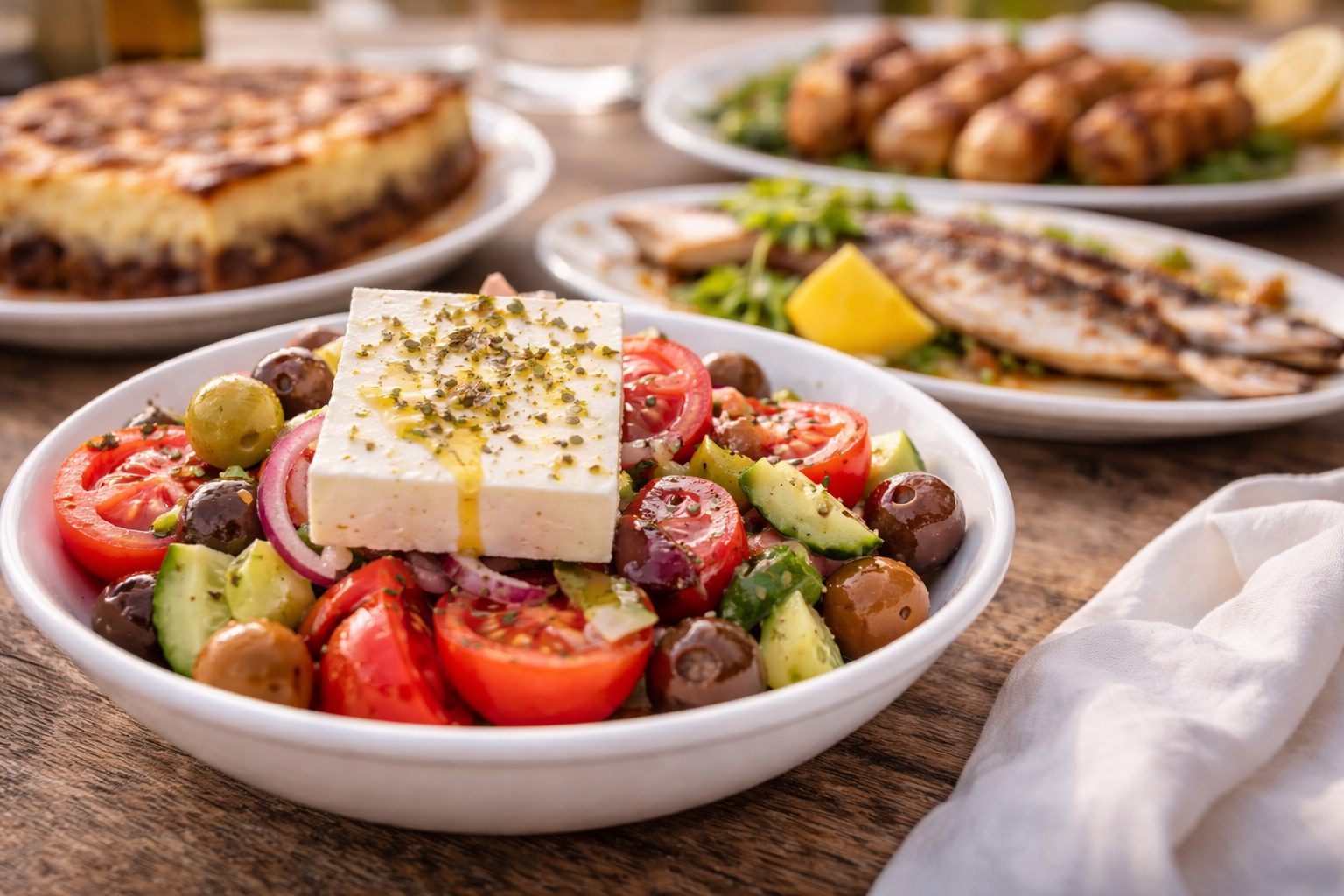
Then come the core warm dishes people really should try: souvlaki, grilled fish, moussaka, dolmades, spanakopita, and various vegetable-based plates that show how much Greece can do without relying entirely on meat. Moussaka is still worth eating, but not because it is “the national dish.” It is worth eating because it shows how comfort food in Greece can be layered, rich, and deeply satisfying without losing its home-cooked feeling. Souvlaki matters for the opposite reason — it is fast, direct, and social, a perfect example of how Greek street food can still feel rooted in real culinary identity.
Tzatziki also deserves its fame, but only if readers understand where it belongs. It is not just “that yogurt dip.” It is a cooling, tangy counterweight that makes grilled meats, bread, and fried things feel more balanced and more alive. This is the key to Greek eating in general: dishes rarely stand alone. They work by supporting each other.
For a broader official overview of Greek gastronomy beyond the usual shortlist, see the Visit Greece guide to traditional cuisine.
Greek Street Food: The Fastest Way to Understand the Country
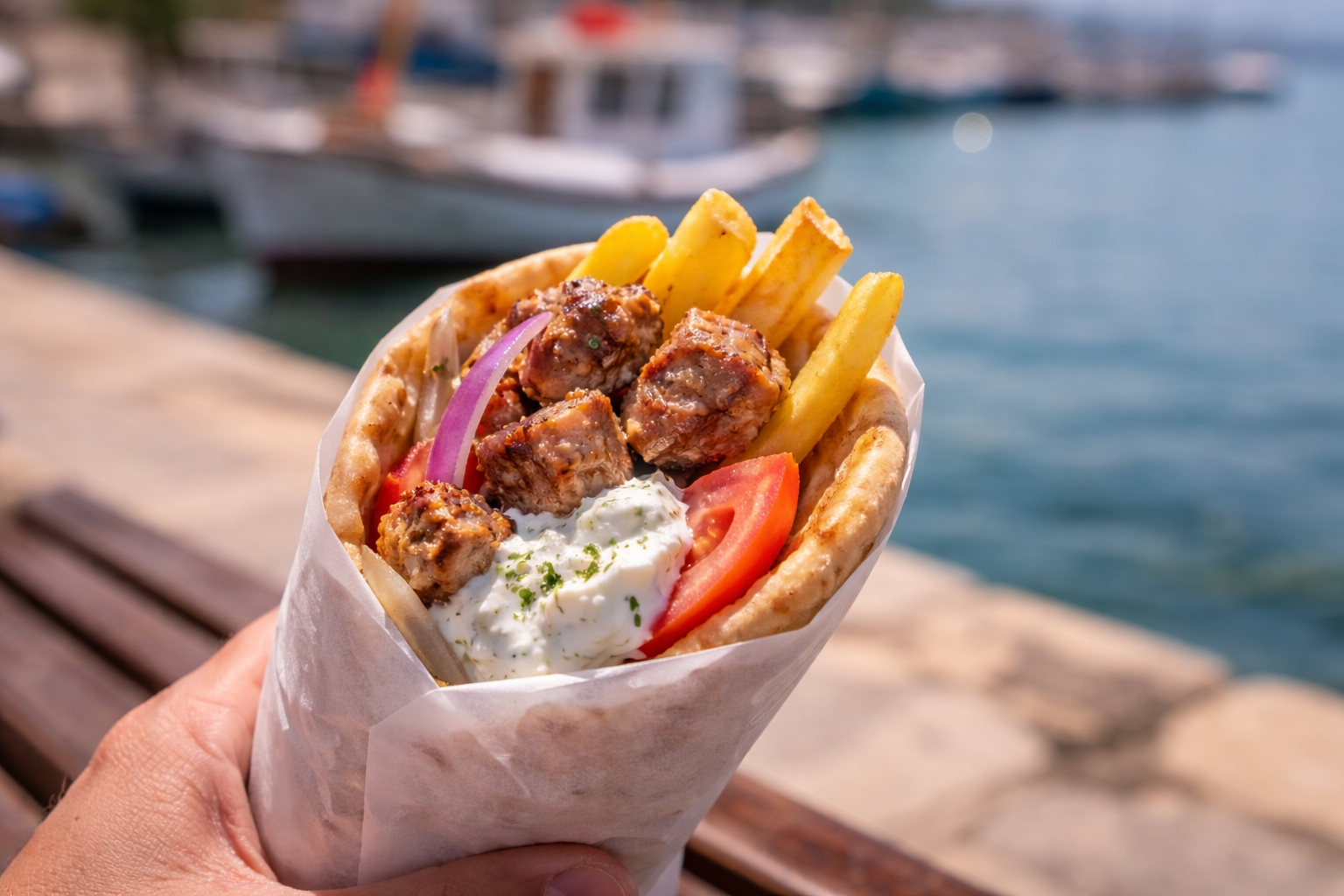
Street food is one of the best ways to understand a country because it reveals what people actually eat when they are hungry, busy, social, and not trying to perform for visitors. In Greece, this makes Greek street food especially valuable. It is warm, portable, filling, and often far more satisfying than the generic “tourist menu” at a bad waterfront restaurant. Souvlaki is the obvious hero here — grilled meat, pita, onion, tomato, maybe fries, maybe tzatziki — but what matters is not only the dish itself. What matters is how naturally it fits into Greek daily life.
Beyond souvlaki, travelers should keep an eye out for pies and baked things: cheese pies, spinach pies, flaky pastries that make great breakfasts or late snacks, and little bakery stops that can save both money and energy during a long sightseeing day. These are often more useful than formal lunches when the heat is strong or the itinerary is busy. They also reveal something important about Greece: everyday food culture is often built around very good simple things, not around constant restaurant drama.
This is one reason a smarter Greek food travel guide should include street food near the center rather than as a side note. Travelers remember the perfect quick lunch eaten on a harbor bench or after a swim just as vividly as the “special dinner.” Sometimes they remember it more. Street food gives the trip spontaneity, and spontaneity is part of why Greece feels so pleasurable.
Tavernas, Meze, and How to Order Like You Actually Know What You’re Doing
Walking into a Greek taverna can be deceptively easy. The atmosphere is relaxed, the menu looks friendly, and the whole thing feels casual — until you realize you do not actually know whether to order one big dish, several small ones, or some mix of both. The best answer is usually the table answer, not the individual answer. Order a spread. One salad, one or two dips, something grilled, something fried, maybe one baked dish, and bread. Let the table build itself. That is how Greece often tastes best.
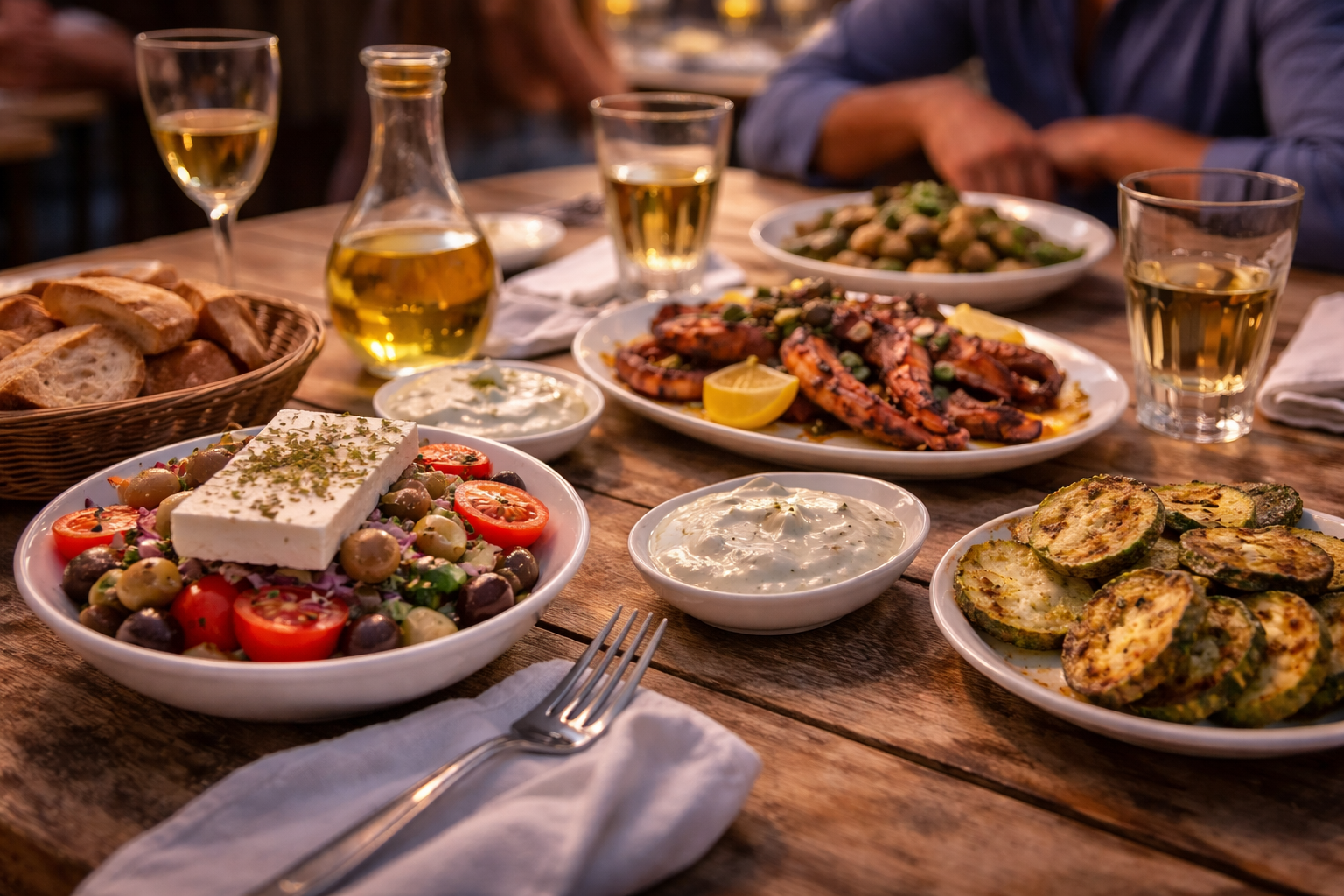
This is where Greek meze culture becomes important. Meze are not only about portion size; they are about meal logic. The point is to create variety and flow, to let conversation guide the pace, and to make the meal feel shared rather than isolated. This is especially good advice for couples and small groups, because ordering this way makes the evening feel more generous without necessarily making it more expensive. It also prevents the classic mistake of ordering one heavy plate each and getting bored halfway through.
Readers should also remember that a good taverna experience depends on restraint. You do not need to order everything. In Greece, confidence often comes from choosing a few strong things and letting them breathe. One of the best Greek food travel guide lessons you can give someone is that they will enjoy the meal more if they stop trying to “cover the cuisine” in one sitting.
Regional Food in Greece: Why the Islands, Mainland, and Mountains Don’t Taste the Same
Greek food is not one unified national menu repeated across the country. The islands, northern mainland, mountain villages, and cities all push the cuisine in different directions, and readers should know that before they travel. Seafood naturally becomes stronger on the islands and along the coast, where grilled fish, octopus, fried small fish, and simpler warm-weather dishes make more sense. These meals often feel lighter, saltier, and more immediate, shaped as much by place and weather as by tradition.
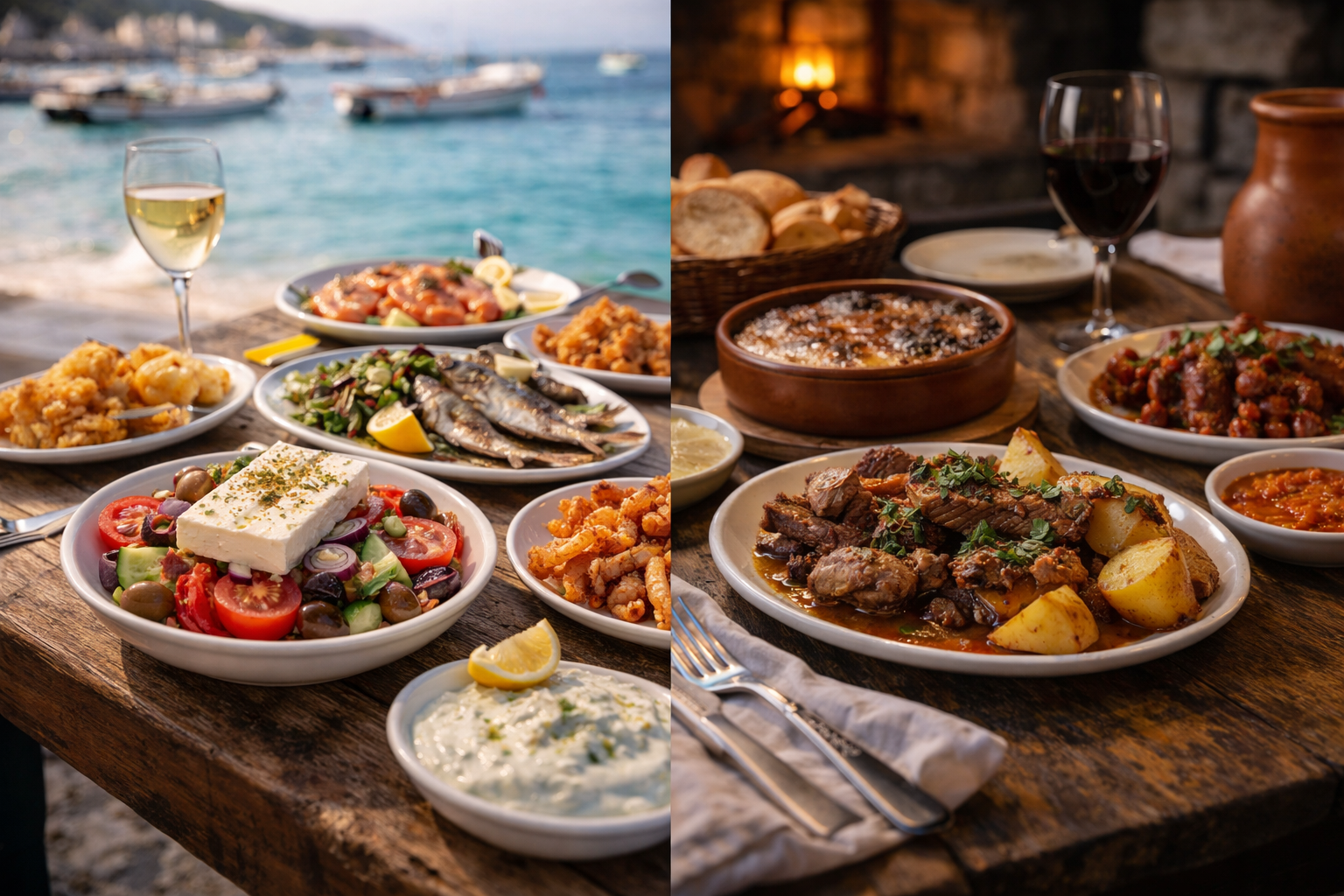
The mainland and mountain regions often feel heartier. Slow-cooked meat dishes, baked foods, richer pies, beans, and more deeply comforting plates can dominate, especially where climate and local agriculture support a different kind of table. This is where regional food in Greece becomes one of the most interesting parts of the trip. The country begins to feel less like a single cuisine and more like a set of edible landscapes. You stop eating “Greek food” in the abstract and start eating places.
This variation also helps the article stay unique compared with your other gastronomy content. We are not doing “French wine regions” or “Italian pasta by region” here. We are showing how Greece changes flavor through geography and temperature, through islands and inland life, through seaside appetite and mountain appetite. That makes the article both more useful and more distinct.
If you’re drawn to the island side of Greek food culture, this guide to Greece’s archipelago adds the wider coastal rhythm that makes those meals feel even more memorable.
The Foods Tourists Miss but Shouldn’t
One reason travelers leave Greece thinking the food was “good but repetitive” is that they stay too close to the obvious menu items. They repeat souvlaki, moussaka, and Greek salad until the trip starts tasting the same. A better approach is to notice the things that do not always get top billing: dolmades, gigantes beans, horta, fava, grilled halloumi-like regional cheeses, fried zucchini, local sausage dishes, seafood meze, and village desserts that feel homemade rather than branded. These are the foods that turn the country from “familiar” into memorable.
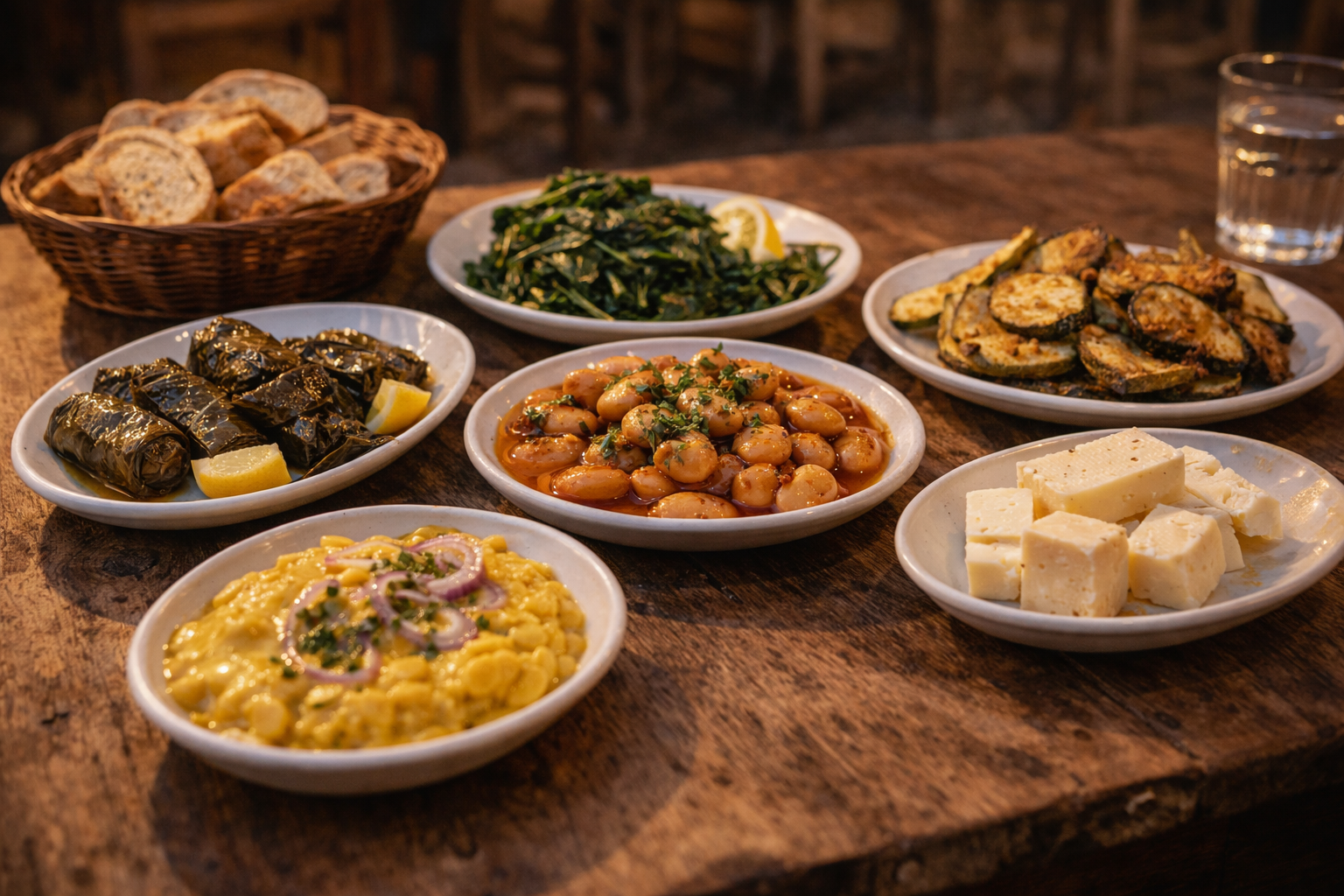
Bread also deserves more respect than it usually gets in travel writing. Good bread in Greece is not only a side; it is part of how the table functions. It carries dips, catches oil, balances salt, and slows the meal down. The same can be said for olive oil, which is not a garnish but a structural ingredient. Once readers begin noticing these “small” things, their whole perception of the cuisine improves.
Dessert is another place where people often miss the point. Yes, baklava matters, and yes, loukoumades are worth trying, but what often makes a Greek dessert moment memorable is the context — after dinner, with coffee, after a swim, in a village square, late at night when no one seems in a hurry to leave. Travel food content gets better when it remembers that flavor is inseparable from timing.
How to Build a Perfect Greek Food Day
A really good Greek food day does not start with a giant restaurant lunch. It starts lightly. A bakery breakfast, a coffee, maybe a savory pastry or yogurt with honey. This keeps the day flexible and lets readers experience one of Greece’s easiest food pleasures without overcommitting too early. Midday should usually stay simple too, especially in hot weather — a salad, grilled seafood, a pita, a taverna lunch by the water, something that feeds rather than overwhelms.
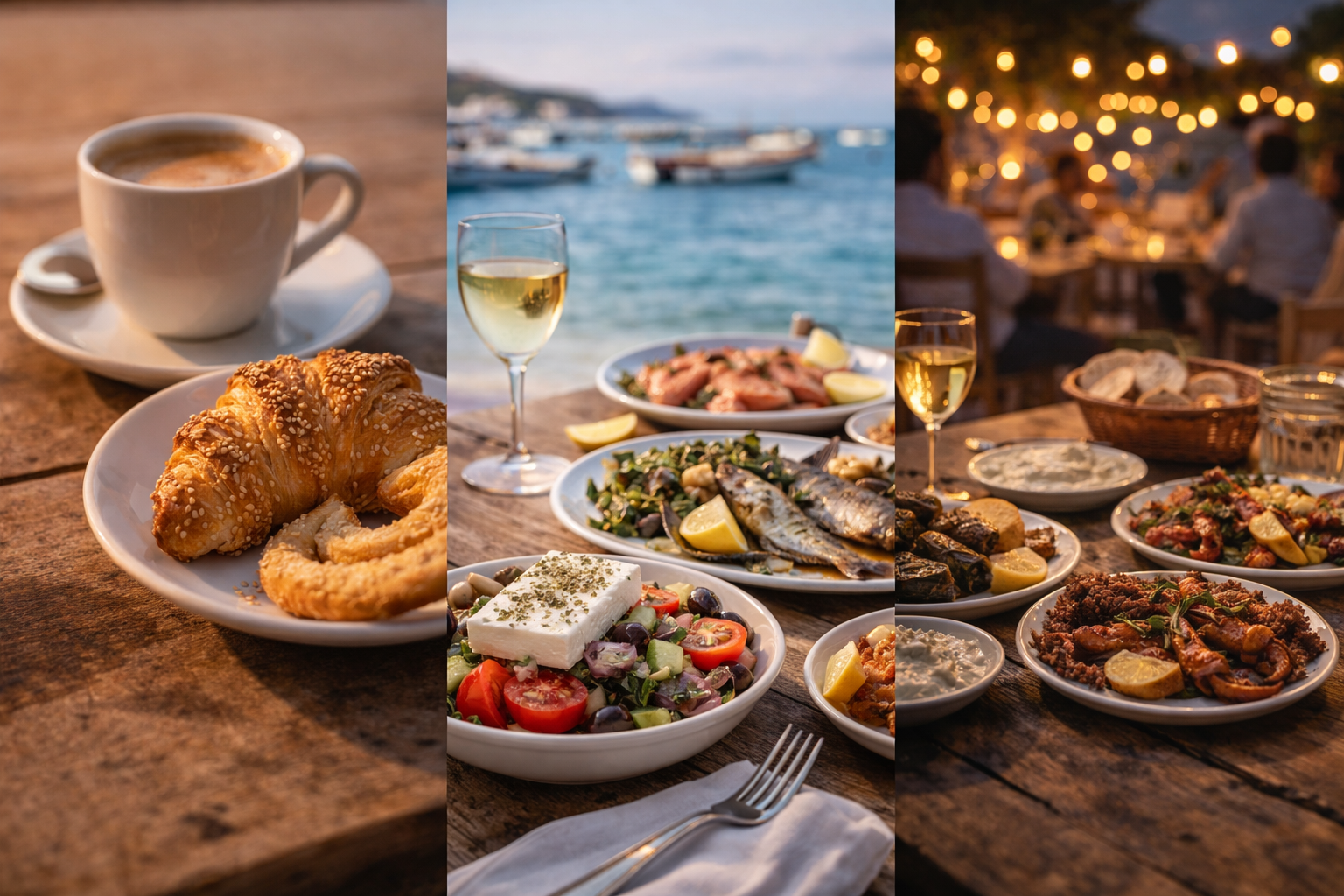
The evening is where Greece often shines most strongly. This is when the table slows down and the meal becomes social rather than functional. Start with meze logic: one salad, one dip, something warm, something grilled, perhaps a glass of wine or ouzo if it fits the mood. Build gradually. Let the meal breathe. This is one of the most important what to eat in Greece lessons a traveler can learn: the best dinner is often one that unfolds rather than one that arrives all at once.
A strong food day also includes one spontaneous moment — fruit from a market, a sweet from a bakery, a roadside stop, an unplanned taverna because the shade and smell felt right. Greece rewards that kind of looseness. Readers should feel encouraged to trust appetite and setting, not only internet rankings.
How Not to Get Stuck in Tourist Food
Tourist-food traps in Greece usually follow a few predictable patterns: giant menus with photos, restaurants placed too perfectly in the busiest strip, staff trying too hard to pull you in, and dishes that sound “internationally Greek” rather than naturally local. None of these are absolute rules, but together they often point in the wrong direction. A better meal is usually one street back, one square away, or in a place where families and older locals are eating without much fuss.
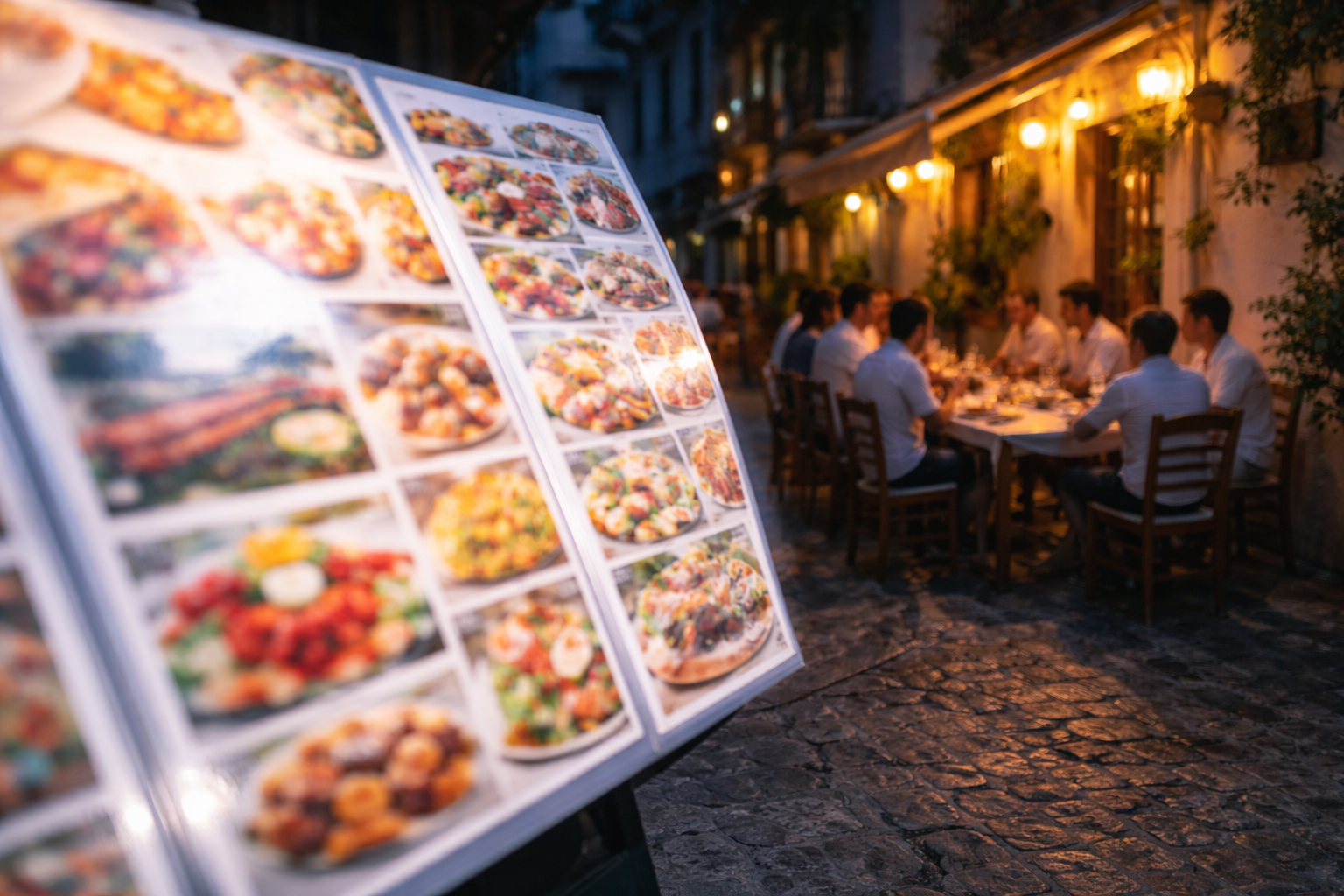
Another good tactic is to order less “for the photo” and more “for the table.” Places built around Instagram often push dramatic plating or oversized portions, while good Greek tavernas tend to trust ingredients and repetition more. If the menu feels like it was written for someone who has never eaten in Greece before, it probably was. Readers should be encouraged to look for places where the food sounds normal, not spectacular. In Greece, normal can be exceptional.
This matters because food disappointment can flatten a whole destination. Greece deserves better than being reduced to overpriced souvlaki and limp salad near a port. A practical Greek food travel guide should protect readers from that by teaching them how to recognize places where food still belongs to life rather than to performance.
Conclusion: Greece Tastes Best When You Stop Trying to “Do It Right”
Greek food is powerful not because it is complicated, but because it is confident. It knows when to stay simple, when to share, when to slow down, and when to let one ingredient carry a whole plate. That is why people remember it so strongly. A tomato, some bread, a little fish, a grilled skewer, a bowl of tzatziki, a pie from a bakery — none of this sounds dramatic on paper, and yet together it creates one of the warmest and most satisfying food cultures in Europe.
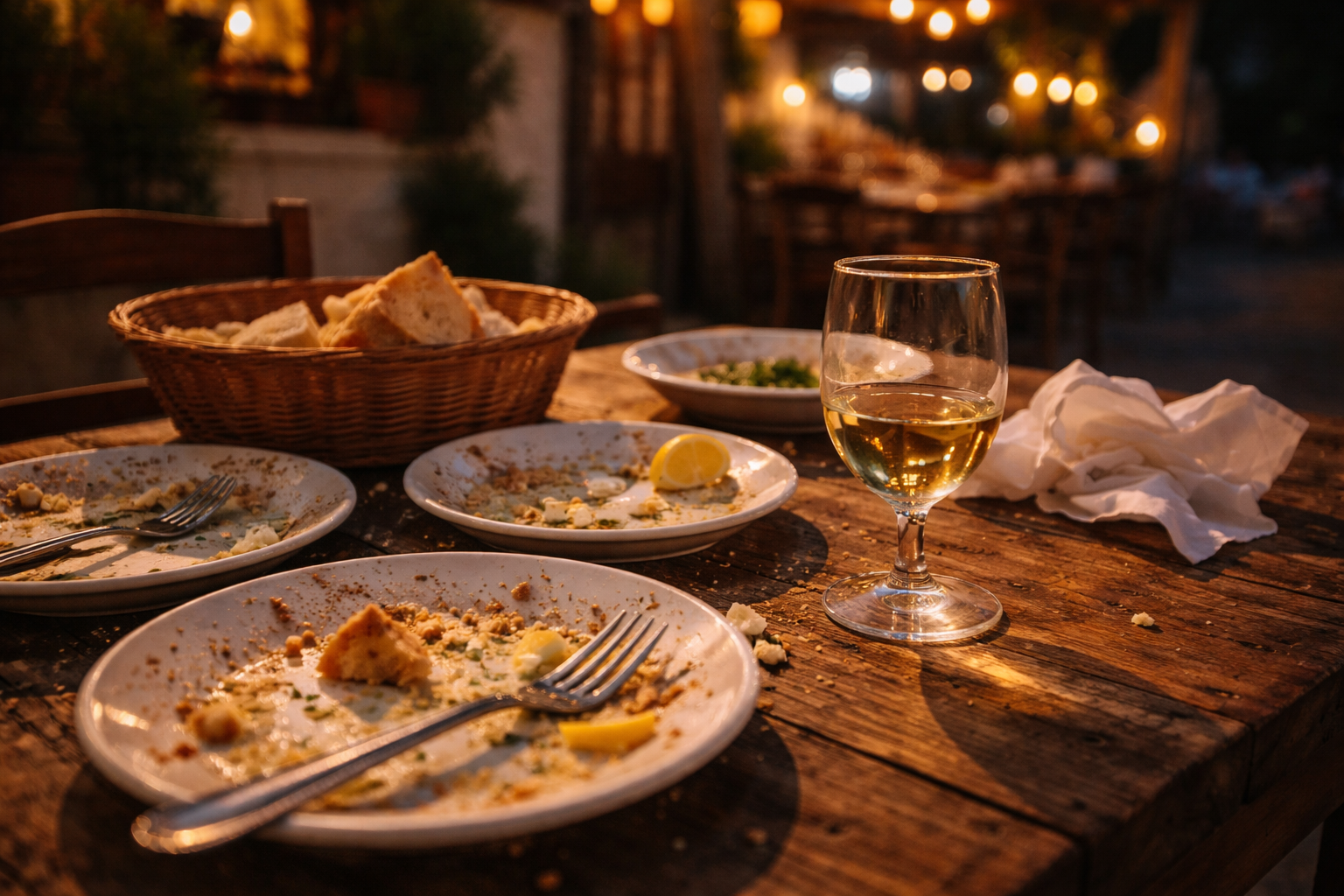
The best way to use this Greek food travel guide is not as a checklist, but as a way of eating better while you travel. Order more for the table, trust regional logic, keep your days paced around appetite and weather, and let the country teach you how meals are supposed to feel. Once you do that, Greece stops being only a beautiful place to visit. It becomes a place that knows how to feed you properly — which is one of the deepest pleasures travel can offer.
I’ve visited Greece four times and every time I go I very much enjoy the food. My favorite street food is souvlaki. But I like a lot of other things. You mention Tzatziki, but also Dolmades, gyros, pastichio, Greek salads, spanikopita, Taramasalata, and desserts like baklava and loukoumades.