
Rice and Meat Dishes
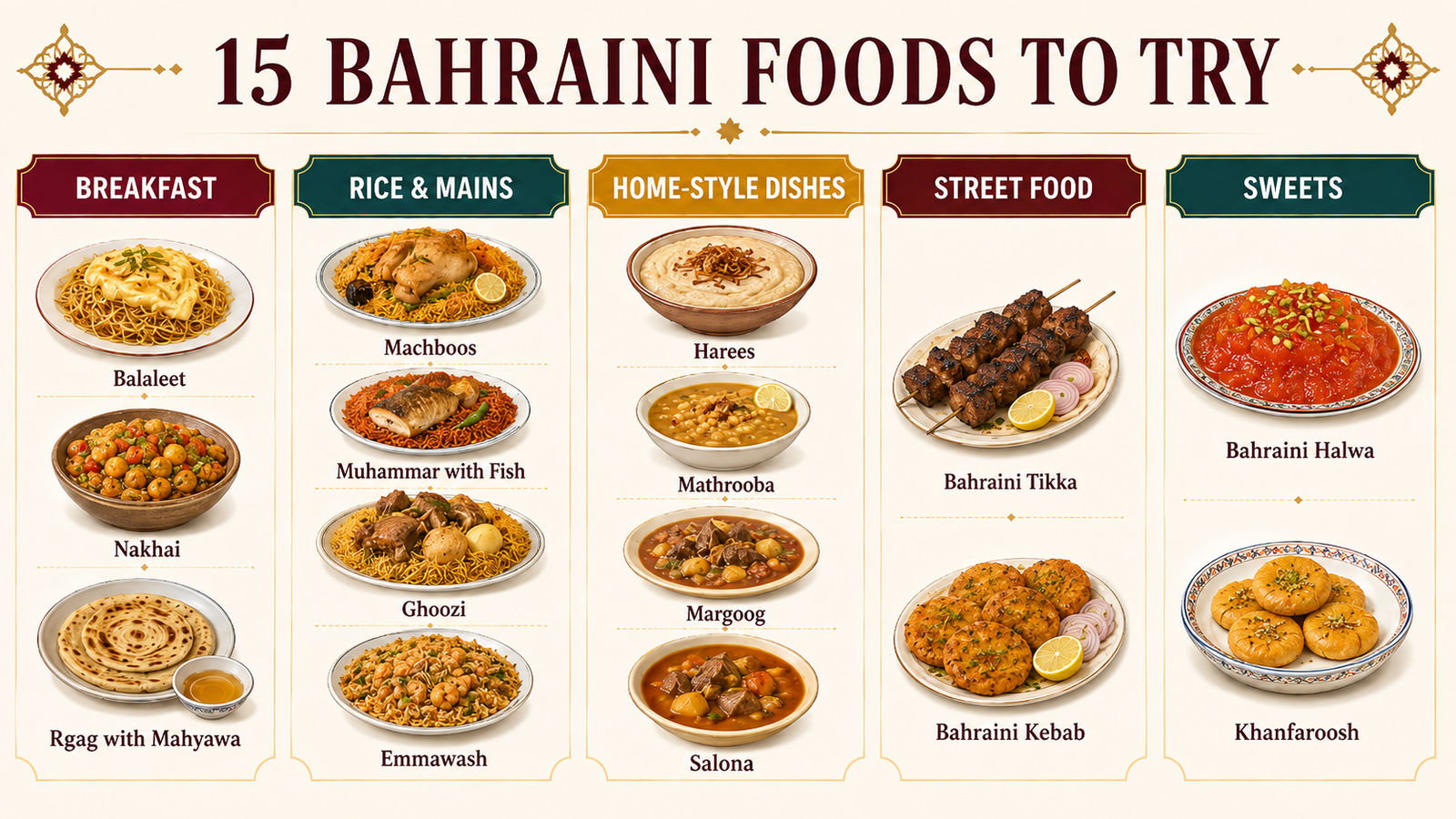
1. Machboos: Bahrain’s Essential Rice Dish
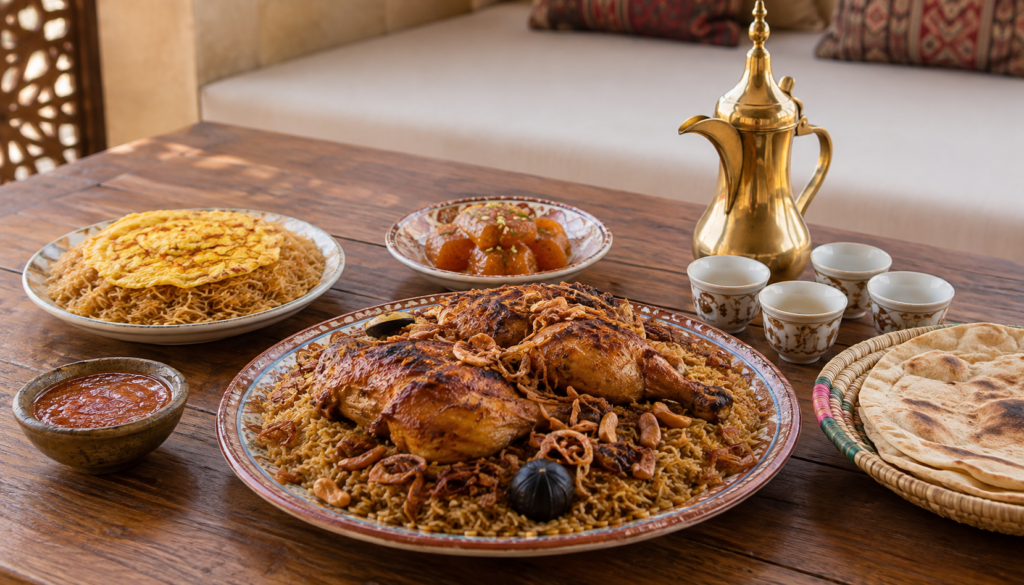
Machboos is the most important dish to recognise when exploring traditional Bahraini food. It combines basmati rice with meat, poultry, shrimp or fish, cooked with onions, tomatoes and spices.
Dried black lime, known as loomi, gives the dish its characteristic citrus fragrance and slightly earthy bitterness. Cardamom, cinnamon, cloves, coriander and black pepper may also appear, although recipes vary between households and restaurants.
Chicken machboos is the safest introduction for a first-time visitor. Lamb versions are richer, while shrimp and hammour versions reflect Bahrain’s maritime identity.
Machboos is normally accompanied by daqoos, a tomato-based sauce served separately. Add it gradually rather than pouring the entire portion over the rice.
Current published menus demonstrate how widely the price can vary. Prawn machboos is listed at approximately BHD 3.650 on the Al Abraaj menu, while chicken and seafood versions at the more polished Ghancha restaurant range from BHD 7.500 to BHD 9.800.
Best for: a first traditional lunch
Contains: meat or seafood; may contain nuts
Typical portion: usually a complete main meal
2. Muhammar with Fried Fish
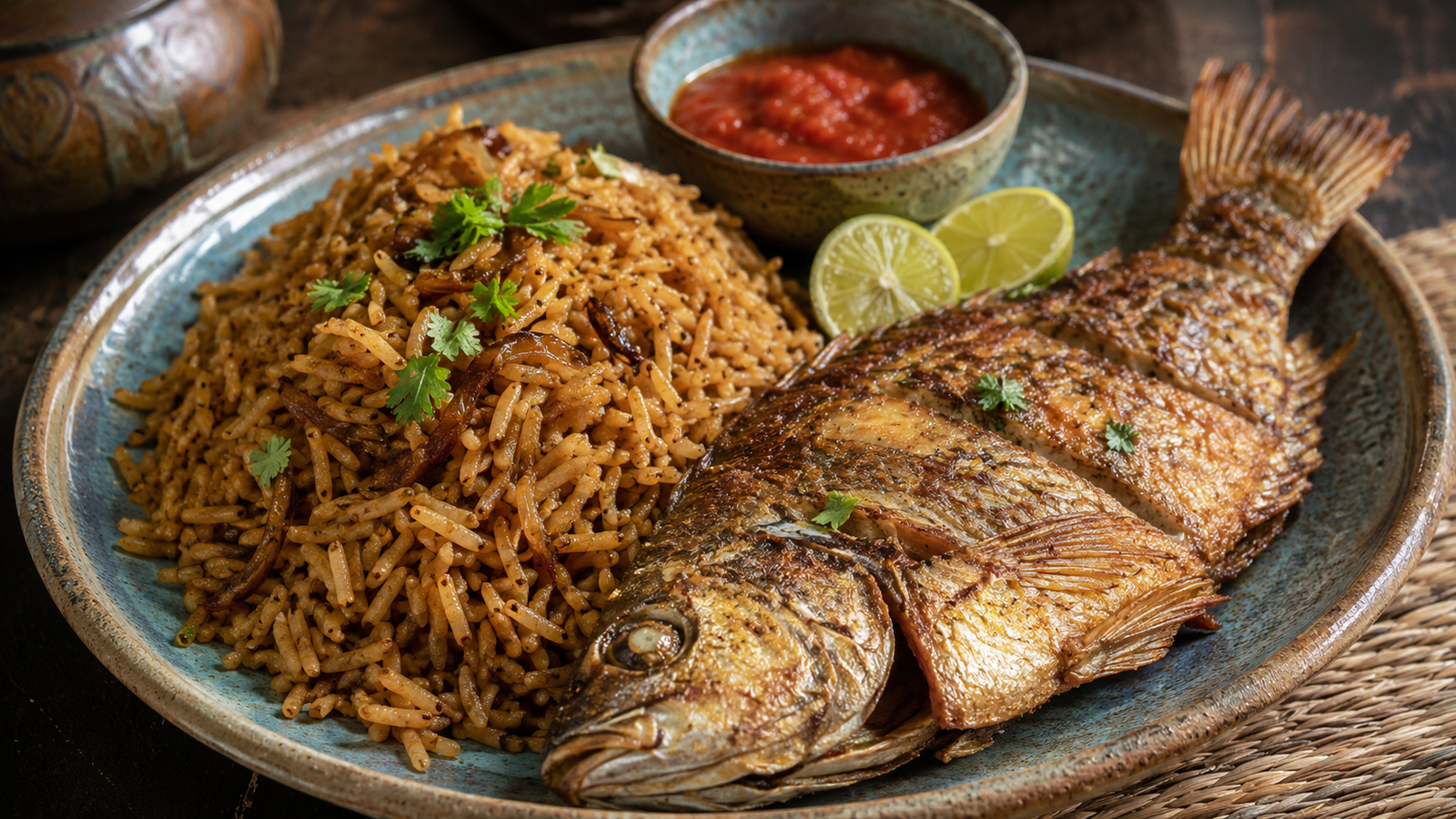
Muhammar is rice sweetened with date molasses or sugar and flavoured with spices. It is traditionally served with fish, creating a deliberate contrast between sweet rice and salty seafood.
Safi, a local rabbitfish, is a common companion, although kingfish and other available catches may be used. Visitors accustomed to purely savoury rice may find the first bite surprising, but the combination makes more sense when the rice and fish are eaten together.
A current restaurant example pairs local safi with rice cooked in date molasses and Bahraini spices for BHD 8.500.
Best for: travellers wanting a distinctly Gulf combination
Contains: fish; the rice may contain butter or ghee
Flavour: sweet, salty and aromatic
3. Ghoozi
Ghoozi—also written as gozi, quzi or ouzi—is a celebratory rice dish topped with roasted lamb. Nuts, raisins, eggs or a spiced stuffing may be added depending on the preparation.
It is richer and heavier than chicken machboos and is often suited to sharing. At restaurants, ask whether the listed price is for an individual serving or a family platter.
A current individual lamb gozi dish can cost around BHD 9.700, while large platters prepared for groups cost considerably more.
Best for: a substantial lunch or shared dinner
Contains: lamb; frequently contains nuts
Flavour: rich, savoury and slightly sweet
4. Emmawash
Emmawash—also spelled emawash, amwash or momawash—combines rice with mung beans and dried or fresh shrimp. The beans give the rice an earthy flavour, while the shrimp adds saltiness and depth.
The name also inspired Emmawash Traditional Restaurant, whose description identifies amwash as a traditional dish made with rice, dried shrimp and green beans.
A shrimp emmawash in a contemporary restaurant costs approximately BHD 6.500. Simpler versions may be less expensive.
Best for: seafood lovers who want something less familiar than machboos
Contains: shellfish
Flavour: earthy, savoury and moderately spiced
5. Harees
Harees is made by slowly cooking wheat with meat until the grains and meat form a smooth, dense mixture. It is commonly finished with ghee and may be seasoned with cinnamon.
Its appearance is plain, but its texture is the defining feature. Harees is mild rather than fiery and is closely associated with family meals and Ramadan, although some restaurants serve it throughout the year.
The Bahrain Authority for Culture and Antiquities identifies harees as part of the country’s traditional food heritage. A current restaurant portion costs approximately BHD 4.200, while a lighter harees soup may cost around BHD 2.500. Bahrain’s official health guidance also lists it among traditional dishes.
Best for: travellers who prefer mild, comforting food
Contains: wheat and meat; usually contains ghee
Texture: thick and soft
6. Mathrooba
Mathrooba, frequently written as madrouba or madhrooba, is another soft, slow-cooked dish. Wheat or rice is cooked with chicken or fish until the mixture becomes thick and almost porridge-like.
Tomatoes, onions, dried lime, coriander and tamarind may provide more acidity than in harees. A chicken version made with jareesh wheat is currently listed at approximately BHD 4.500.
The Bahrain Authority for Culture and Antiquities names mathrooba alongside harees and margoog as an established part of Bahraini cuisine. The official heritage description is particularly useful for distinguishing these home-style dishes from generic restaurant food.
Best for: an authentic home-style meal
Contains: wheat and usually meat or fish
Flavour: savoury and slightly tangy
7. Margoog
Margoog is a stew containing meat, vegetables and thin pieces of dough cooked directly in the sauce. The dough absorbs the broth, giving the dish a soft texture and making it especially filling.
Recipes vary substantially. Lamb or chicken may be combined with tomatoes, onions, courgettes, aubergines and other vegetables. Because it is associated more with household cooking than fast restaurant service, it may not appear every day.
Ask whether margoog is the daily dish rather than expecting it on every permanent menu.
Best for: travellers interested in domestic Bahraini cooking
Contains: gluten and usually meat
Flavour: warming, savoury and moderately spiced
8. Salona
Salona is a tomato-based stew prepared with lamb, chicken, fish or vegetables. Potatoes, okra, aubergines and carrots are common additions, while dried lime contributes the familiar Gulf acidity.
It is normally eaten with rice or bread. Compared with machboos, the sauce remains separate and the vegetables play a more prominent role.
Restaurant versions with lamb or hammour commonly fall between BHD 8 and BHD 10, although simpler vegetable salona can cost less.
Best for: travellers wanting vegetables with a traditional main course
Contains: ingredients depend heavily on the version
Ordering tip: confirm whether rice is included
Traditional Bahraini Breakfast
9. Balaleet
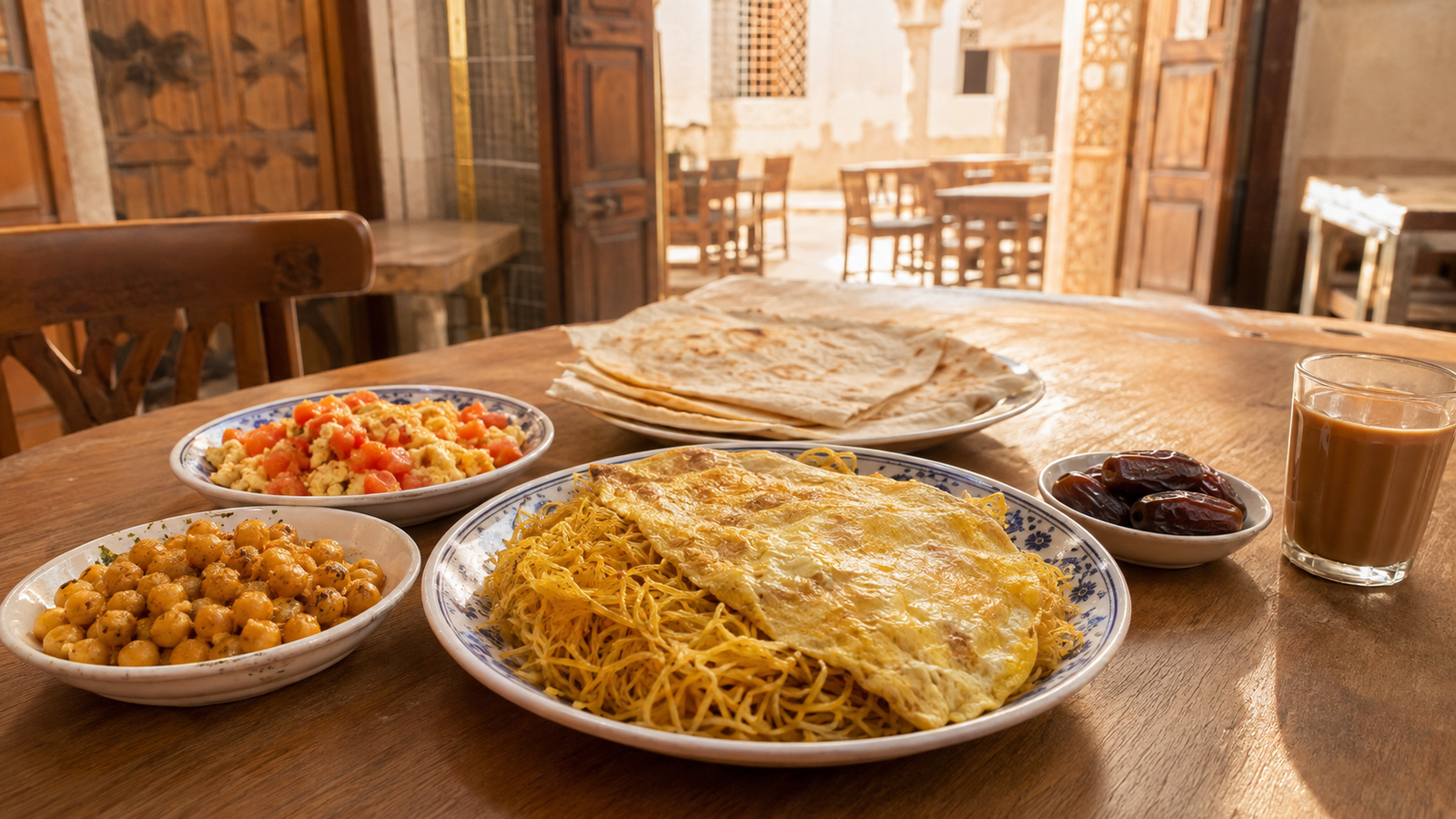
Balaleet is one of Bahrain’s most recognisable breakfast dishes. Sweet vermicelli is seasoned with saffron, cardamom and rose water, then topped with an omelette or fried eggs.
The combination of sugar and egg may sound unusual, but the savoury topping keeps the noodles from tasting like a conventional dessert. It can be served warm or at room temperature.
A current restaurant serving costs approximately BHD 3.500. Bahrain’s cultural authority also describes balaleet as part of the traditional breakfast served around Muharraq.
Best for: a first Bahraini breakfast
Contains: eggs, gluten and usually ghee
Flavour: floral, sweet and savoury
10. Nakhai
Nakhai consists of cooked chickpeas seasoned with spices, chilli and sometimes vegetables. It can accompany eggs and bread as part of a larger breakfast or be eaten as an inexpensive snack.
More elaborate restaurant portions with fresh bread cost approximately BHD 2.300. Small casual portions can be found for around BHD 0.500.
Nakhai is usually suitable for vegans, but it remains sensible to ask whether butter or meat stock has been used.
Best for: an inexpensive vegetarian breakfast
Contains: chickpeas; preparation may vary
Flavour: earthy and mildly spicy
11. Bahraini Tikka
Bahraini tikka consists of small pieces of meat grilled over charcoal. What distinguishes many local versions is the use of loomi, which gives the meat a sharp, slightly sour flavour.
It may be ordered as skewers, a plate with bread or inside a sandwich. The official Bahrain street-food guide highlights tikka among the country’s popular casual foods and identifies Karbabad and several grill shops as places where it is commonly served.
Best for: an informal evening meal
Contains: beef or lamb; marinades may contain allergens
Typical cost: approximately BHD 1–5 depending on portion and setting
12. Bahraini Kebab
Despite its name, Bahraini kebab is not always meat grilled on a skewer. One traditional breakfast version is a fried vegetable patty made with chickpea flour, tomatoes, onions, herbs and spices.
This makes it a useful vegetarian option, although restaurants may also use the word kebab for meat dishes. Always check the description rather than relying on the name alone.
A traditional breakfast set containing balaleet, khanfaroosh and Bahraini vegetable kebab has been advertised for approximately BHD 5.500, while small individual portions cost less.
Best for: vegetarians wanting a savoury breakfast item
Contains: chickpea flour; may share frying oil with meat products
Flavour: spicy and crisp
13. Rgag Bread with Mahyawa
Rgag is an extremely thin flatbread cooked on a hot convex surface. It may be eaten plain or filled with cheese, egg, honey and other ingredients.
One more challenging version is topped with mahyawa, a fermented fish sauce with a strong salty aroma. Mahyawa reflects the maritime connections shared by Bahrain and communities across the Gulf.
This is not the best choice for someone who dislikes fermented flavours, but it is one of the more distinctive local breakfast experiences.
Best for: adventurous eaters
Contains: gluten and fish
Typical cost: approximately BHD 0.200–1.500 depending on filling
Bahraini Desserts
14. Bahraini Halwa
Bahraini halwa is a glossy confection made with starch, sugar and oil, then flavoured with saffron, rose water, cardamom and nuts.
It is denser and more elastic than the sesame-based halva found elsewhere. A small portion is usually sufficient, especially when served with bitter Arabic coffee.
According to the Bahrain Authority for Culture and Antiquities, the Shuwaiter family has been associated with the craft for more than 200 years. Muharraq remains the most logical place to look for established halwa shops.
Best for: a food souvenir or dessert with coffee
Contains: nuts; ingredients vary by producer
Flavour: intensely sweet, floral and spiced
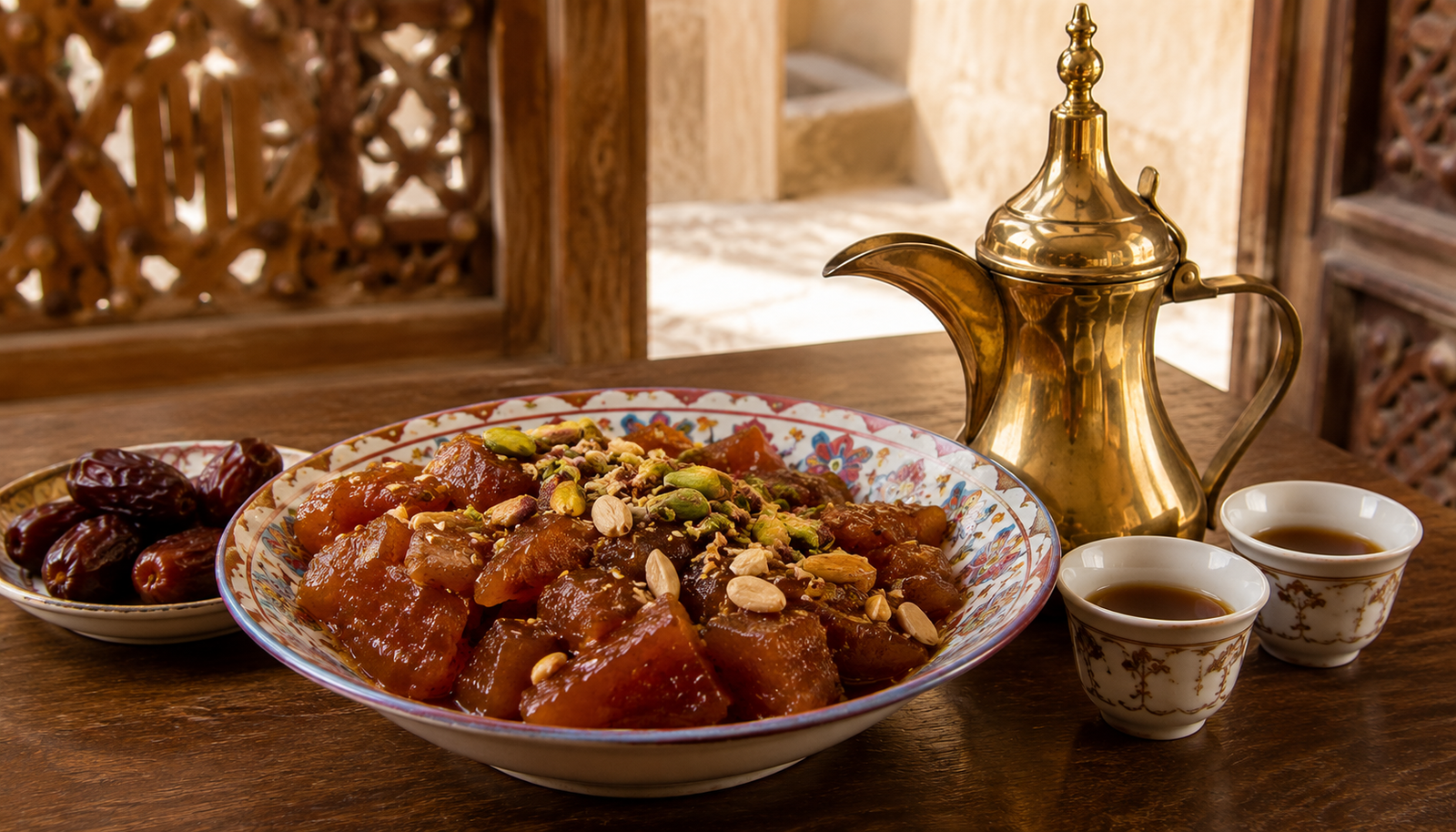
15. Khanfaroosh
Khanfaroosh consists of small fried or baked cakes flavoured with saffron, cardamom and rose water. They are softer and more cake-like than luqaimat and are commonly served with tea or Arabic coffee.
The dish is strongly connected with traditional home cooking and may be easier to find at breakfast restaurants, bakeries and heritage events than on an all-day restaurant menu.
Luqaimat—fried dough balls covered with date molasses—are also worth trying, although they are shared across several Gulf cuisines rather than being exclusive to Bahrain.
Best for: coffee or afternoon tea
Contains: flour, eggs and usually dairy
Typical cost: approximately BHD 0.500–3
Traditional Drinks in Bahrain
Arabic Coffee
Arabic coffee, or gahwa, is lightly roasted and commonly scented with cardamom and sometimes saffron. It is traditionally poured into a small cup without filling it completely and served with dates or halwa.
The drink is part of hospitality rather than simply a source of caffeine. Accepting at least one small cup is generally appreciated when coffee is offered.
Karak Tea
Karak is strong black tea cooked with milk, sugar and cardamom. Saffron, ginger or rose may also be added.
It is available from inexpensive drive-through cafeterias as well as specialist cafés. Current prices demonstrate the difference between settings: a small karak at Tea Time Bahrain is listed from BHD 0.200, while a restaurant serving can cost approximately BHD 1.300.
Chai Haleeb
Chai haleeb literally means tea with milk. Traditional variations may include saffron, dried rose, pistachio and cardamom. Bahrain’s cultural authority includes the drink among the country’s established food traditions.
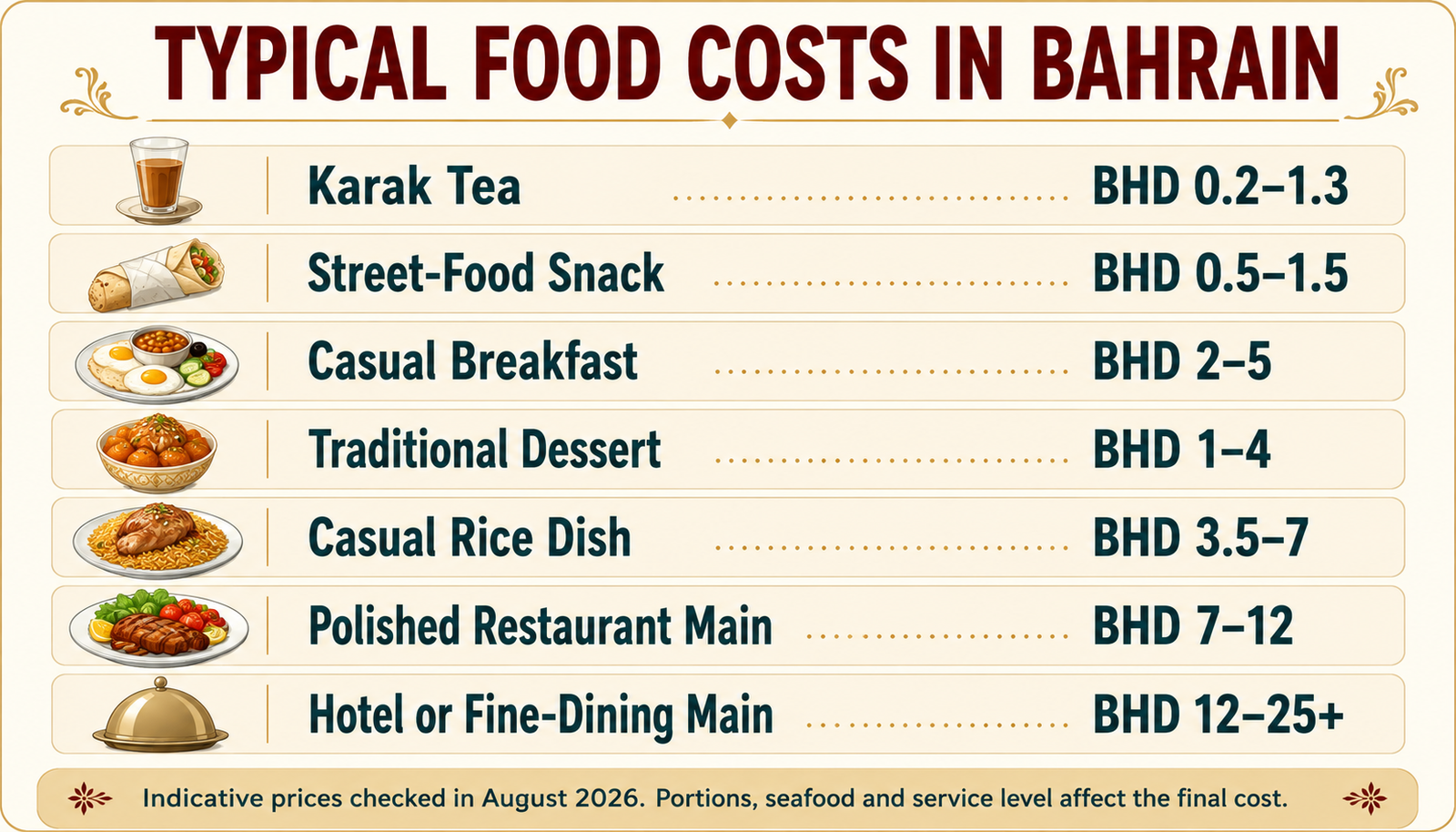
These are working travel-budget ranges, not fixed national prices. Portion size, seafood selection, location and service level can change the cost substantially.
Check whether service charges and government levies are already included. Some published menus display inclusive prices, while hotel restaurants may describe additional charges separately.
Where to Try Traditional Bahraini Food
Manama Souq
Manama Souq combines inexpensive cafeterias, grills, bakeries and traditional restaurants within a relatively compact area. It works well for visitors who want to combine food with Bab Al Bahrain, the Gold Souq and the surrounding market.
The current official street-food guide recommends establishments in and around the souq for balaleet, fresh khubz and other local dishes.
Muharraq
Muharraq is particularly appropriate for a traditional breakfast and Bahraini halwa. Food can be combined with the Pearling Path, heritage houses and Souq Al Qaisariya.
Because some older cafés have limited seating or changing hours, check the latest listing before travelling specifically for one establishment.
Seef
Seef contains malls and contemporary Bahraini restaurants with published English menus. It is easier for visitors who want predictable opening hours, card payment and clearly described dishes.
Prices are normally higher than in a neighbourhood cafeteria, but menus may provide better explanations of unfamiliar ingredients and allergens.
Adliya
Adliya offers restaurants covering local, Gulf and international cuisines. It is useful for dinner and late-night eating, but not every Arabic restaurant there serves specifically Bahraini food.
Use Bahrain Tourism’s current dining directory and filter for local cuisine rather than assuming that every Middle Eastern menu is Bahraini.
Vegetarian Food and Allergens
Vegetarians can usually find:
- nakhai;
- foul;
- beans with tomato;
- eggs and tomatoes;
- Bahraini vegetable kebab;
- vegetable samboosa;
- rgag with cheese, egg or honey;
- balaleet;
- many traditional desserts.
However, the name alone is not always sufficient. Vegetable dishes may be cooked with meat stock, and frying oil may be shared.
Important allergens include:
- gluten: bread, harees, mathrooba, margoog and khanfaroosh;
- nuts: machboos garnishes, ghoozi, halwa and desserts;
- dairy: ghee, karak, balaleet and some breads;
- eggs: balaleet and breakfast dishes;
- fish: mahyawa and seafood rice;
- shellfish: emmawash and shrimp machboos.
Ask directly about allergies before ordering. Spelling dishes in English does not guarantee that every ingredient will appear in the translated description.
A One-Day Bahraini Food Route
Breakfast: Muharraq
Begin with balaleet, nakhai, eggs with tomatoes and fresh bread. Order several small dishes to share rather than choosing one large breakfast per person.
Late Morning: Bahraini Halwa
Visit an established halwa shop and try a small portion with Arabic coffee. Halwa also works as a packaged souvenir, but confirm storage recommendations before travelling with it.
Lunch: Manama
Choose chicken machboos for a straightforward introduction, or shrimp emmawash for something more distinctive. Add daqoos gradually and check whether the dish is garnished with nuts.
Afternoon: Karak
Stop for karak or chai haleeb. An inexpensive cafeteria gives a different experience from a modern specialist café, even though the underlying drink is similar.
Evening: Tikka and Street Food
Finish with Bahraini tikka, vegetable kebab, samboosa or a local sandwich. Karbabad and the casual food areas highlighted in Bahrain’s official street-food guide are suitable places to explore informal grills.
This food route can be combined with the attractions in our Things to Do in Bahrain guide.