
These are suggested stays, not the time required to explore each mountain range fully. For a short holiday, choose one or two areas rather than trying to visit all five.
Use this map to compare the five mountain areas and their travel bases. The locations are alternatives for planning your trip, not stops on a single route.
Town markers show possible bases; nature markers show selected visitor locations. This overview is not a hiking navigation map.
Where Are the Romanian Carpathians?
The Carpathians extend across several countries. In Romania, the mountain system curves around Transylvania and includes eastern, southern and western groups.
This guide focuses on selected southern and western destinations that offer useful contrasts for trip planning. It is not a complete list of Romania’s mountain regions.
The distinction matters when booking accommodation. A hotel described as being “in the Carpathians” may be nowhere near the lake, cave or trail you want to visit. Choose your main activity first, then identify its access point and a suitable base. The Romania Tourism mountain overview provides broader geographical context.
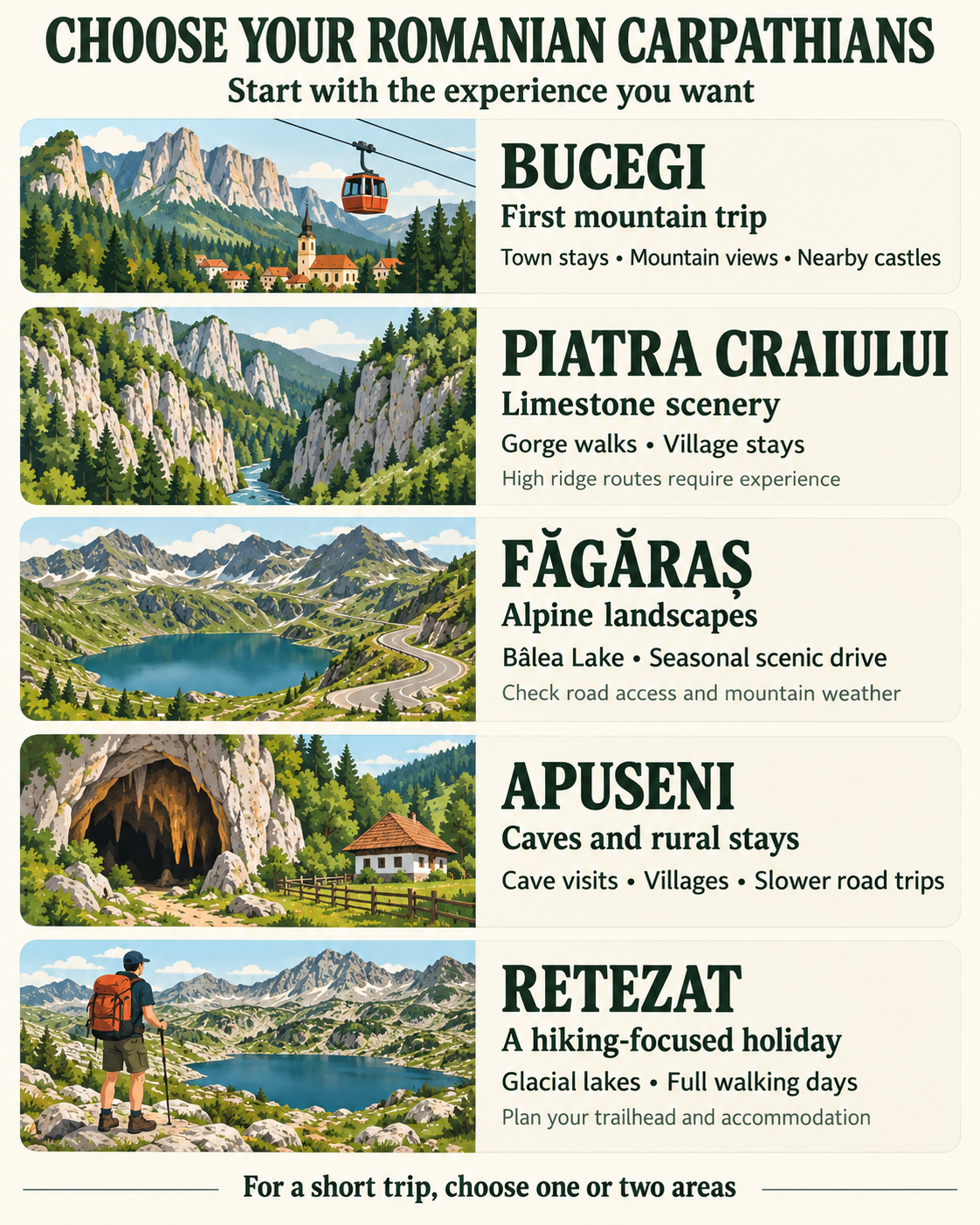
1. Bucegi Mountains: Best for a First Mountain Trip
Sinaia and Bușteni are useful starting points if you want mountain scenery alongside restaurants, accommodation and rail connections. They also allow you to combine outdoor time with cultural visits without changing regions.
Choose Sinaia if you want to include Peleș Castle and use the town as your main base. Choose Bușteni if your planned activities begin on that side of the Bucegi Mountains. The towns are close enough to combine, but their mountain access points are not interchangeable.
A lift-assisted outing can make higher viewpoints accessible without a long ascent. However, the arrival station still places you in a mountain environment. Wind, fog and cold can affect both the visit and the return journey.
Before leaving, check the exact installation, departure station, operating status and last descent. For Sinaia, consult the local lift operator. Use the Bucegi Natural Park map to understand the surrounding terrain.
A sensible first visit: reserve one day for a weather-dependent mountain outing and another for Sinaia or Bușteni at lower elevation. Avoid making a long plateau walk dependent on catching the final lift.
For castle visits on the same trip, use our Romania Castles Guide.
2. Piatra Craiului: Best for Limestone Scenery and Village Stays
Piatra Craiului offers a sharp contrast between its high limestone ridge and the valleys and settlements below it.
Zărnești is a practical base for arranging access and supplies. Măgura and Peștera suit visitors seeking a rural stay, but check the approach to your accommodation and how you will reach walking routes.
For a less demanding introduction, consider Prăpăstiile Zărneștilor, also called Zărnești Gorges. An out-and-back walk lets you choose a turnaround point rather than commit to a long circuit. Confirm access and conditions before setting off.
The main ridge requires a different level of preparation. Its approaches are physically demanding, and exposed sections should not be treated as an extension of an easy gorge walk. The park’s attraction guide describes these contrasting landscapes.
A sensible first visit: spend one day around the gorge and another on a suitable marked walk or village outing. Choose a ridge route only after checking its demands against your experience and the forecast.
3. Făgăraș Mountains: Best for Alpine Scenery
The Făgăraș Mountains suit travellers looking for a higher, more alpine landscape. For a short visit, the Bâlea area provides a clear focus; a full ridge traverse is a separate undertaking.
Cârțișoara is useful for approaching from the north. Sibiu works as a city base for an arranged excursion, but allow for the journey to and from the mountains.
Distinguish between visiting Bâlea Lake and hiking beyond it. Reaching a scenic stopping point does not mean the surrounding slopes and passes are suitable for an unplanned walk. Select a marked route in advance and assess elevation gain, exposure and remaining daylight.
The local municipality describes the Transfăgărășan and its mountain setting. Road access is seasonal, so confirm current restrictions rather than assuming that the crossing will be open on a particular date.
A sensible first visit: devote a day to the Bâlea area when access and weather permit. Keep another day flexible if mountain views are a major reason for your trip.
4. Apuseni Mountains: Best for Caves and a Slower Road Trip
Apuseni suits travellers who prefer a mixture of rural accommodation, limestone landscapes and cave visits. Its attractions are spread across different valleys, so choosing the right base can save considerable driving.
Gârda de Sus and Arieșeni are useful options for the southern part of the region. Other attractions may be better approached from a different base. Check actual road connections before grouping places together.
A managed cave visit is different from exploring an undeveloped cave or a rugged karst circuit. Choose attractions with established visitor arrangements if you want a straightforward outing. Scărișoara is one of the region’s well-known cave destinations; verify its current access and visiting arrangements locally.
The Apuseni section of Romania Tourism’s mountain guide introduces the region’s caves and settlements.
A sensible first visit: allow several nights in one part of Apuseni, pairing a cave visit with nearby walks and village time.
For more ideas on rural stays, see our traditional Romanian villages guide.
5. Retezat National Park: Best for a Dedicated Hiking Trip
Retezat is a good choice when walking is the main purpose of your holiday. Its glacial lakes and mountain terrain reward a stay that leaves room for weather changes and recovery between longer days.
Choose the park entrance before booking accommodation. Hațeg can be useful for supplies and an overnight stop, but a room nearer your selected access point may suit an early departure better.
Approaches such as Cârnic and Râușor serve different routes. Do not assume that accommodation close to the park boundary is close to your intended trail.
The park’s tourist information explains access options and designated camping areas. Camping is restricted to approved locations.
A sensible first visit: use one entrance, select walks appropriate to your ability and allow a spare day. A lake should not be treated as an easy destination simply because it appears close on a small-scale map.
Hiking in Romania: Match the Route to Your Experience
The name of a mountain range tells you little about the difficulty of a particular walk. In the same area, you may find a relatively gentle valley outing and a demanding ridge requiring confidence on exposed terrain.
With a car or arranged transfers, you have more flexibility. Without one, confirm the connection between bases and each trailhead before committing to the itinerary.
Făgăraș, Apuseni and Retezat also deserve several days. Choose one as an alternative focus rather than adding all three to this five-day plan.
Mountain Safety and Bears
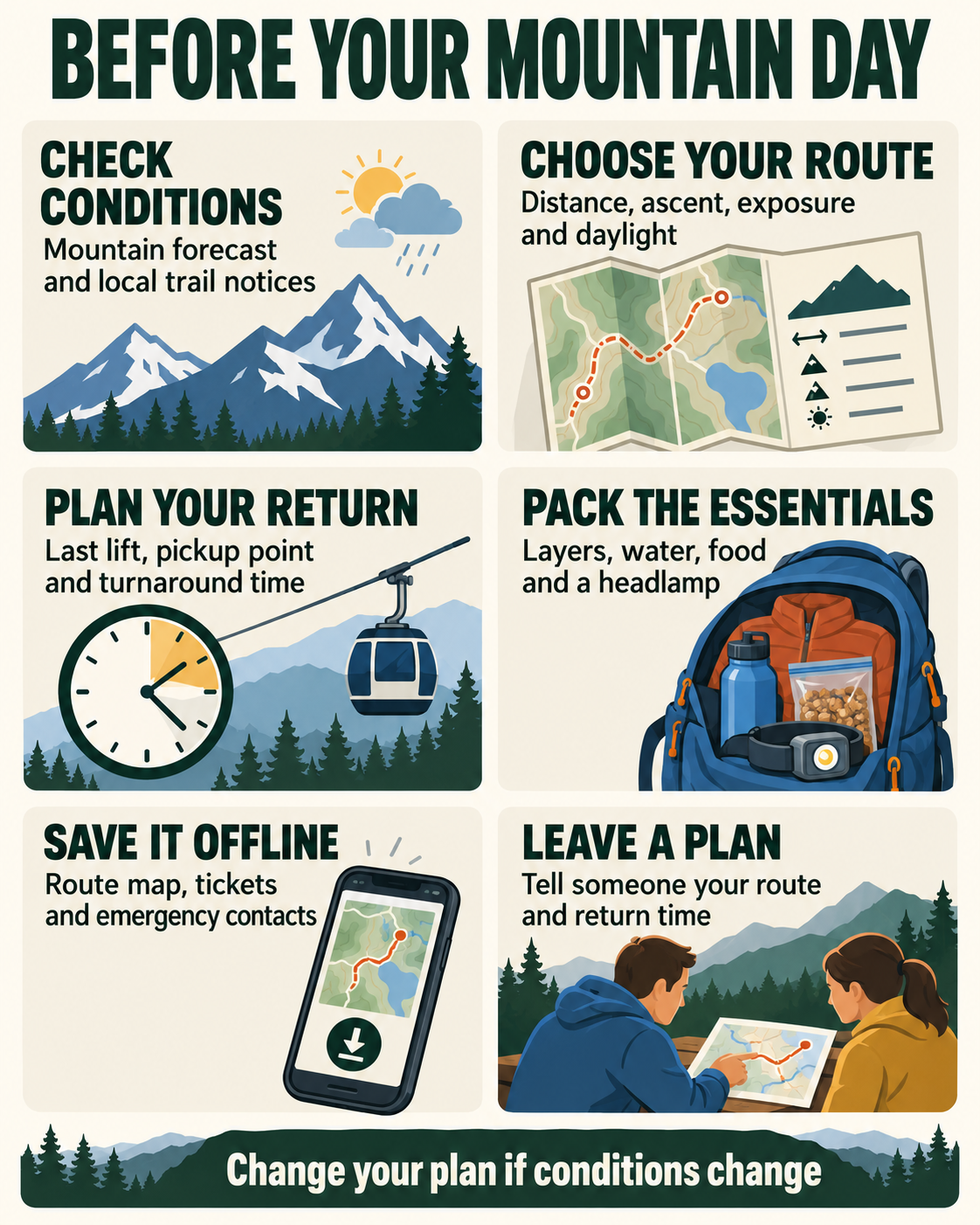
Check the forecast for the altitude you will visit, carry suitable footwear and waterproof layers, and take water, food, a headlamp, a charged phone and an offline route map. Tell someone where you are going and when you expect to return.
Set a turnaround time before starting. If conditions deteriorate or progress is slower than expected, shorten the day. A cable car or mountain hut shown on a map may not be operating when you arrive. These preparations follow Salvamont’s visitor guidance.
Bears live in the Romanian Carpathians. Do not approach or feed them, including animals beside roads. Keep your distance, avoid getting between a bear and its cubs, and do not run towards or away from an animal for a photograph. Check Salvamont’s wildlife advice and local warnings before walking.
For an emergency, call 112. Salvamont also lists +40 725 826 668 for its mountain-rescue dispatch service. Provide your location, the nature of the problem and the number of people involved. See the official emergency-call guidance.