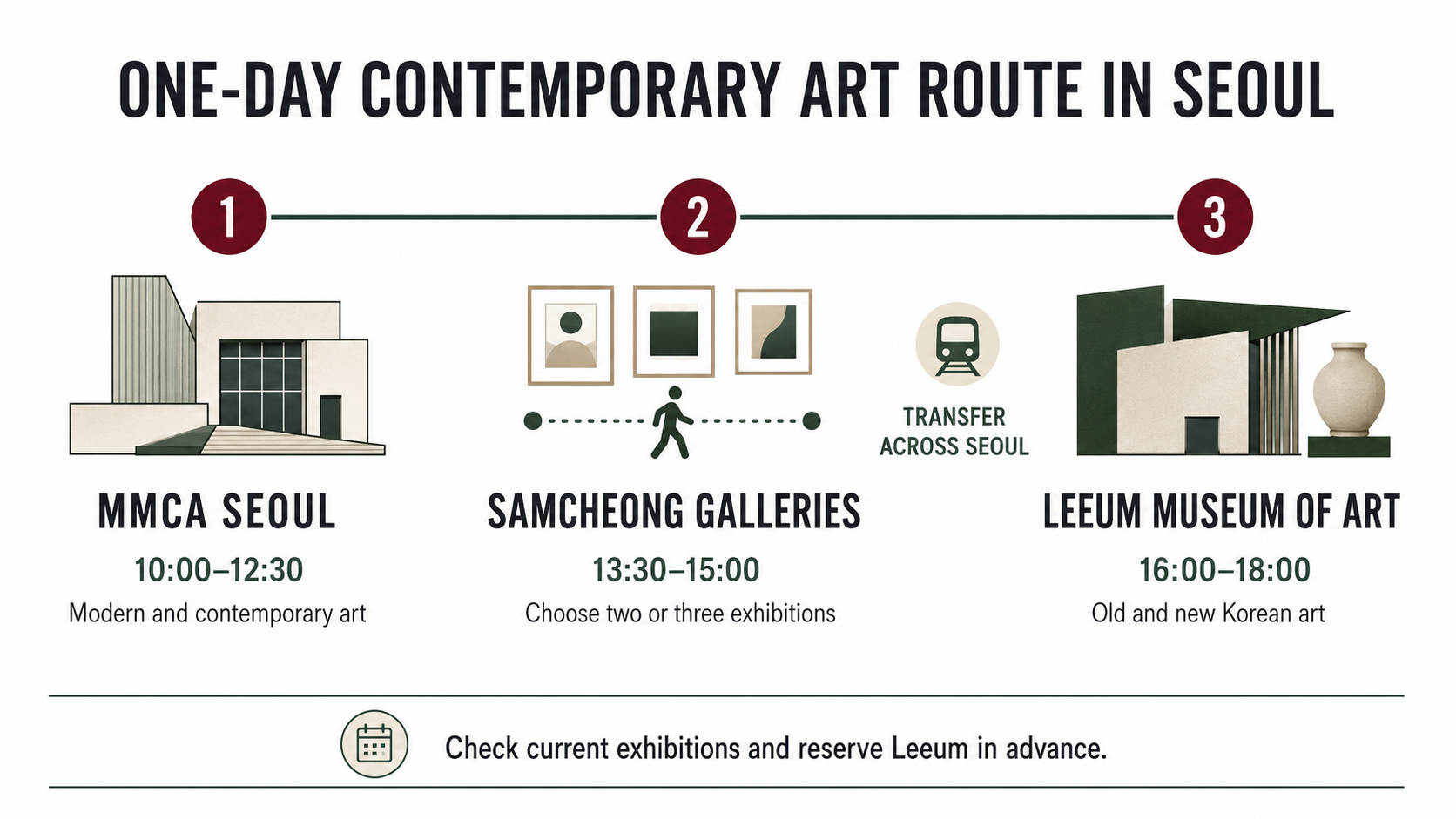
If you have only one day, combine MMCA Seoul with the nearby galleries of Samcheong-dong and then continue to Leeum. Do not try to add MMCA Gwacheon or the Gwangju Biennale to the same itinerary.
From Korean Modern Art to Today’s Contemporary Scene
Understanding a few historical movements makes Korean museums considerably easier to navigate. Contemporary art in Korea did not follow a single linear path. It developed through the effects of colonial rule, division, war, rapid industrialization, authoritarian government, democratization and globalization.
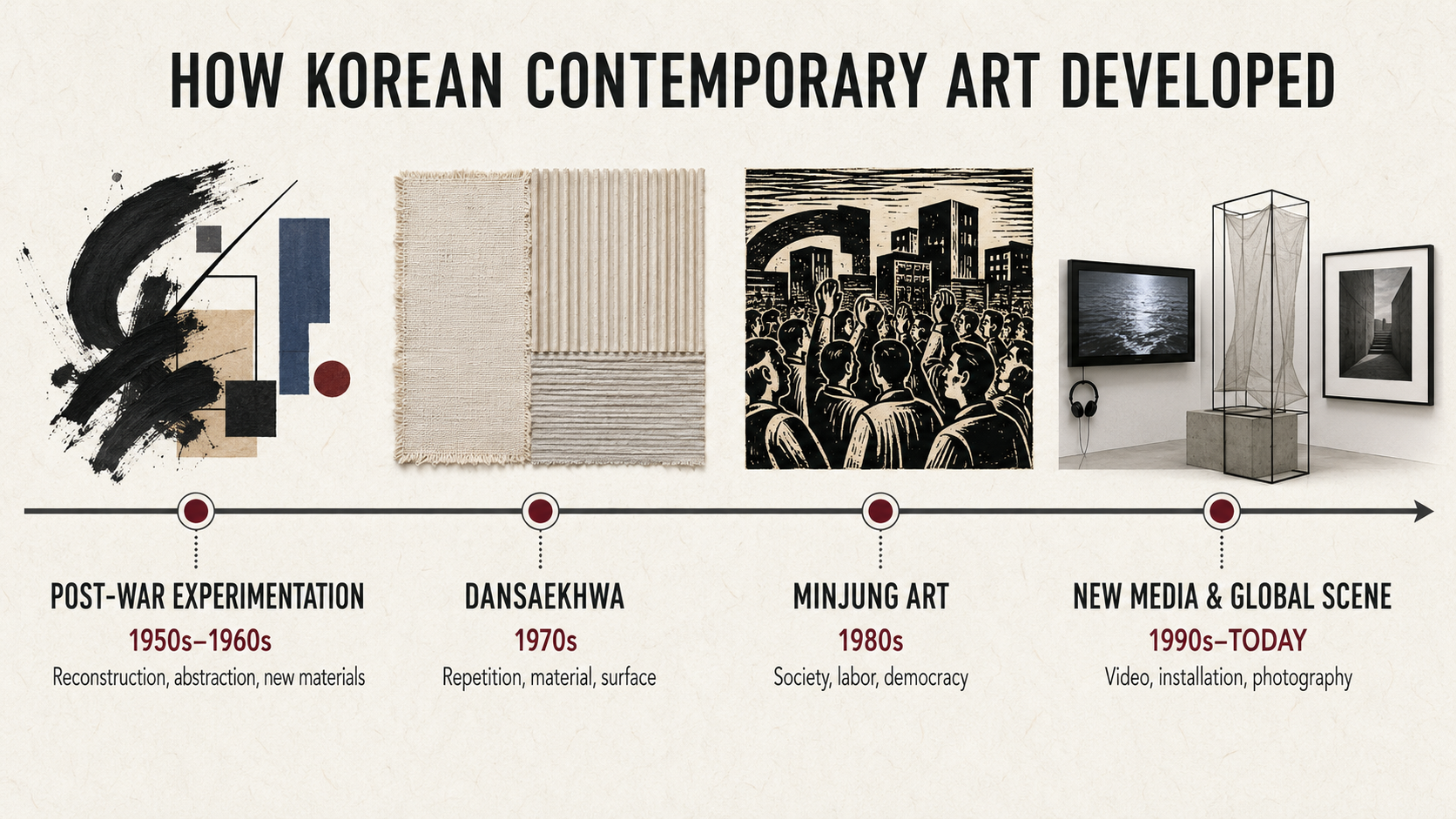
Post-war experimentation and abstraction
After the Korean War, artists worked in a society undergoing physical reconstruction and dramatic political change. During the 1960s and 1970s, some moved away from conventional representation and experimented with abstraction, performance, installation and unconventional materials.
These practices were not simply copies of Western modernism. Korean artists interpreted international artistic languages through local experiences, materials and philosophical traditions.
MMCA’s collection and historical exhibitions are useful starting points because they place abstract and experimental work alongside the social conditions in which it developed. The museum’s overview of Korean art from the 1960s onward includes abstraction, experimental art, figurative work and socially engaged movements.
Dansaekhwa
Dansaekhwa is often translated as “Korean monochrome painting.” The term is associated with a loose group of practices that became prominent during the 1970s.
Many works use restrained colors and repeated physical actions: pushing paint through canvas, dragging pencils across a surface, layering pigment or working directly with the material structure of paper and fabric. The process can be as important as the finished image.
Dansaekhwa should not be understood as one school with a shared manifesto. The artists grouped under the label used different methods and ideas. Nevertheless, the term remains useful for recognizing the importance of repetition, material, surface and physical labor in post-war Korean art.
Minjung art
Minjung art developed more visibly during the political struggles of the 1980s. Instead of concentrating only on formal abstraction, participating artists addressed labor, inequality, national division, state violence and the movement for democracy.
Artists used accessible visual forms such as woodcuts, banners, documentary photography, collage, comics and imagery borrowed from advertising or mass media. Art could therefore function as social communication rather than only as an object displayed inside a gallery.
MMCA describes Minjung art as closely connected to contemporary social concerns and the political conditions of South Korea in the 1980s.
New media and the global art scene
From the 1990s onward, the Korean art scene became increasingly diverse and internationally connected. Video, installation, photography, performance, sound and digital media became more visible alongside painting and sculpture.
The expansion of museums, biennales, alternative spaces and commercial galleries also changed how artists worked and how their work reached international audiences. Today, Korean contemporary art cannot be reduced to a single national style. It includes local histories, global debates and individual practices that often cross cultural and disciplinary boundaries.
Best Contemporary Art Museums in Seoul
MMCA Seoul: Best Overall Introduction
The Seoul branch of the National Museum of Modern and Contemporary Art is the most practical starting point for first-time visitors. Its temporary exhibitions cover Korean and international art, while collection-based exhibitions provide essential historical context.
The museum is located beside Gyeongbokgung Palace in the Samcheong-dong cultural district. This makes it easy to combine with nearby galleries, bookshops and traditional architecture.
Practical information:
- Address: 30 Samcheong-ro, Jongno-gu, Seoul
- Opening hours: 10:00–18:00 on Monday, Tuesday, Thursday, Friday and Sunday
- Extended hours: 10:00–21:00 on Wednesday and Saturday
- Closed: January 1, Lunar New Year and Chuseok
- Admission: individual exhibition prices vary
- Combined ticket: ₩10,000 when at least three eligible paid exhibitions are open
- Free evening admission: Wednesday and Saturday from 18:00 to 21:00
- Suggested visit: 2–3 hours
Unlike many museums, MMCA Seoul is normally open on Mondays. This is useful when planning around galleries and other museums that frequently close at the beginning of the week.
Check the current exhibition list before visiting. Not every exhibition will necessarily focus on Korean art, and some popular shows may use timed admission. See the official MMCA Seoul visitor information.
Leeum Museum of Art: Best for Old and New Korea
Leeum Museum of Art is particularly valuable because it places Korean antiquities, modern art and contemporary exhibitions within one institution. The contrast helps visitors see that contemporary Korean culture did not develop separately from ceramics, calligraphy, Buddhist art and other historical traditions.
The museum complex is also architecturally significant. Its principal buildings were designed by Mario Botta, Jean Nouvel and Rem Koolhaas.
Leeum’s permanent displays and temporary exhibitions have separate admission and reservation conditions. At the time of this update, the permanent Korean antiquities exhibition and the Gabriel Orozco garden were free, while selected temporary exhibitions required paid tickets.
Practical information:
- Address: 60-16 Itaewon-ro 55-gil, Yongsan-gu, Seoul
- Nearest station: Hangangjin Station, Line 6, Exit 1
- Walking time: approximately five minutes uphill from the station
- Opening hours: Tuesday–Sunday, 10:00–18:00
- Ticket desk closes: 17:30
- Closed: Monday, January 1, Lunar New Year and Chuseok day
- Suggested visit: about 2 hours
- Reservation: recommended for popular exhibitions and preferred time slots
Individual reservations generally open 14 days before the visit. Same-day tickets may be available, but waiting times can increase when the museum is busy. Confirm availability through the official Leeum visitor page.
SeMA Seosomun: Best Free or Low-Cost Option
The Seosomun Main Branch of the Seoul Museum of Art is close to City Hall and Deoksugung Palace. Its exhibition program covers modern Korean art, contemporary installations, photography and international projects.
SeMA is a useful alternative when MMCA or Leeum’s current exhibitions do not match your interests. Most exhibitions are free, although admission may be charged for selected special events.
Practical information:
- Address: 61 Deoksugung-gil, Jung-gu, Seoul
- Nearest station: City Hall
- Tuesday–Thursday: 10:00–20:00
- Friday: 10:00–21:00
- Weekend and public-holiday hours vary seasonally
- Closed: Monday and January 1
- Last admission: one hour before closing
- Suggested visit: 1–2 hours
Because SeMA’s program changes regularly, check the exhibition calendar rather than visiting for one specific artwork. Current information is available from the official SeMA Seosomun page.
MMCA Gwacheon: Best for a Half-Day Museum Trip
MMCA Gwacheon is larger and quieter than the central Seoul branch. It is surrounded by the landscape of Seoul Grand Park and is suitable for travelers who want more time with the national collection, sculpture and large-scale exhibitions.
It should be treated as a half-day destination. Although it is connected to Seoul by subway, reaching the museum takes longer than visiting the central institutions.
Practical information:
- Address: 313 Gwangmyeong-ro, Gwacheon
- Nearest station: Seoul Grand Park Station, Line 4
- Opening hours: Tuesday–Sunday, 10:00–18:00
- Closed: Monday and January 1
- Admission: ₩3,000 for all exhibitions
- Free admission: last Wednesday of the month
- Suggested visit: half day
A museum shuttle normally connects the area around Seoul Grand Park Station with MMCA, but the timetable can change. Check the official MMCA Gwacheon information before departure.
Seoul Gallery Districts
Museums provide historical structure, while gallery districts show what artists, curators and collectors are discussing now. Commercial galleries usually allow visitors to enter without buying anything, and admission is commonly free.
Schedules are less predictable than museum hours. Galleries may close between exhibitions, and many close on Monday, Sunday or both. Check the website or social media page of each gallery on the day of your visit.
Samcheong-dong and Sogyeok-dong
The area surrounding MMCA Seoul has the highest concentration of galleries that can be combined on foot. Established spaces include Gallery Hyundai, Kukje Gallery and Hakgojae, alongside smaller galleries that change over time.
This is the most efficient gallery district for a first visit because it requires little additional transport. Begin with MMCA, have lunch nearby and then select two or three galleries with exhibitions that genuinely interest you.
Allow approximately 20–40 minutes per gallery. Do not plan to enter every space in the district: exhibition quality, language support and opening schedules vary.
Hannam-dong
Hannam-dong combines Leeum Museum of Art with commercial galleries and design-oriented spaces. It is more spread out than Samcheong-dong, so checking exact addresses before walking is important.
The district works best as an extension of a Leeum visit. Choose one or two additional galleries based on current exhibitions instead of following a fixed list copied from an older travel guide.
Gangnam and Cheongdam-dong
Gangnam and Cheongdam-dong contain major commercial galleries, luxury retail and design spaces. The district can be useful for visitors interested in the commercial side of the Korean art market.
Distances between galleries are greater, and the area is less suitable for spontaneous walking. Create a route in advance and confirm that the galleries are open. Visit Seoul identifies Samcheong-dong, Hannam and Gangnam as three of the city’s principal art districts in its official Seoul art guide.
Gwangju Biennale 2026
The Gwangju Biennale is one of South Korea’s most significant recurring contemporary art events. Founded in 1995, it connects international artistic practices with the history and civic identity of Gwangju.
The 16th Gwangju Biennale, titled You Must Change Your Life, is scheduled for September 5 to November 15, 2026. Its main exhibition explores change as an ongoing artistic and social practice.
2026 visitor information:
- Dates: September 5–November 15, 2026
- Main location: Gwangju Biennale Exhibition Hall and associated venues
- Adult presale ticket: ₩17,000
- Adult regular ticket: ₩20,000
- Suggested time: one full day
- Advance planning: strongly recommended
Gwangju is not a practical extension of a normal Seoul museum day. Plan it as a separate trip and check which venues are included in the ticket. Exhibition sections may be distributed across the city.
Dates and curatorial information are available on the official Gwangju Biennale website.
What About Ihwa Mural Village?
Ihwa Mural Village frequently appears in older lists of art attractions in Seoul, but it should not be presented as a central destination for Korean contemporary art.
The murals were introduced as part of an urban regeneration project, but the resulting visitor traffic created tension with local residents. Some artworks were later removed or painted over. Ihwa remains a residential neighborhood rather than an outdoor museum designed exclusively for tourists.
If you visit:
- Keep voices low near homes.
- Do not photograph residents without permission.
- Do not enter private stairways or courtyards.
- Expect some murals shown in old photographs to be gone.
- Avoid visiting early in the morning or late at night.
For a clearer introduction to contemporary art, prioritize MMCA, Leeum, SeMA or the Samcheong gallery district.
One-Day Korean Contemporary Art Route in Seoul
Route A: MMCA, Samcheong Galleries and Leeum
This route gives first-time visitors the most balanced introduction.
10:00–12:30 — MMCA Seoul
Begin with the collection-based or Korean-focused exhibitions before moving to larger international shows.
12:30–13:30 — Lunch in Samcheong-dong
Choose a restaurant near the museum rather than crossing the city during lunchtime.
13:30–15:00 — Samcheong and Sogyeok-dong galleries
Select two or three galleries according to their current programs. Gallery Hyundai, Kukje Gallery and Hakgojae are possible starting points, but do not assume every space will have an exhibition open.
15:00–16:00 — Travel to Hannam-dong
Use public transport or a taxi depending on traffic and walking tolerance. MMCA and Leeum are not within a convenient short walk of each other.
16:00–18:00 — Leeum Museum of Art
Reserve your preferred admission time in advance. Concentrate on either the permanent collection or the main temporary exhibition rather than rushing through everything.
Route B: Central Seoul on a Smaller Budget
Choose this route if you prefer mostly free exhibitions.
10:00–12:00 — SeMA Seosomun
Check the current exhibitions before arriving.
12:00–13:30 — Jeong-dong and City Hall area
Have lunch and walk around the historic streets near Deoksugung.
14:00–17:00 — MMCA Seoul
Travel to Samcheong-dong and visit one or two exhibitions at MMCA. Wednesday and Saturday evening admission can reduce costs further.
17:00 onward — Samcheong-dong
Visit any galleries that remain open or finish the day in the surrounding neighborhood.