
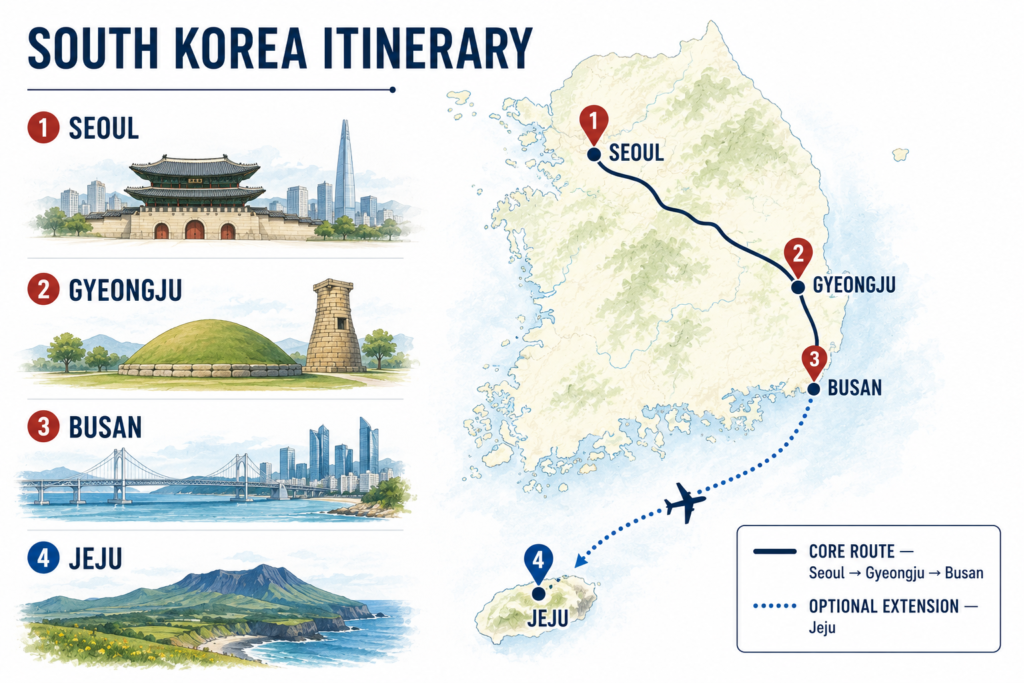
Map of a South Korea itinerary through Seoul, Gyeongju, Busan and Jeju

South Korea Itinerary and Travel Guide: Plan 7, 10 or 14 Days

A well-planned South Korea itinerary can combine historic palaces, contemporary Seoul, traditional neighborhoods, mountain landscapes, coastal cities, markets, museums, and regional food without turning the trip into a race between train stations.

For most first-time visitors, the most balanced route is Seoul → Gyeongju → Busan. Seven days covers the essentials, ten days provides a more comfortable pace, and fourteen days leaves room for Jeju Island or a nature-focused extension.

This South Korea travel guide compares all three options and explains when to go, how much to budget, how to travel between cities, where to stay, and what to arrange before arrival.

Research note: This guide is based on official immigration, transport, tourism, museum, and destination resources. Entry rules, prices, schedules, and opening hours can change. Important details were reviewed in July 2026 and should be checked again before booking.

South Korea Trip at a Glance

Planning question Practical answer
Best trip length
10–14 days
Best first-time route
Seoul → Gyeongju → Busan
Optional extension
Jeju, Sokcho/Seoraksan, or Jeonju
Best general seasons
April–May and October–early November
Main intercity transport
KTX trains and express buses
Local transport
Subway, bus, and occasional taxi
Currency
South Korean won, KRW or ₩
Useful transport card
Tmoney or EZL
Useful navigation app
NAVER Map
Useful translation app
Papago
Main arrival airport
Incheon International Airport, ICN
Recommended advance bookings
Flights, first hotel, KTX during busy periods, major attractions
Typical first-trip budget
Approximately ₩80,000–₩320,000 per person per day, depending on travel style

The budget range includes accommodation, local transport, meals, and ordinary sightseeing but excludes international flights and major shopping.

How Many Days Do You Need in South Korea?
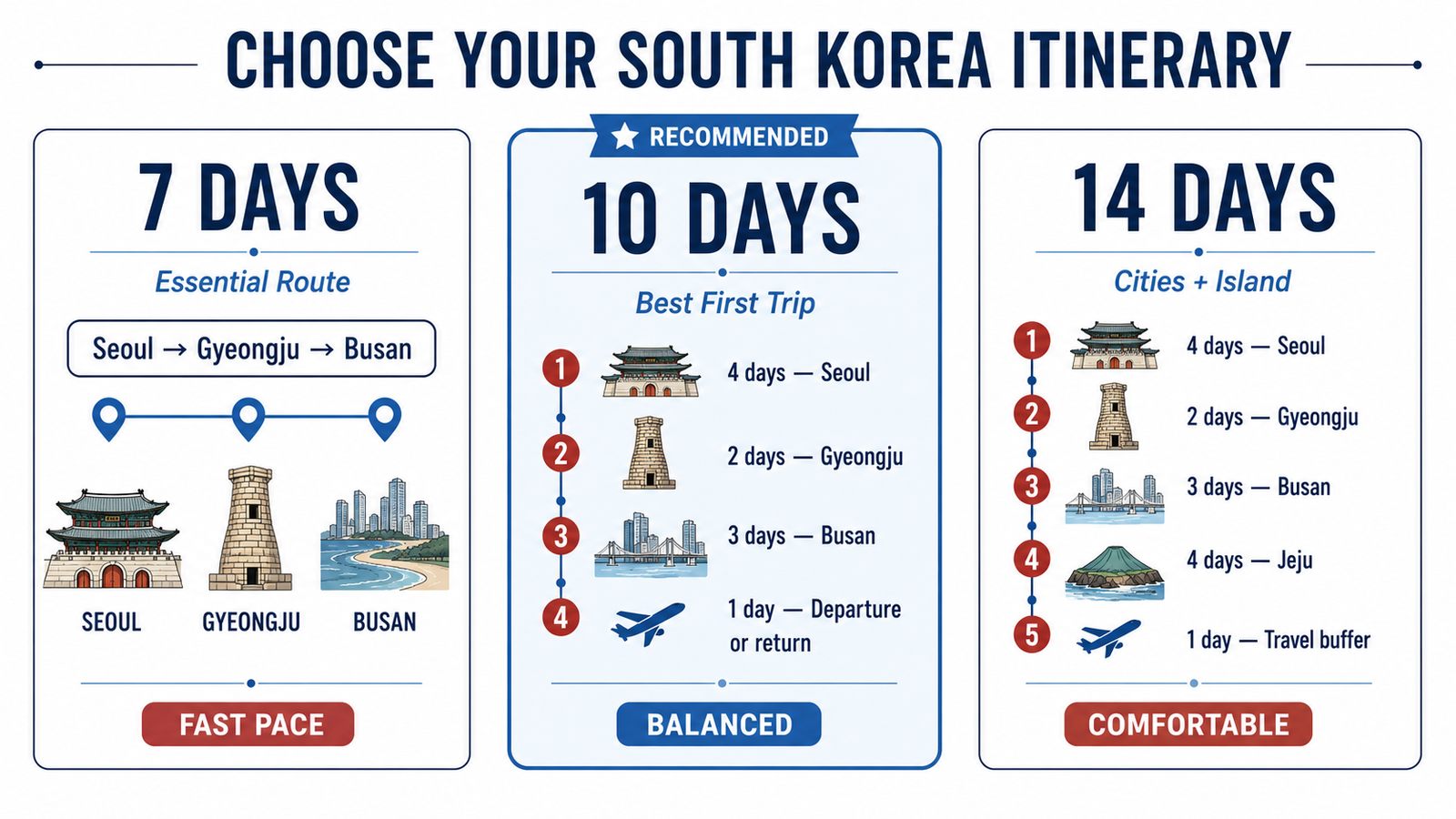
Comparison of 7, 10 and 14 day South Korea itineraries

Seven days: the essential route

Choose seven days if this is a short first visit and you are comfortable moving quickly. Concentrate on Seoul, Gyeongju, and Busan rather than trying to include Jeju.

Ten days: the best first-time balance

A 10 day South Korea itinerary provides enough time to understand Seoul, visit Korea’s principal historic city, and experience the coast without changing accommodation every night.

This is the best option for most first-time visitors.

Fourteen days: cities plus an island or nature

With fourteen days, add Jeju Island, Seoraksan National Park, or Jeonju. Choose one major extension instead of attempting to include all three.

Trip length Recommended route Pace
7 days
Seoul → Gyeongju → Busan
Fast
10 days
Seoul → Gyeongju → Busan
Balanced
14 days
Seoul → Gyeongju → Busan → Jeju
Comfortable
14 days without flights
Seoul → Sokcho → Gyeongju → Busan
Nature-focused

Map Your South Korea Itinerary

The three core destinations—Seoul, Gyeongju, and Busan—form the most practical first-time route. Jeju, Sokcho and Jeonju are optional extensions rather than essential stops.

Use the map to compare their locations before choosing a 7, 10 or 14 day itinerary. The markers show destinations, not a turn-by-turn route: trains, buses and domestic flights should be checked separately for your travel dates.

How to use this map: Start with Seoul, Gyeongju and Busan. Add only one optional extension unless you have at least 14 days.

7 Day South Korea Itinerary

This route works best with an open-jaw flight arriving near Seoul and departing from Busan. If your return flight leaves from Incheon, reserve enough time to return to Seoul.

Day Base Suggested plan
1
Seoul
Arrive, check in, walk around the local neighborhood and recover from the flight
2
Seoul
Gyeongbokgung Palace, Bukchon or Seochon, Insadong and Cheonggyecheon
3
Seoul
Choose modern architecture, contemporary art, shopping, or Hallyu attractions
4
Seoul
Explore a second district or take a carefully planned day trip
5
Gyeongju
Travel by KTX, visit the central historic area and Donggung Palace and Wolji Pond
6
Busan
See an additional Gyeongju site, then continue to Busan
7
Busan
Coastal or market-focused day, followed by departure or return journey

Do not add Jeju to a seven-day itinerary. The airport transfers, security, flight time, and hotel change consume more of the trip than the map suggests.

If you must return to Incheon, either leave Busan on the evening of day six or add another night in Seoul before the international flight.

10 Day South Korea Itinerary

This is the route I recommend as the main version of the article.

Day Base Suggested plan
1
Seoul
Arrival and an easy neighborhood walk
2
Seoul
Gyeongbokgung, historic neighborhoods and Insadong
3
Seoul
Modern Seoul, museums or architecture
4
Seoul
Shopping, K-pop, food markets or a day trip
5
Gyeongju
KTX to Singyeongju, check in and explore the central heritage district
6
Gyeongju
Bulguksa, Seokguram or another focused heritage route
7
Busan
Transfer to Busan and explore a market or central district
8
Busan
Eastern coast: Haeundae, Dongbaekseom or coastal attractions
9
Busan
Choose Gamcheon, Taejongdae, museums, temples or a slower beach day
10
Seoul or Busan
Departure, return to Seoul, or an additional night before the flight

Four nights in Seoul allow visitors to see more than a collection of famous landmarks. Different interests can be developed through the site’s detailed guides:

These supporting guides should provide the detail; the pillar page only needs to help readers decide where each interest fits into the itinerary.

14 Day South Korea Itinerary

A two-week trip can include Jeju without sacrificing the three core destinations.

Day Base Suggested plan
1–4
Seoul
Historic Seoul, modern districts and one interest-based day
5–6
Gyeongju
Historic center, Bulguksa and a second cultural route
7–9
Busan
Markets, coast, temples and neighborhood exploration
10
Jeju
Fly to Jeju, collect transport and settle in
11–13
Jeju
Divide the island into regional day routes
14
Seoul or Jeju
Fly onward or position yourself for the international departure

Jeju is much larger than it appears on a simplified tourist map. Avoid planning attractions on opposite sides of the island on the same day. Travellers who do not want to rent a car should build each day around bus-accessible areas or book selected guided transport.

Alternative 14-day nature itinerary

Visitors more interested in mountains than islands can use:

Seoul → Sokcho and Seoraksan → Gyeongju → Busan

This version avoids a domestic flight and connects naturally with the site’s hiking in South Korea guide.

Best Time to Visit South Korea

The best time to visit South Korea depends on whether you prioritize mild weather, flowers, festivals, hiking, beaches, or a lower travel budget.

Period Conditions Best for Main disadvantage
March–May
Gradually warmer; spring flowers
City walks, gardens and general sightseeing
Popular flower periods can be crowded
June–August
Hot and humid; rainy periods possible
Beaches, water activities and summer festivals
Heat, humidity and weather disruption
September–November
Cooler and generally comfortable
Hiking, city travel and autumn landscapes
Popular foliage destinations become busy
December–February
Cold and dry, with regional snow
Winter scenery, skiing and indoor attractions
Short daylight and low temperatures

The Korea Tourism Organization describes spring and autumn as the most moderate seasons for travelling on foot, while summer is generally hot and humid and winter cold and dry. Check the current forecast shortly before departure rather than relying on annual averages. See the official VISITKOREA climate guide.
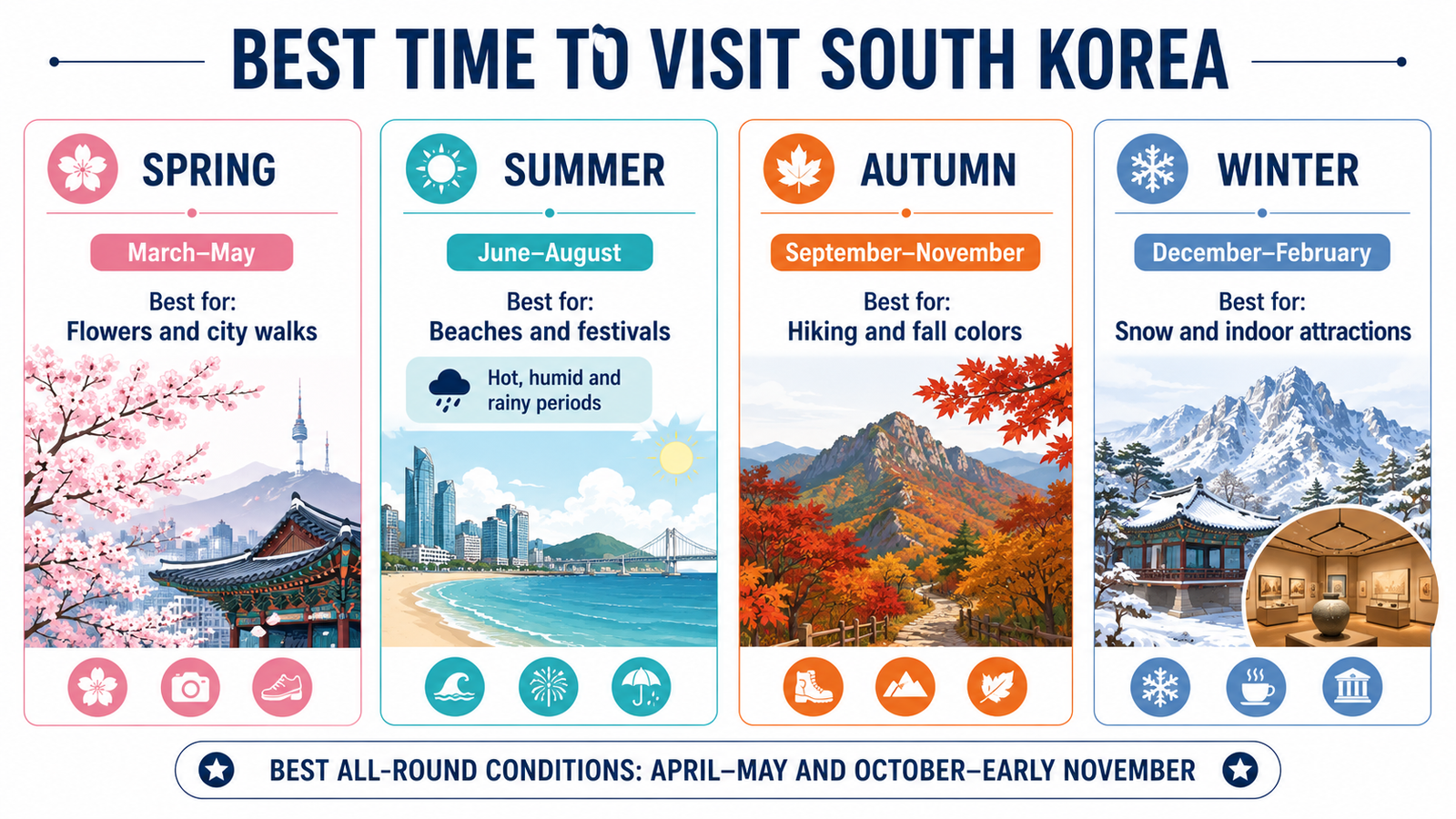
Best time to visit South Korea by season

When should you book?

Book earlier if your dates overlap with:

  • major national holidays;
  • cherry blossom periods;
  • peak autumn foliage;
  • major festivals;
  • Friday and Sunday intercity travel;
  • K-pop concerts or ticketed events.

Festival dates change annually. Use the South Korea festivals guide for comparison, then confirm the final dates on the organizer’s website.

Where to Go on a First Trip

Seoul: allow at least four nights

Seoul is not one compact sightseeing zone. Historic Jongno, commercial Myeongdong, youthful Hongdae, business-oriented Gangnam, the Han River and eastern districts require separate journeys.

Four nights provide enough time for:

  • one historic day;
  • one modern or museum day;
  • one interest-based day;
  • one flexible day or excursion.

Choose accommodation near a useful subway interchange rather than selecting a hotel purely because it appears close to one attraction.

Gyeongju: allow one or two nights

Gyeongju provides historical context that Seoul alone cannot. Its central archaeological area is relatively concentrated, but Bulguksa and Seokguram require additional transport.

One night is possible on a fast itinerary. Two nights are more sensible if heritage is a priority.

For a broader comparison of palaces, fortresses and UNESCO-related destinations, see South Korea historical landmarks.

Busan: allow two or three nights

Busan combines beaches, hills, markets, temples and dense urban areas. Attractions are geographically dispersed, so a hotel location that works for one part of the city may be inconvenient for another.

Choose between:

  • Seomyeon for transport connections and nightlife;
  • Nampo for markets and older central districts;
  • Haeundae for the eastern coast and beach atmosphere;
  • Gwangalli for evening views and a more relaxed coastal base.

Jeju: allow at least three nights

Jeju works best as a deliberate extension, not a box to tick. Weather can affect flights, ferries and outdoor plans, so keep some flexibility.

For water-based travel ideas beyond Jeju sightseeing, compare seasons and destinations in the surfing in South Korea guide.

Sokcho and Seoraksan

Choose this extension for mountain scenery and hiking rather than additional city attractions. Overnighting in Sokcho or near the park is usually more practical than attempting a rushed return trip from Seoul.

Jeonju

Jeonju suits travellers interested in traditional architecture, local food and a slower urban stop. It is less efficient on a Seoul–Gyeongju–Busan rail route, so include it only when the subject genuinely matters to you.

Getting Around South Korea
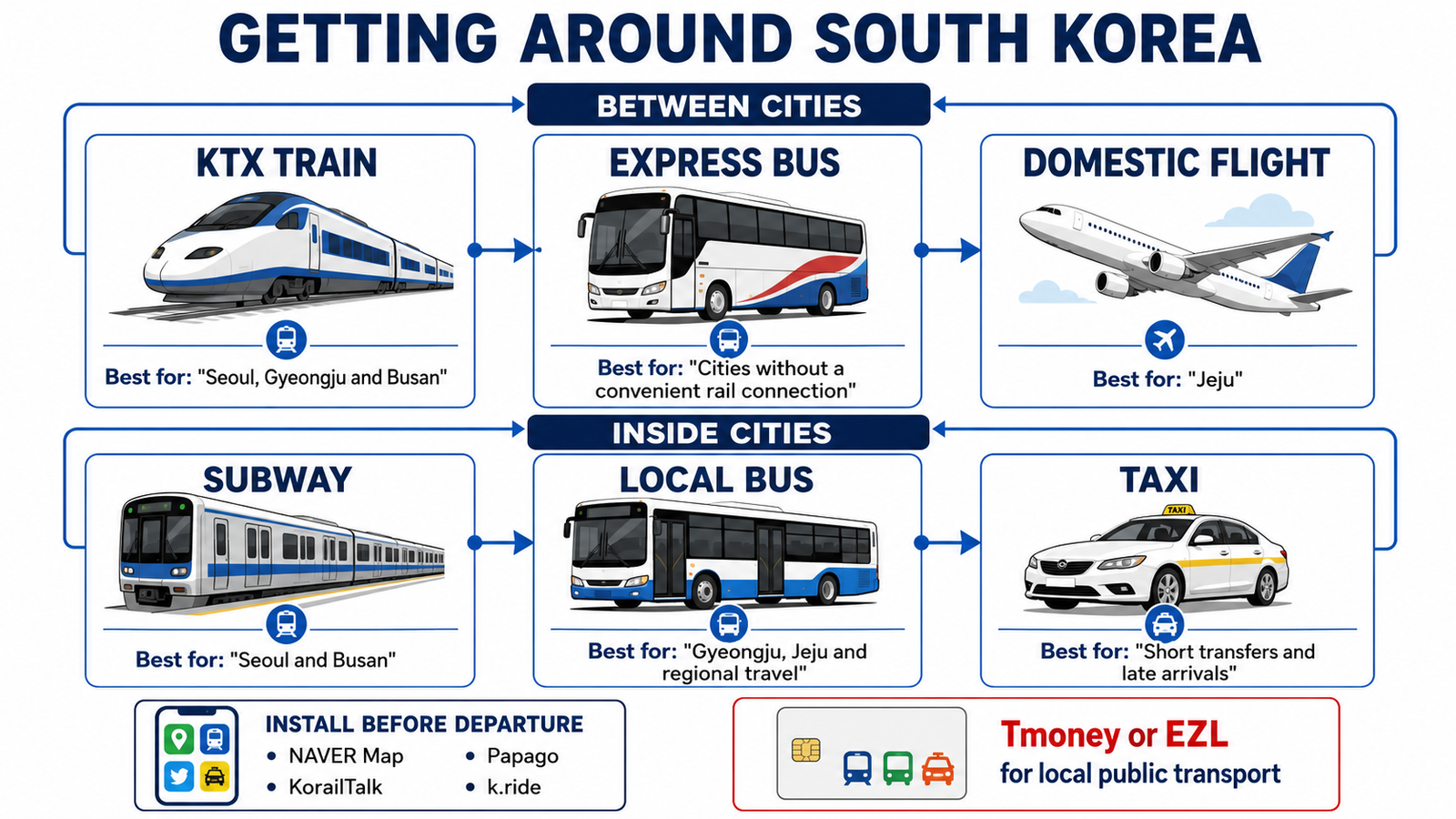
How to travel between Seoul, Gyeongju, Busan and Jeju

Travelling between cities

KTX trains are usually the simplest option between Seoul, Gyeongju and Busan. Reserve through the official KORAIL booking service or KorailTalk.

Express and intercity buses can be useful when:

  • the destination does not have a convenient rail station;
  • the bus terminal is closer to the attraction;
  • train seats are unavailable;
  • the route would otherwise require several transfers.

Remember that the KTX station serving Gyeongju is outside the historic center. Include the local transfer in your travel time.

Getting around cities

Subways are convenient in Seoul and Busan, while buses become more important in Gyeongju and Jeju.

Tmoney and EZL are rechargeable transport cards available at convenience stores and transport locations. Card coverage and reloading methods vary, so check the current official transportation-card comparison.

In Seoul, short-term Climate Card passes may suit visitors making many eligible journeys, but they do not cover every route. Airport transport and travel outside the service area require particular attention.

Essential transport apps

Install the main applications before departure:

  • NAVER Map: routes, place information and public transport;
  • KorailTalk: train searches and bookings;
  • Papago: translation;
  • k.ride: tourist-oriented taxi booking where supported.

The Korea Tourism Organization’s updated 2026 transport guidance specifically recommends KorailTalk and NAVER Map for visitors. See its essential travel apps guide.

Save hotel names and addresses in Korean as well as English. This is useful when taking a taxi or asking for directions.

South Korea Trip Cost

The following figures are planning allowances, not fixed prices. Accommodation changes substantially according to dates, location, room type and whether a solo traveller pays for the entire room.
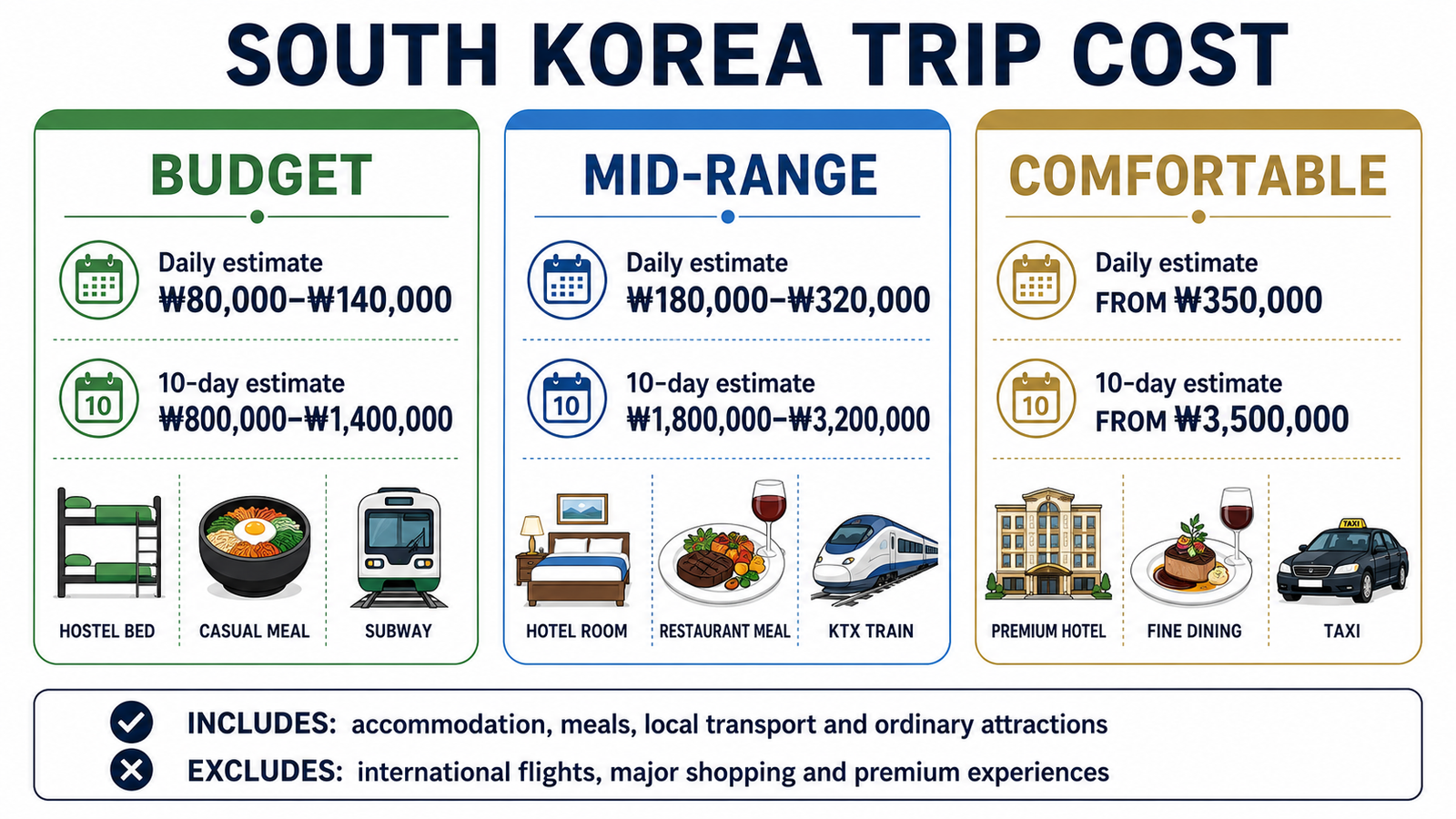
Travel style Approximate daily allowance per person 10-day planning range
Budget
₩80,000–₩140,000
₩800,000–₩1,400,000
Mid-range
₩180,000–₩320,000
₩1,800,000–₩3,200,000
Comfortable
From ₩350,000
From ₩3,500,000

Estimated South Korea trip cost by travel style

These estimates include ordinary accommodation, meals, local transport and paid attractions. They exclude:

  • international flights;
  • extensive shopping;
  • premium restaurants;
  • concert tickets;
  • private tours;
  • ski passes;
  • car rental;
  • major medical or beauty treatments.

Where the budget goes

Expense Lower-cost approach Higher-cost approach
Accommodation
Hostel, guesthouse or simple room
Centrally located hotel or premium property
Food
Kimbap, markets, cafeterias and casual restaurants
Korean barbecue, tasting menus and hotel dining
Transport
Subway, bus and standard trains
Taxis, premium train seats and private transfers
Attractions
Parks, neighborhoods and free museums
Theme parks, performances and organized tours
Intercity travel
Advance planning and logical route
Frequent changes, domestic flights and late bookings

Keep a small amount of cash even if you mainly pay by card. Credit cards are widely accepted, but transport-card reloading, small businesses or particular machines may still require Korean won. See the official VISITKOREA currency and payment guide.

Entry Requirements and Arrival Formalities

Entry requirements depend on citizenship, passport type, purpose of travel and length of stay. Do not rely on a general blog statement as confirmation that you can enter without a visa.

Before booking, check:

  1. the official Korea Visa Portal;
  2. the official K-ETA website;
  3. the Korean embassy or consulate responsible for your country of residence;
  4. your airline’s documentation requirements.

The temporary K-ETA exemption for eligible countries and regions has been extended through December 31, 2026. This does not mean that every nationality is exempt or that every visitor can enter without a visa.

Travellers who must submit an e-Arrival Card can generally do so through the official e-Arrival Card website within three days before arrival, based on Korean Standard Time. Visitors holding a valid K-ETA or belonging to another exempt category may not need the arrival card.

Check all rules again shortly before departure because immigration requirements can change after this article is updated.

SIM Cards, Internet and Payments

SIM or eSIM

Arrange an eSIM before departure or buy a SIM/Wi-Fi service at the airport. Before paying, check:

  • whether your phone supports eSIM;
  • whether it is network-unlocked;
  • the amount of high-speed data;
  • whether a Korean phone number is included;
  • whether voice calls and SMS are necessary for bookings.

Downloading maps does not remove the need for live route information, especially when buses or walking directions change.

Paying for purchases

South Korea is highly card-oriented, but carrying a modest cash reserve is sensible. Notify your bank of travel if required and bring a second payment method stored separately from the first.

Do not convert every price into your home currency mentally. Establish a simple benchmark for ₩10,000 and use it consistently when comparing meals, transport and admission fees.

Where to Stay

Destination Good first-time base Best for
Seoul
Jongno/Euljiro
Historic sights and central connections
Seoul
Hongdae
Airport access, restaurants and evening activity
Seoul
Myeongdong
Shopping and central sightseeing
Seoul
Gangnam
Modern districts, business travel and southern Seoul
Gyeongju
Central historic area
Evening walks and heritage sites
Gyeongju
Near the bus terminals
Practical onward transport
Busan
Seomyeon
Transport connections
Busan
Nampo
Markets and central Busan
Busan
Haeundae
Beach and eastern attractions
Jeju
Jeju City
Airport access and northern routes
Jeju
Seogwipo
Southern landscapes and attractions

Before booking, check the walking route from the station to the hotel rather than only the straight-line distance. A property across a river, railway, hill or large road can be less convenient than the map initially suggests.

Build the Trip Around Your Interests

A useful pillar should help readers choose detailed guides without repeating every child article.

Culture and history

Use the South Korea historical landmarks guide to compare palaces, fortresses, historic towns and UNESCO-related sites.

Travellers looking for a slower cultural experience can read the South Korea temple stay guide.

Food

Start with the best Korean food guide for dishes, typical price levels, spice expectations and ordering tips.

Hiking and outdoor travel

Compare parks, routes, difficulty and transport in the hiking in South Korea guide.

For beaches, seasons and lessons, use the South Korea surfing guide.

Art, architecture and technology

These three subjects can be combined into one modern-Seoul day, but attempting to visit every listed museum in a single day would be unrealistic.

Shopping and Hallyu

Wellness and responsible travel

Korean Food Basics for First-Time Visitors

Korean cuisine is much broader than barbecue and kimchi. A first trip can include soups, noodles, rice dishes, dumplings, pancakes, seafood and numerous regional specialities.

A few practical points help:

  • some restaurants specialize in one dish;
  • menus may require a minimum order for shared meat dishes;
  • several side dishes are normally served with the meal;
  • spice levels cannot always be adjusted;
  • vegetarian-looking broths or sauces may contain meat or seafood ingredients;
  • market prices and portion sizes should be confirmed before ordering.

Travellers with allergies or strict dietary requirements should prepare a clear Korean-language explanation rather than relying on spontaneous translation.

Practical Etiquette

Visitors are not expected to understand every social convention, but a few habits reduce friction:

  • speak quietly on public transport;
  • wait for passengers to leave before boarding;
  • follow photography restrictions at museums and religious sites;
  • remove shoes where clearly indicated;
  • do not assume every restaurant accepts modifications;
  • return shared spaces and temple-stay rooms in good condition;
  • sort waste according to local instructions;
  • avoid blocking narrow streets while taking photographs.

Respectful observation is more useful than trying to perform every custom perfectly.

Common South Korea Itinerary Mistakes

Adding too many cities

Every change of hotel involves packing, checkout, station travel, waiting and check-in. Four destinations in seven days may look efficient on a map but often produce a fragmented trip.

Treating Seoul as one compact center

Cross-city journeys can consume a meaningful part of the day. Group attractions by district.

Visiting Jeju for one night

Jeju requires airport transfers and regional travel after landing. Allow at least three nights or leave it for another trip.

Ignoring the return flight

A route ending in Busan is simple only if you have an appropriate onward flight or enough time to return to the Seoul area.

Booking around annual averages

Cherry blossom, foliage and festival periods move with weather and organizer decisions. Confirm actual forecasts and official dates.

Depending on one payment method

Bring a second card and some Korean won.

Schedules, admission fees and entry rules change. Open the official page again before making the final booking.

Frequently Asked Questions

Is seven days enough for South Korea?

Seven days is enough for a fast Seoul–Gyeongju–Busan route, but it does not allow much flexibility. Do not add Jeju unless you remove another destination.

What is the best South Korea itinerary for a first trip?

For most visitors, the strongest route is four nights in Seoul, two nights in Gyeongju and three nights in Busan. This forms a coherent 10 day South Korea itinerary with relatively straightforward transport.

How much does a trip to South Korea cost?

A realistic planning allowance is approximately ₩80,000–₩140,000 per person per day for budget travel and ₩180,000–₩320,000 for a mid-range trip. International flights and major shopping are not included.

What is the best time to visit South Korea?

April–May and October–early November generally offer comfortable conditions for walking and sightseeing. The best period still depends on whether the priority is flowers, beaches, hiking, festivals or winter activities.

Do I need a car?

A car is unnecessary for the standard Seoul–Gyeongju–Busan route. It becomes more useful for parts of Jeju and rural destinations, although bus-based or guided alternatives exist.

Should I buy a rail pass?

Compare the pass price with the actual point-to-point tickets for your itinerary. A rail pass is not automatically cheaper when the trip contains only two or three train journeys.

Can I use Google Maps in South Korea?

It can still be useful for place discovery, but local applications often provide more complete public-transport and walking information. Install NAVER Map before departure.

Do I need to speak Korean?

No, but learning basic greetings and keeping addresses in Korean is useful. Papago can help with short translations, while information centers and the 1330 Korea Travel Helpline can assist visitors.

Final Planning Checklist

Before paying for the entire trip:

  • choose the 7-, 10- or 14-day route;
  • confirm entry requirements for your passport;
  • check the international arrival and departure airports;
  • reserve the first accommodation;
  • compare intercity train and bus connections;
  • install navigation and translation apps;
  • create a realistic daily budget;
  • verify seasonal conditions;
  • keep at least one flexible half-day;
  • save official booking links and Korean-language addresses.

The objective is not to see every famous place in South Korea. A successful itinerary connects a manageable number of destinations, leaves time to understand them, and preserves enough flexibility for weather, transport changes and unexpected discoveries.

Leave a Comment

Your email address will not be published. Required fields are marked *