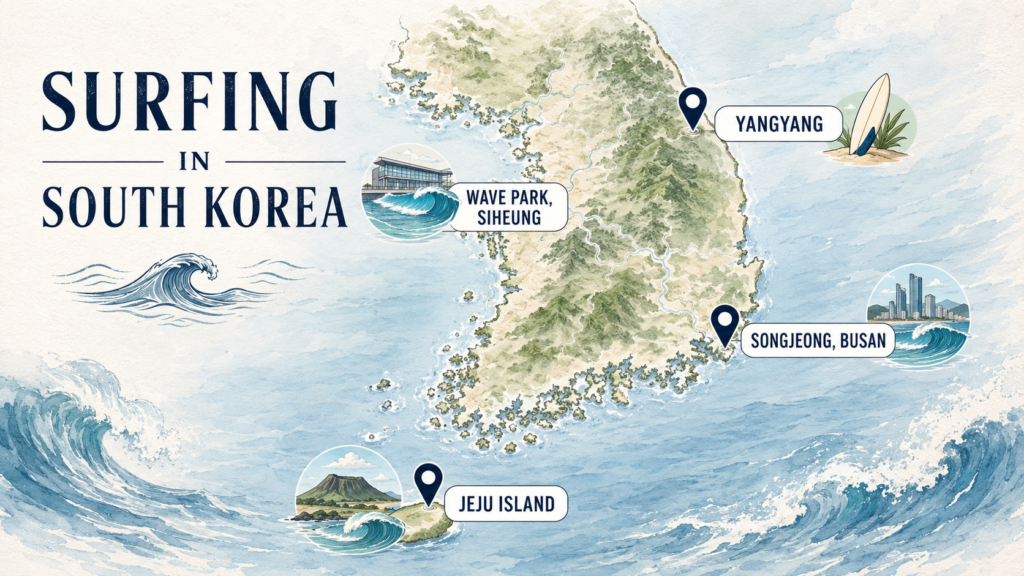
Surfing in South Korea map with Yangyang, Busan, Jeju and Siheung

Surfing in South Korea: Best Beaches, Costs and Beginner Tips

Surfing in South Korea is more accessible than many international visitors expect. The country has established surf communities on the east coast, beginner-friendly schools in Busan, powerful breaks on Jeju Island and even an artificial wave park within reach of Seoul.

The main challenge is not finding somewhere to surf. It is choosing the right coast for your experience level, season and itinerary.

Yangyang has the largest concentration of surf beaches and schools. Songjeong works well when Busan is already part of your trip. Jeju combines surfing with an island holiday but requires more careful attention to tides and local conditions. Beginners who do not want to travel to the coast can also consider Wave Park near Seoul.

This guide compares the main surfing destinations in Korea, current lesson prices, transport considerations and the practical details you should confirm before booking.

Research note: Prices, operating information and transport options were checked in July 2026 using official tourism resources and current surf-school listings. Surf conditions, lesson schedules and prices can change, so confirm them directly before travelling.

Surfing in South Korea: Quick Comparison

Surfing destination Region Best suited to Typical planning note
Jukdo Beach
Yangyang
Beginners and travellers wanting a surf-town base
Many surf shops, accommodation and cafés nearby
Ingu Beach
Yangyang
First lessons and shallow-water practice
Located beside Jukdo, with several surf facilities
Surfyy Beach
Yangyang
Organised lessons, rentals and beach facilities
Dedicated surfing area north of Hajodae
Songjeong Beach
Busan
Beginners already visiting Busan
Urban transport and several established schools
Jungmun Saekdal Beach
Jeju
Intermediate and advanced surfers
Conditions are strongly affected by wind and tides
Woljeong and Iho Tewoo
Jeju
Travellers comparing alternative Jeju surf schools
Confirm the lesson location with the operator
Wave Park
Siheung
Predictable artificial waves near Seoul
Advance booking and a separate admission fee required
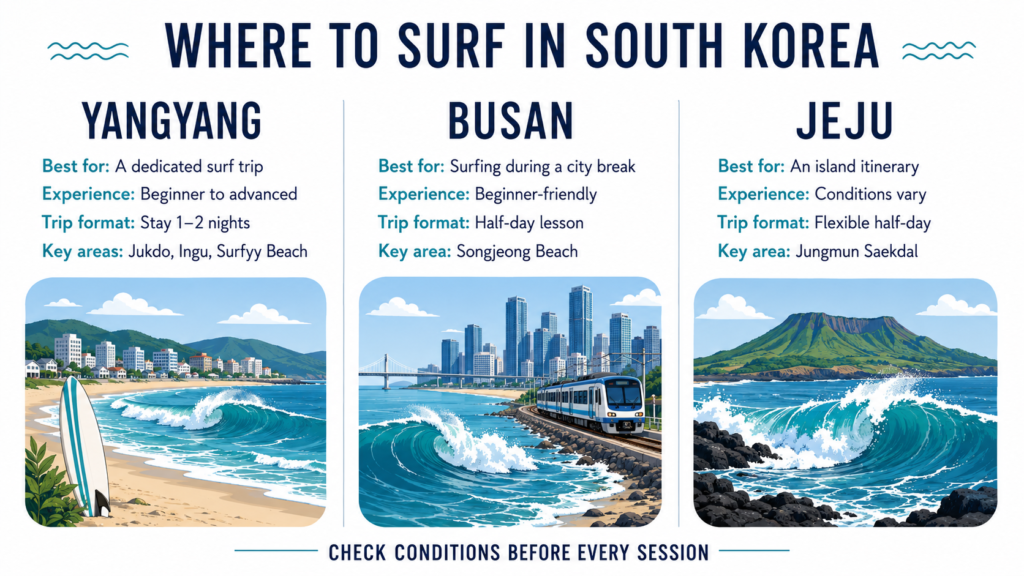
Comparison of Yangyang, Busan and Jeju surfing destinations

Is South Korea a Good Surfing Destination?

South Korea is not a tropical surf destination with guaranteed waves every day. Its strength lies elsewhere: several distinct surfing regions, accessible beginner lessons, rental infrastructure and the ability to include surfing in a wider trip.

The Korea Tourism Organization identifies natural surf spots along the east, south and Jeju coasts. Its current sports and leisure guide lists Jukdo, Ingu, Songjeong, Jungmun Saekdal, Iho Tewoo and several other beaches.

For most international visitors, the choice comes down to three regions:

  • Yangyang for the largest concentration of surf infrastructure;
  • Busan for the easiest combination of surfing and city travel;
  • Jeju for more exposed island conditions and a longer coastal itinerary.

Wave quality changes with wind, swell and season. A beach described as suitable for beginners can still be unsafe on a particular day. Always follow the surf school’s assessment rather than choosing a beach only from photographs or an old forecast.

Yangyang: Korea’s Main Surfing Region

Yangyang is the most practical destination for a dedicated surfing trip from Seoul. Its coastline contains a group of beaches with surf schools, rentals, accommodation and cafés.

The principal areas are Jukdo Beach, Ingu Beach and Surfyy Beach. They are not interchangeable, although they are often grouped together in travel guides.

Jukdo Beach: Best Overall Surf Base

Jukdo is the most convenient base for travellers who want to stay near the surfing community rather than arrive for only one lesson.

The area around the beach contains:

  • surf schools and equipment rentals;
  • guesthouses and small hotels;
  • cafés and restaurants;
  • convenience stores;
  • the Waveworks workation centre;
  • access to neighbouring Ingu Beach.

Yangyang’s official smart-tourism platform provides live webcams and wave information for 13 local beaches. Check the current feed before leaving your accommodation, but use the surf school’s decision as the final safety assessment.

Jukdo is a sensible choice if you want two or more sessions. Staying overnight also gives you flexibility when a lesson is moved because of wind or unsuitable waves.

Ingu Beach: A Practical Beginner Option

Ingu Beach lies immediately south of Jukdo. Official tourism information describes its shallow water as one of the reasons it attracts novice surfers. The surrounding area also has surf shops, accommodation, cafés and restaurants.

That makes Ingu useful for:

  • a first group lesson;
  • travellers staying near Jukdo;
  • couples or groups with both surfers and non-surfers;
  • visitors who want beach facilities within walking distance.

The beach itself is free to enter. Surf lessons, board rentals, wetsuits and changing facilities are provided by private operators and are charged separately.

See the current beach information on the official VISITKOREA Ingu Beach page.

Surfyy Beach: Lessons and Organised Facilities

Surfyy Beach is a dedicated surfing beach north of Hajodae. It operates a surf school and provides board and wetsuit rentals, along with food, lounge and recreation facilities.

It is a straightforward option for someone who wants an organised experience without comparing numerous independent shops.

Current tourism information lists introductory surfing lessons at approximately ₩50,000–₩60,000. Rates can vary by date, package and season, so check the current booking page before using this figure in your budget.

Surfyy Beach is open throughout the year, but lesson availability and daily operating hours can change with weather and daylight.

Check current information through VISITKOREA’s Surfyy Beach listing and the linked operator website.

How to Reach Yangyang from Seoul

The most practical independent route is normally:

  1. Take an intercity or express bus from Seoul to Yangyang.
  2. Continue from Yangyang terminal by local bus or taxi.
  3. Stay near Jukdo or Ingu if you plan more than one session.

Check the current long-distance timetable using Bustago, Kobus or Tmoney Go. Do not build the day around an old timetable copied from a blog.

Local connections along the coast are less frequent than transport inside Seoul. A same-day return can work, but it leaves little flexibility if your lesson is delayed. One night in Yangyang is the safer format for a dedicated surf trip.

An organised day tour may include transport, a lesson and equipment. One current product promoted through VISITKOREA was priced from ₩250,000, but that is a packaged tour rather than the normal cost of a local surf lesson.

Songjeong Beach: Surfing in Busan

Songjeong Beach is the most practical choice for travellers who already plan to visit Busan.

The Korea Tourism Organization describes Songjeong as a popular surfing destination with shallow water and established training infrastructure. The beach is outside the busiest central districts, but it remains much easier to combine with urban transport than a separate trip to Yangyang.

Songjeong is particularly useful for:

  • first-time surfers;
  • travellers staying in Haeundae or eastern Busan;
  • visitors who want one lesson rather than a multi-day surf trip;
  • people combining the beach with Haedong Yonggungsa or the coastal area around Osiria.

A current Songjeong surf-school listing charges ₩65,000 for an introductory lesson, including a board and wetsuit. Other schools may have different prices, lesson lengths and language options.

Check the details before paying:

  • whether the wetsuit is included;
  • how much time is spent in the water;
  • whether free surfing after the lesson is included;
  • the cancellation policy;
  • minimum age;
  • availability of English instruction.

Current beach information is available from VISITKOREA’s Songjeong Beach page.

Getting to Songjeong

Possible connections include the Donghae Line, local buses, taxis and Busan’s TABARA demand-responsive service.

The final route depends on your accommodation. Check Naver Map or KakaoMap on the day of travel because they normally provide more complete local public-transport information than international mapping applications.

Songjeong is a better choice than Yangyang when surfing is only one part of a Busan itinerary. Choose Yangyang when the surf environment itself is the primary reason for the trip.

Surfing on Jeju Island

Jeju has an important place in Korean surfing history and provides a very different experience from the organised beach districts of Yangyang.

The island’s most recognised surf location is Jungmun Saekdal Beach. Official Korean tourism material also lists Iho Tewoo and Woljeongni among Jeju’s surfing areas.

Do not assume that all Jeju beaches suit beginners. Conditions can change rapidly, and some areas are more exposed than the shallow beaches commonly used for introductory lessons.

Jungmun Saekdal Beach

Jungmun Saekdal Beach is located on the southern side of Jeju, beside Jungmun Tourist Complex. It has a wide sandy area surrounded by volcanic coastal scenery.

The Korea Tourism Organization identifies Jungmun as one of the country’s most significant surfing locations. It also notes that stronger waves around Duke Point are better suited to experienced surfers.

Lesson schedules at Jungmun can change daily because of tides. A current local operator lists a beginner lesson at ₩60,000 per person, excluding wetsuit rental. Treat this only as a current example rather than a fixed price for the beach.

Beginners should book a lesson and accept the operator’s choice of time and training area. Do not paddle into a stronger section simply because other surfers are using it.

See the official Visit Jeju Jungmun Saekdal Beach listing.

Woljeong and Iho Tewoo

Woljeongni and Iho Tewoo appear in official national surfing guides, but lesson locations and seasonal availability vary among operators.

If a Jeju school advertises lessons at several beaches, confirm which beach will actually be used on your date. Operators may move sessions according to wind, tide and swell.

This is especially important when choosing accommodation. A school name containing “Jeju” does not mean every lesson departs from Jeju City or Jungmun.

Getting to Jeju Surf Beaches

Jeju is reached by domestic flight or ferry. Once on the island, transport planning depends heavily on the chosen beach.

For Jungmun:

  • direct and connecting buses operate from Jeju City and the airport area;
  • a rental car gives more flexibility;
  • taxis may be practical for the final connection;
  • allow extra time for the walk between the road, surf school and beach.

If surfing is your main purpose, stay near the selected beach. Crossing the island before an early lesson adds unnecessary risk when the start time can already change with the tide.

Wave Park: Artificial Surfing Near Seoul

Wave Park is an artificial surf facility on Geobukseom Island in Siheung. It is not a substitute for a Korean coastal surf trip, but it offers controlled waves and structured sessions within reach of Seoul.

It may suit travellers who:

  • have only one free day;
  • want predictable artificial waves;
  • prefer organised facilities;
  • do not want to plan an overnight coastal trip.

The facility operates seasonally and uses separate programs for different ability levels. Admission, equipment and instruction may be priced separately, so check the official booking page rather than relying on the previous year’s package.

VISITKOREA describes Wave Park as approximately one hour from Seoul by car. Public-transport travel usually requires more time and may involve transfers.

See the official VISITKOREA Wave Park overview.

How Much Does Surfing in Korea Cost?

These are planning ranges based on current examples checked in July 2026, not fixed national prices.

Expense Approximate amount What to verify
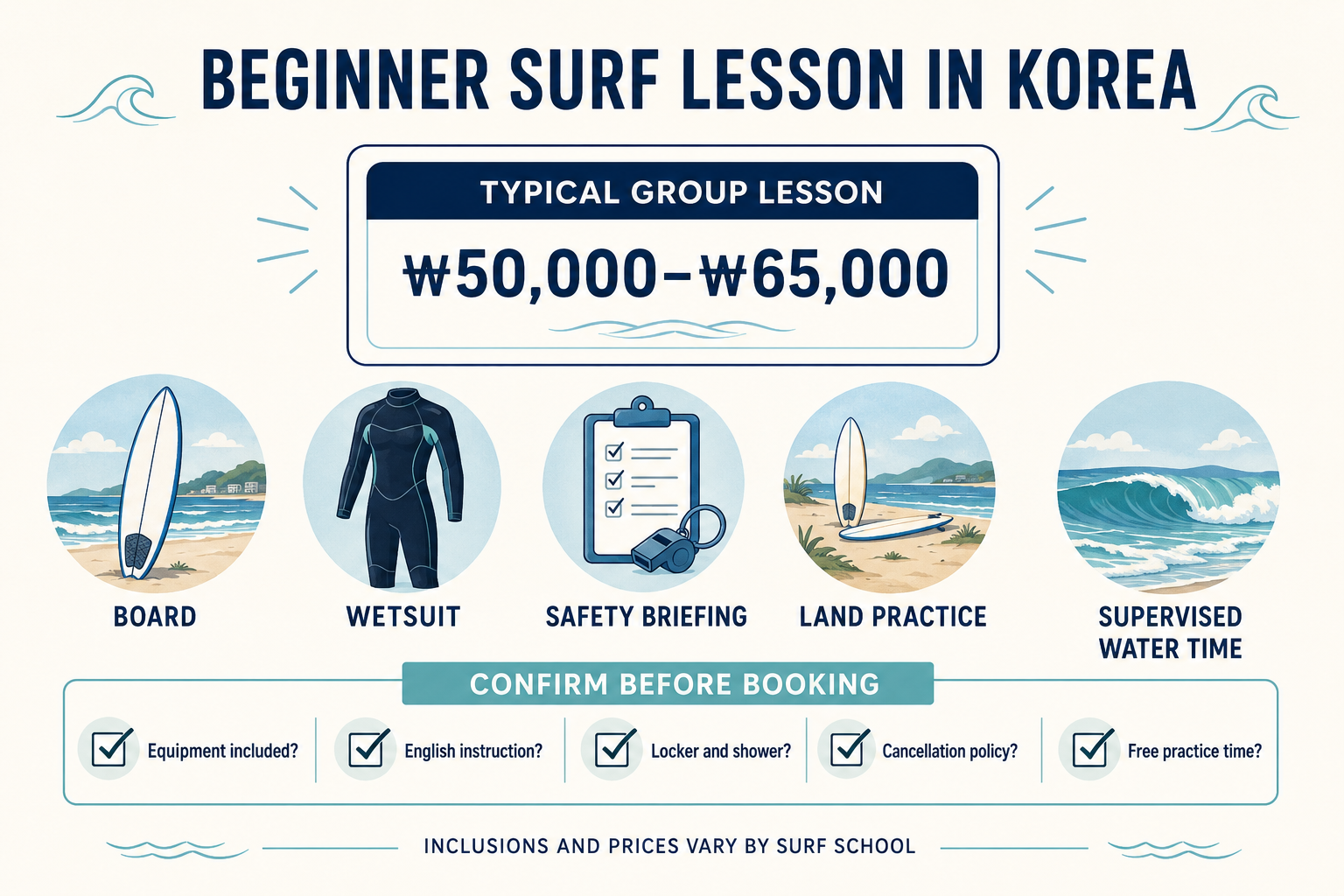
Introductory group lesson
₩50,000–₩65,000
Lesson length and number of participants
Board and wetsuit rental
Sometimes included
Rental duration and deposit
Wetsuit rented separately
Around ₩10,000 in one current Jeju example
Thickness and size availability
Private lesson
Commonly more than ₩100,000
Whether the price is per person or group
Organised Yangyang tour from Seoul
From approximately ₩250,000 in one current example
Transport, equipment and cancellation terms
Beach entry
Usually free at the beaches covered here
Private zones and facilities may charge separately
Artificial wave session
Variable
Admission, board, wetsuit and coaching may be separate

A low advertised price is not automatically a better deal. Compare what is included:

  • board;
  • wetsuit;
  • safety briefing;
  • land instruction;
  • supervised water time;
  • insurance;
  • shower and locker use;
  • free practice after the lesson;
  • photographs or video;
  • cancellation after bad weather.

Typical cost and inclusions of a beginner surf lesson in South Korea

How to Book a Surf Lesson

1. Choose the Region Before the School

Start with your itinerary:

  • Seoul-based trip: Yangyang or Wave Park;
  • Busan itinerary: Songjeong;
  • Jeju itinerary: a school operating near your accommodation.

2. Confirm the Actual Beach

Some schools use several beaches and decide the final location according to the conditions. Ask for the meeting point in both English and Korean.

3. Ask What the Price Includes

Confirm in writing:

  • total price;
  • board and wetsuit;
  • lesson duration;
  • free-surfing time;
  • shower and locker;
  • age or swimming requirements;
  • refund or rescheduling rules.

4. Confirm Language Support

An English website does not guarantee an English-speaking instructor for every session. Ask directly before booking.

5. Reconfirm the Day Before

Weather, waves and tides can change the start time or location. Save the school’s phone number or messaging contact and check for updates.

Best Time for Surfing in South Korea

There is no single month that guarantees the best conditions everywhere.

Summer

June through August is the simplest period for most beginners because:

  • more schools operate regular lessons;
  • beach facilities are open;
  • the weather and water are warmer;
  • rental availability is generally better.

The disadvantage is larger crowds, particularly during weekends and the July–August holiday period.

Spring and Autumn

Spring and autumn can offer fewer beach crowds, but conditions and water temperature vary. Confirm that the school is running lessons and ask what wetsuit is provided.

Winter

Some Korean surf facilities operate during winter, but cold air and water make the experience less suitable for a casual first lesson. Winter surfing requires appropriate equipment, physical preparation and a reliable local assessment of conditions.

Do not choose a season solely because someone describes its waves as “better.” The best period for an experienced independent surfer may be a poor choice for a beginner.

Surfing Safety in Korea

Surfing should be treated as a weather-dependent activity, not a guaranteed attraction.

Before entering the water:

  • take a lesson if you are a beginner;
  • ask the school about currents and restricted areas;
  • use a board appropriate for your level;
  • wear the recommended wetsuit;
  • inspect the leash;
  • keep distance from swimmers and other boards;
  • do not surf alone at an unfamiliar beach;
  • obey lifeguards, warning flags and closures;
  • leave the water if instructed.

Check the Korea Meteorological Administration for active wind-wave and severe-weather warnings. Yangyang visitors can also use the official local webcams to inspect current beach conditions.

Do not enter the sea during a typhoon, wind-wave warning or official closure. Korea’s national safety guidance advises people to move away from coastal areas when high waves or typhoon conditions are expected.

Travel insurance should specifically cover surfing. General travel insurance may exclude adventure sports or provide coverage only during supervised lessons.

What to Bring

For a beginner lesson, pack:

  • swimsuit;
  • towel;
  • sunscreen;
  • water;
  • dry clothes;
  • sandals;
  • waterproof bag;
  • any required medication;
  • a warm layer outside midsummer.

The school may provide a board and wetsuit, but confirm this before travelling. If you require a less common wetsuit size, contact the operator in advance.

Avoid buying or transporting a surfboard for a single lesson. Renting locally removes airline fees and makes it easier to use equipment suited to the day’s conditions.
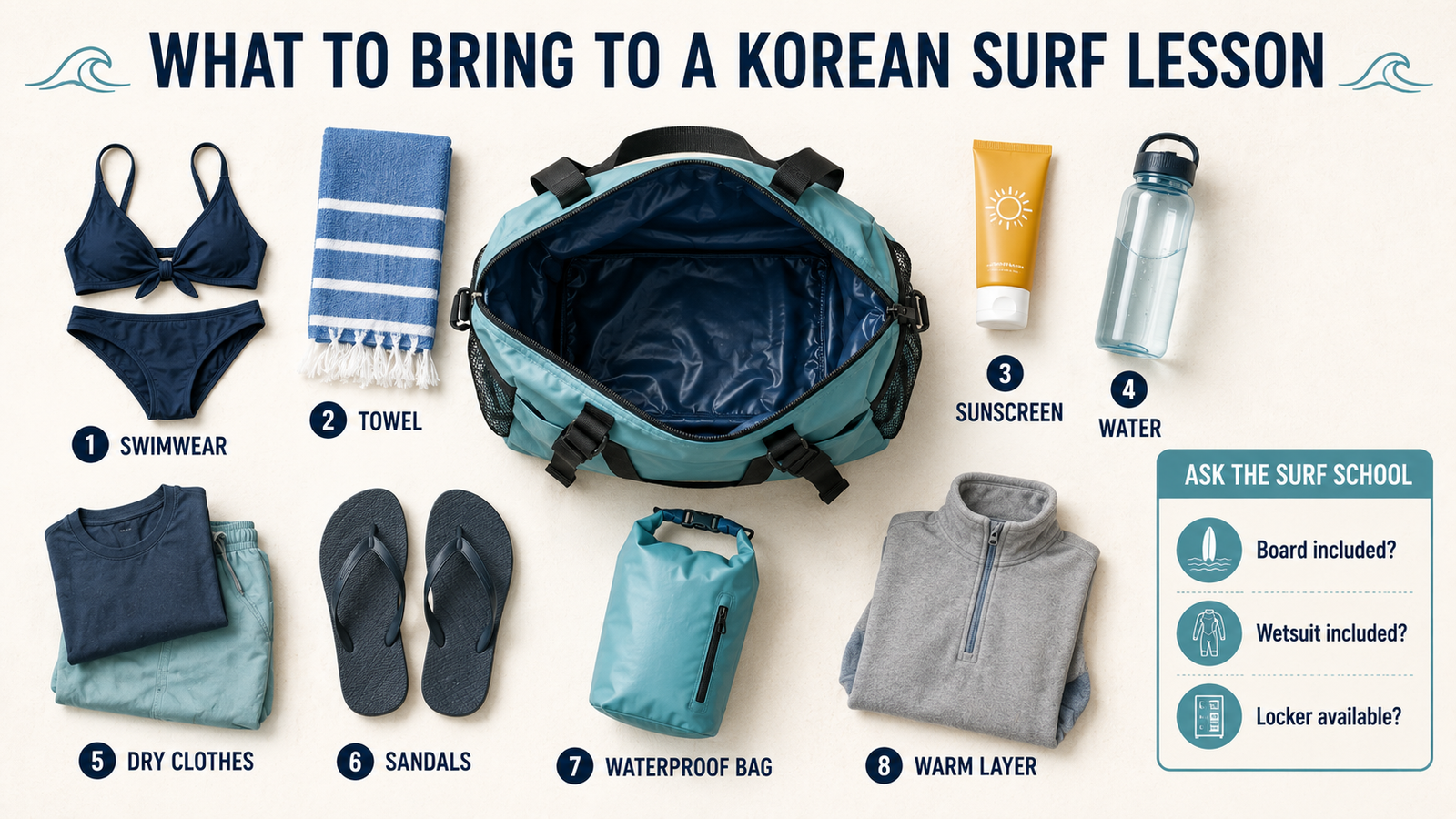
Packing list for a surfing lesson in South Korea

Suggested Surfing Itineraries

One Day from Seoul

Choose either:

  • an organised Yangyang lesson with transport; or
  • Wave Park in Siheung.

Independent public transport to Yangyang is possible, but a same-day return gives you less flexibility if the lesson is rescheduled.

Two Days in Yangyang

Day 1: Travel from Seoul, check in near Jukdo or Ingu, confirm the next lesson and explore the coast.

Day 2: Join the lesson, allow time for changing and lunch, then return to Seoul or continue towards Sokcho.

Travellers continuing to the mountains can use our Hiking in South Korea guide to plan a separate hiking day. Do not combine a demanding hike and first surf lesson into an unnecessarily rushed schedule.

Surfing During a Busan Stay

Stay in Busan and reserve a half-day at Songjeong. The beach can be combined with Haedong Yonggungsa or the eastern coastal area, but keep the surf session as the fixed part of the day because its timing may depend on conditions.

Jeju Surfing Trip

Stay near Jungmun or the beach selected by your school. Reserve at least one flexible half-day in case the session moves with the tide or weather.

For broader transport, accommodation and regional planning, continue with the South Korea Travel Guide.

Frequently Asked Questions

Can beginners surf in South Korea?

Yes. Ingu, Surfyy Beach and Songjeong all have established beginner infrastructure. A beach being beginner-friendly does not mean it is safe under every condition, so take a lesson and follow the instructor’s assessment.

Where is the best place to surf near Seoul?

Yangyang is the main natural surf destination commonly reached from Seoul. Wave Park in Siheung is closer but uses artificial waves.

Is Yangyang or Busan better?

Choose Yangyang for a dedicated surf trip and a larger concentration of surf beaches. Choose Songjeong when Busan is already part of your itinerary.

Can I surf on Jeju Island as a beginner?

Yes, but book through a school. Jungmun can have stronger conditions, and lesson times may change with the tide. Allow the operator to select the appropriate training area.

How much is a beginner lesson?

Current examples are approximately ₩50,000–₩65,000 for a group introduction. Equipment may or may not be included.

Do Korean surf schools offer lessons in English?

Some do, but English support can depend on the instructor and date. Confirm it directly before paying.

Do I need to bring a wetsuit?

Usually not if the rental or lesson includes one. Check the booking conditions, particularly on Jeju, where some listed prices exclude wetsuit rental.

Can lessons be cancelled?

Yes. Strong wind, unsuitable waves, typhoons and official beach restrictions can cause cancellation or rescheduling. Read the refund policy before booking.

Choosing the Right Korean Surf Destination

For most first-time visitors, the decision is straightforward.

Choose Yangyang if surfing is an important part of the trip and you can stay overnight. Choose Songjeong if you want to add one lesson to a Busan itinerary. Choose Jeju if you are already visiting the island and can keep your schedule flexible. Choose Wave Park when time and predictable facilities matter more than surfing in the sea.

The best destination is not necessarily the beach with the most dramatic waves. It is the place where transport, instruction, conditions and your experience level fit together.

Leave a Comment

Your email address will not be published. Required fields are marked *