
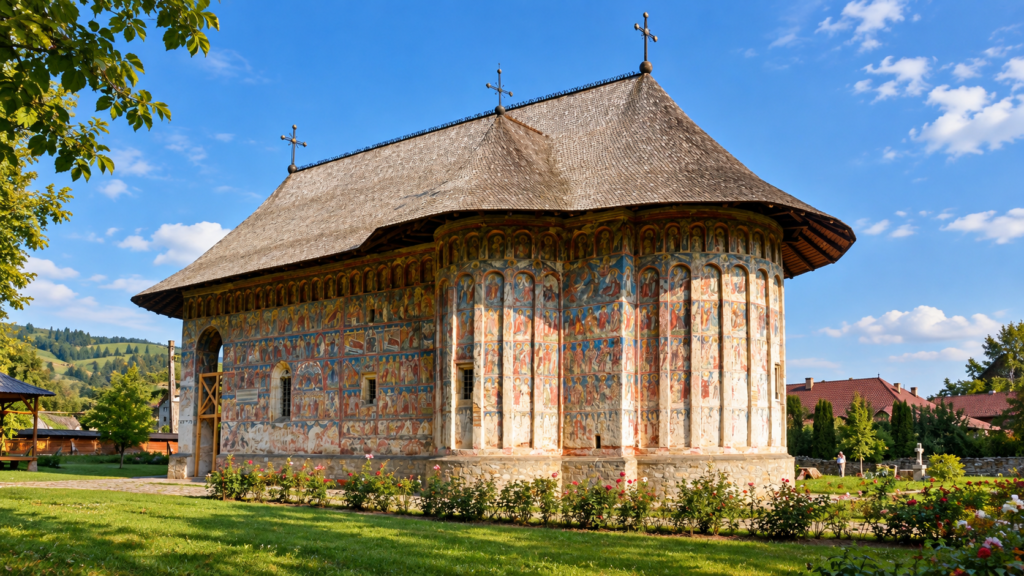
Humor Monastery, one of the painted monasteries of Bucovina, surrounded by greenery

Painted Monasteries of Bucovina: What to See in 1 or 2 Days

The painted monasteries of Bucovina are best explored as a small regional trip, with time to look closely at their frescoes rather than rush between church entrances. For a first visit, focus on four places: Voroneț, Humor, Moldovița and Sucevița.

If you have one day, Voroneț and Humor make a manageable introduction from Gura Humorului. With two full sightseeing days and a car or arranged transport, add Moldovița and Sucevița. Suceava is another useful base, particularly if you are arriving by train or plane.

This guide explains what makes each monastery different, how to group your visits, and what to check before travelling. To fit Bucovina into a wider journey, start with our guide to things to do in Romania.

Which Painted Monasteries Should You Visit?

Choose your stops around the time available and your interest in religious art. You do not need to visit every church in the region to understand why these places are special.

Monastery Main reason to visit Location to use when planning Suggested time on site
Voroneț
Blue frescoes and the Last Judgment
Voroneț, near Gura Humorului
45–75 minutes
Humor
A smaller church with warm reddish-brown frescoes
Mănăstirea Humorului, near Gura Humorului
30–60 minutes
Moldovița
The Siege of Constantinople and Tree of Jesse
Vatra Moldoviței
45–75 minutes
Sucevița
The Ladder of Divine Ascent and fortified enclosure
Sucevița village
60–90 minutes

These are suggested visit lengths, not official tour durations. Allow additional time for parking, tickets, services, museum access and any guided explanation.

For a short introduction, choose Voroneț and Humor. For a broader comparison of the region’s frescoes and architecture, spread all four across two days.

Where Are the Painted Monasteries of Bucovina?

The monasteries covered here are in northeastern Romania, around Gura Humorului, Vatra Moldoviței and Sucevița. They are separate destinations, not attractions within walking distance of one another.

A useful way to organise them is into two pairs:

  • Near Gura Humorului: Voroneț and Humor.

  • A longer driving excursion: Moldovița and Sucevița.

Check the regional monastery map before choosing accommodation. Being close to one monastery does not necessarily put you close to the others.

Place names also matter. Moldovița Monastery is in Vatra Moldoviței, while Humor Monastery is in Mănăstirea Humorului. Search for the monastery itself when setting navigation, rather than selecting a similarly named town or village.

Blue markers show the suggested first-day visits; green markers show the second-day pair. Grey markers indicate possible bases. Transport between sites must be arranged separately.

Why Are the Churches Painted on the Outside?

The exterior frescoes tell religious stories across the walls of the churches. Biblical scenes, saints and complex compositions turn the building itself into a sequence of images that visitors can follow.

UNESCO recognises eight churches under the collective listing Churches of Moldavia. The designation concerns specific historic churches, not every monastery in Bucovina. Their significance lies in their Byzantine-inspired mural cycles, artistic quality and relationship with the surrounding landscape. UNESCO’s description of the property explains this distinction.

Here, “Moldavia” refers to the historical region. The churches in this guide are in Romania, not the Republic of Moldova.

You do not need specialist knowledge to enjoy them. Start with one recognisable scene, then look at how figures, colours and architectural details differ between sites. A guided explanation can be more valuable than adding another monastery to an already crowded day.

Voroneț Monastery: Blue Frescoes and the Last Judgment

Voroneț Monastery is our suggested starting point for a first visit. Its blue-painted backgrounds and large Last Judgment composition provide an immediate introduction to the exterior art for which Bucovina is known.
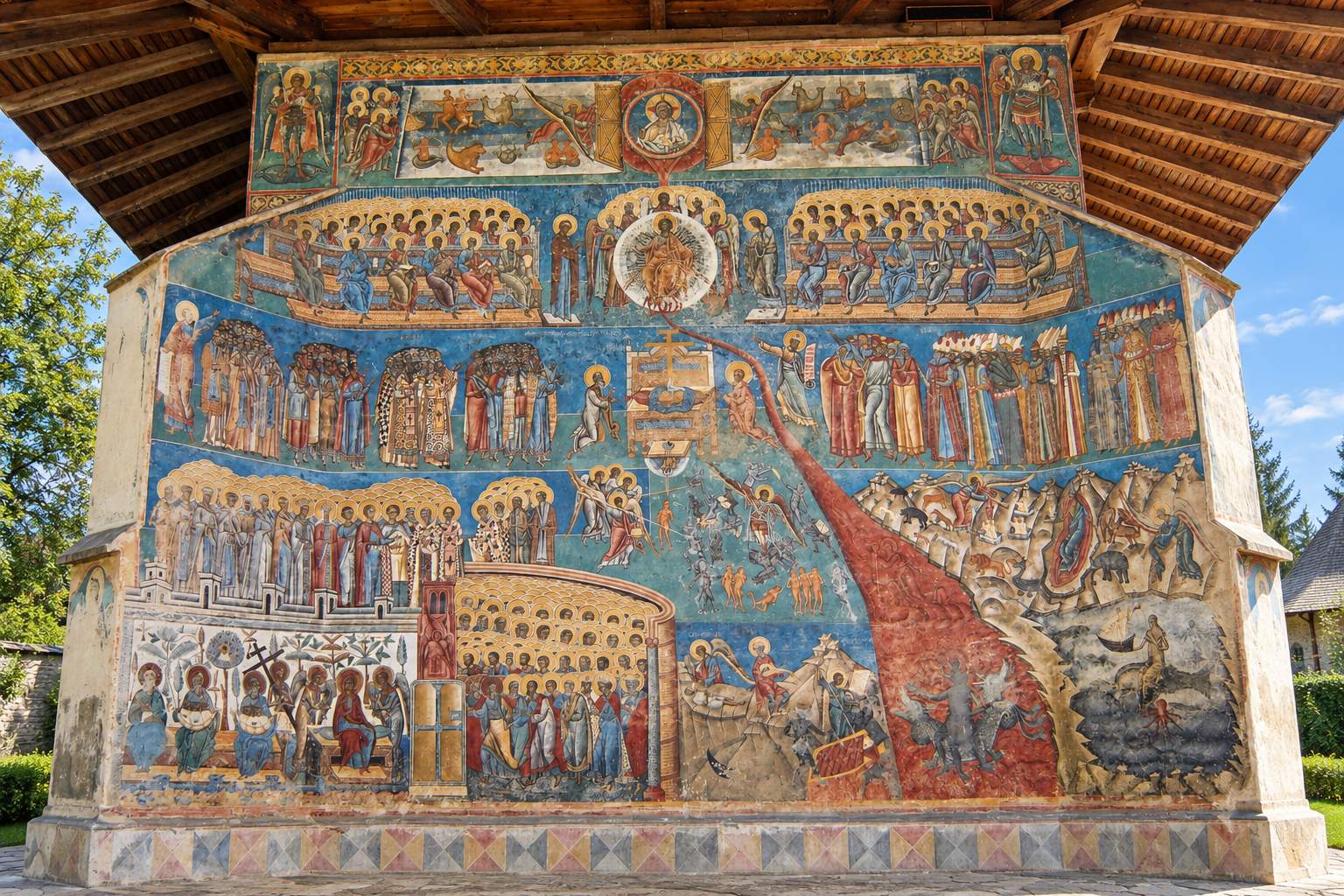
Last Judgment fresco on the exterior wall of Voroneț Monastery

Rather than taking one photograph and moving on, give yourself time to look at the arrangement of the scene: the groups of figures, their expressions and the way the painting fills the wall. Then walk around the church to compare the surviving decoration on different sides.

The familiar description “Voroneț blue” refers to its distinctive colouring. You will encounter plenty of romantic stories about the pigment, but the visible artwork is interesting enough without treating every legend as established fact. Romania Tourism’s Voroneț overview introduces the monastery and its frescoes.

Planning tip: combine Voroneț with Humor rather than immediately driving to the far side of the region. This gives you time for a closer visit and a lunch break.

Ask at the entrance whether guidance is available in a language you understand.

Humor Monastery: A Smaller Church Worth Looking at Closely

Humor Monastery makes a useful contrast to Voroneț. Its church is smaller, with reddish-brown tones in the frescoes and a different architectural profile, including the absence of a tall central steeple.

The present church dates from 1530, with frescoes from 1535. Its scale makes it a good place to slow down and examine individual sections rather than try to absorb an entire painted façade at once. Romania Tourism’s Humor description provides the historical background.

For visitors who are unsure whether they want two full days of monastery sightseeing, Voroneț and Humor offer a useful first-day combination. You can compare two distinct churches without committing to a long circuit.

Planning tip: search for “Humor Monastery” or “Mănăstirea Humorului” when arranging transport. Gura Humorului is your nearby base, not the monastery’s precise location.

Allow a separate transfer between the two monasteries. Their proximity to the same town does not make them adjacent attractions.

Moldovița Monastery: Look for the Siege of Constantinople

Moldovița Monastery stands in Vatra Moldoviței. Its church was built in 1532, and the exterior paintings were completed in 1537.

Two subjects are particularly useful to look for: the Siege of Constantinople and the Tree of Jesse, which represents Christ’s genealogy. The gold and deep-blue colouring provides another comparison with the churches near Gura Humorului. Romania Tourism’s Moldovița overview identifies these principal scenes.
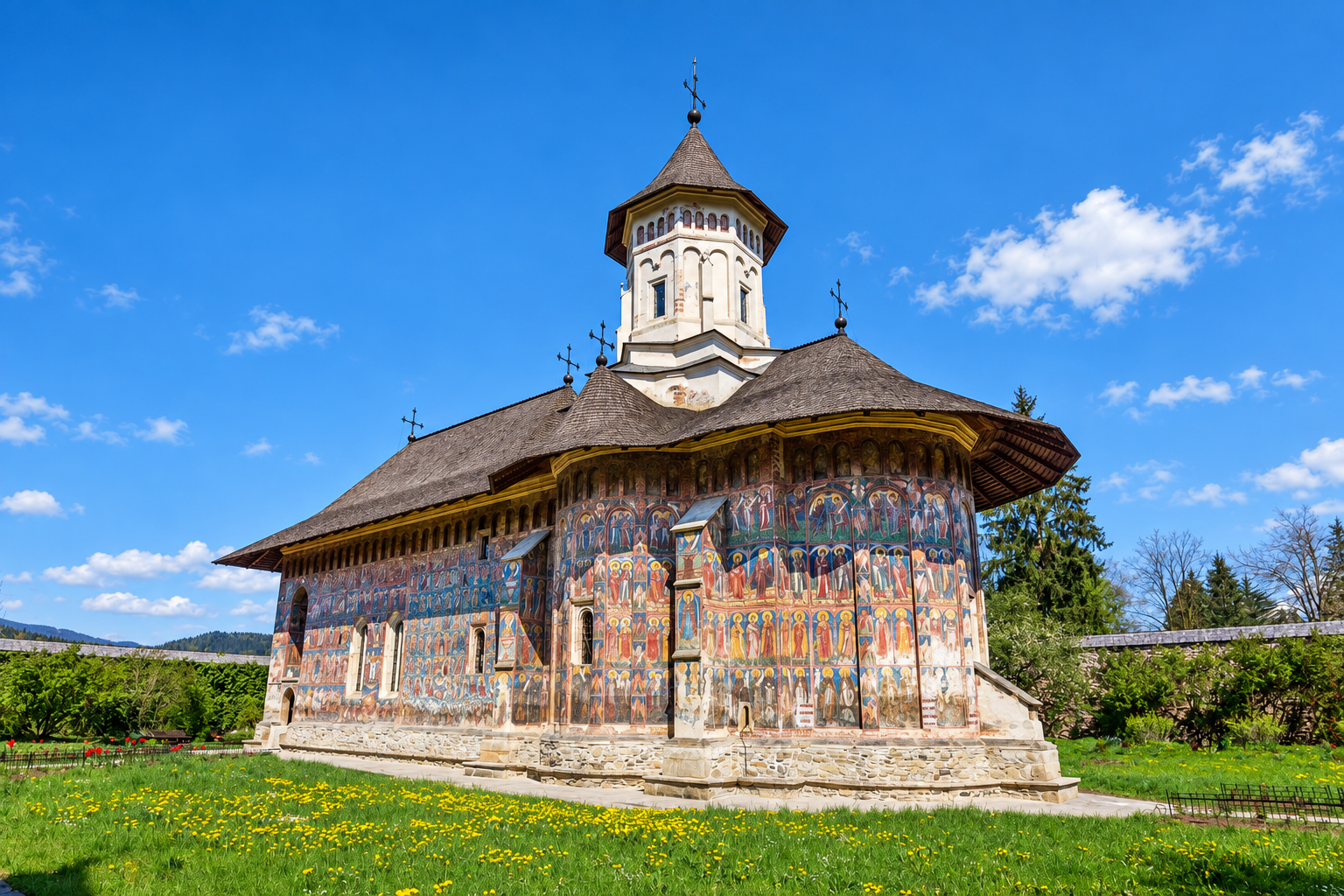
Painted exterior of the church at Moldovița Monastery in Vatra Moldoviței

Look at the compositions as storytelling rather than as a photographic record of a historical event. The paintings communicate religious meaning through their selection and arrangement of figures.

Planning tip: put Moldovița on the same sightseeing day as Sucevița if you have a car or a driver. Check the road route before departure and leave space for the journey itself.

Do not assume that a railway reference in an older travel guide means a convenient current passenger service reaches the monastery. Confirm the actual service for your date and plan the final transfer separately.

Sucevița Monastery: A Fortified Setting and the Ladder of Divine Ascent

Sucevița offers a different first impression: substantial enclosure walls and towers surround the church.

The key fresco to look for is the Ladder of Divine Ascent, also described as the Ladder to Paradise. Its ascending figures, angels and falling figures make it one of the most striking compositions to examine with a guide or a short explanation.
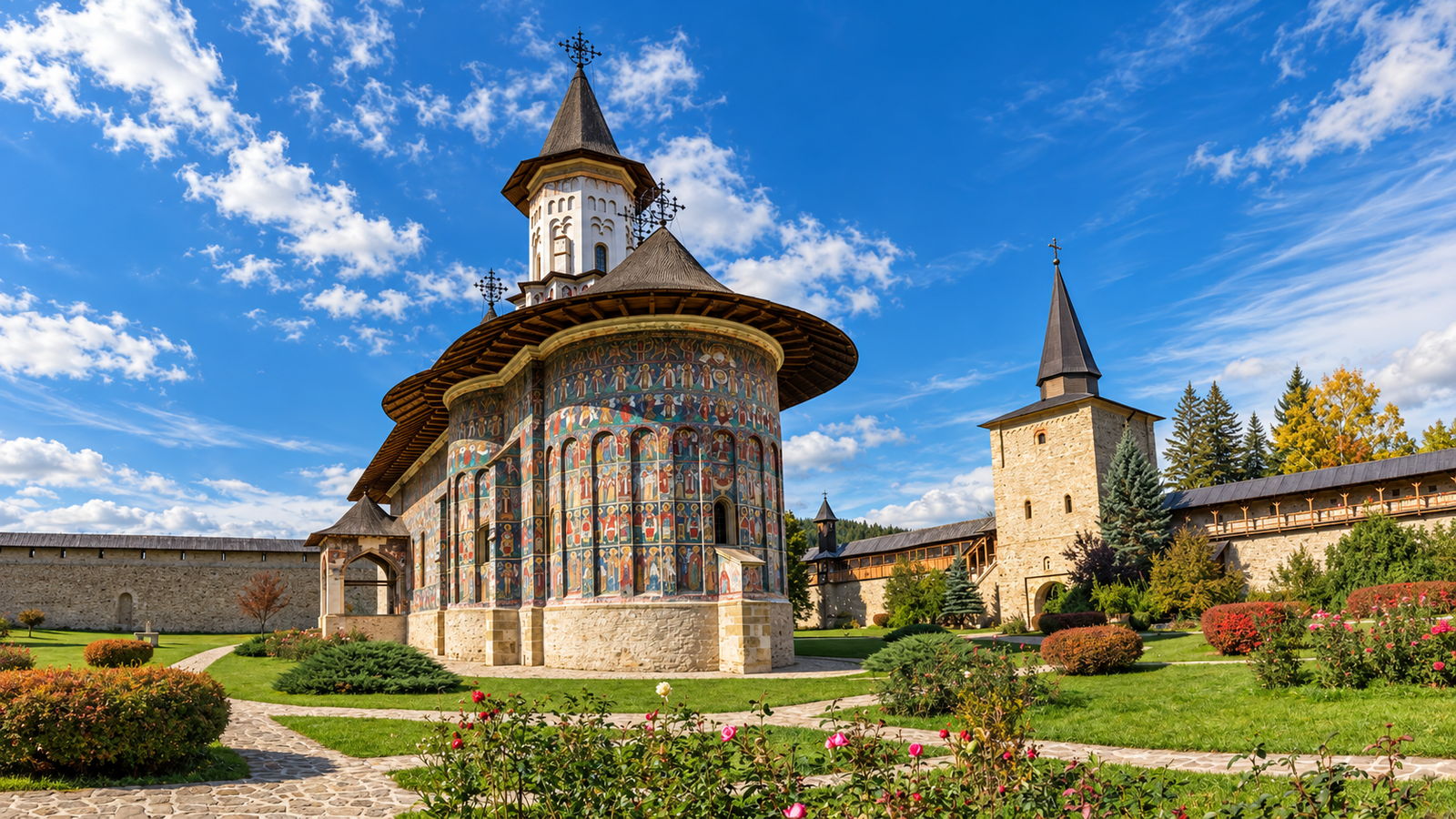
Church and defensive walls inside the Sucevița Monastery complex

The fortified setting also rewards a wider view. Step back to see how the church sits within the enclosure before moving closer to the paintings.

One important detail: the western exterior wall is not painted. It is inaccurate to describe every outside wall as completely covered with frescoes. Romania Tourism’s Sucevița guide describes both the artwork and the complex.

Planning tip: allow more time here if you want to include the museum and it is open. Check museum access separately from access to the monastery grounds.

Other Churches and Monasteries: What Is Worth Adding?

The four main stops are enough for a first visit. Add others because you have a specific interest or extra time, rather than because they appear on a checklist.

The Other UNESCO Churches

Alongside Voroneț, Humor, Moldovița and Sucevița, the UNESCO property includes churches at:

  • Arbore;

  • Pătrăuți;

  • Probota;

  • Suceava — the Church of St George at the Monastery of St John the New.

You can confirm the individual monuments in UNESCO’s component list and maps.

These are not four interchangeable stops to attach to the main circuit. Check their positions and access arrangements before expanding your itinerary. If a particular church is important to your trip, confirm that the areas you want to see will be accessible.

Putna: An Optional Visit with a Different Focus

Putna can be an additional stop for visitors interested in monastic history, religious heritage and the monastery’s collections.

However, it is not one of the eight churches in the UNESCO Churches of Moldavia listing. Do not add it expecting another version of Voroneț’s painted exterior.

Treat Putna as a separate extension, with its own travel time, rather than squeezing it into a day already covering Moldovița and Sucevița. The official Putna website provides information about the monastery, its museum and religious activities.

Painted Monasteries of Bucovina: A One-Day Itinerary

For a first visit, our recommended one-day plan is deliberately limited to Voroneț and Humor, with Gura Humorului as the starting point.

Morning: Voroneț

Begin with Voroneț and allow time to study the Last Judgment and other exterior paintings. If guidance is available, consider using it here to build an understanding that will help at later stops.

Avoid scheduling the next departure so tightly that you have to leave halfway through an explanation.

Midday: Lunch and Transfer

Return towards Gura Humorului for lunch or choose a suitable stop along your route.

This break also gives you flexibility if your first visit overlaps with a service or takes longer than expected. For ideas on what to order, see our guide to traditional Romanian food.

Afternoon: Humor

Visit Humor and compare its smaller scale, roofline and colour palette with Voroneț.

Afterwards, keep the remainder of the day flexible. A relaxed afternoon is preferable to adding a distant monastery simply to increase the number of stops.

Can You Visit All Four in One Day?

A four-monastery circuit is a more intensive option with private transport, suitable opening arrangements and an early start. It is not the default itinerary we recommend.

You would need to account for driving, parking, meals, services and time inside each site. In shorter daylight or poor road conditions, the compromise becomes less attractive.

If all four matter to you, two days give each visit more room.

A Two-Day Itinerary for the Four Main Monasteries

This itinerary assumes two sightseeing days in the region, not two days including a long arrival journey from elsewhere in Romania.
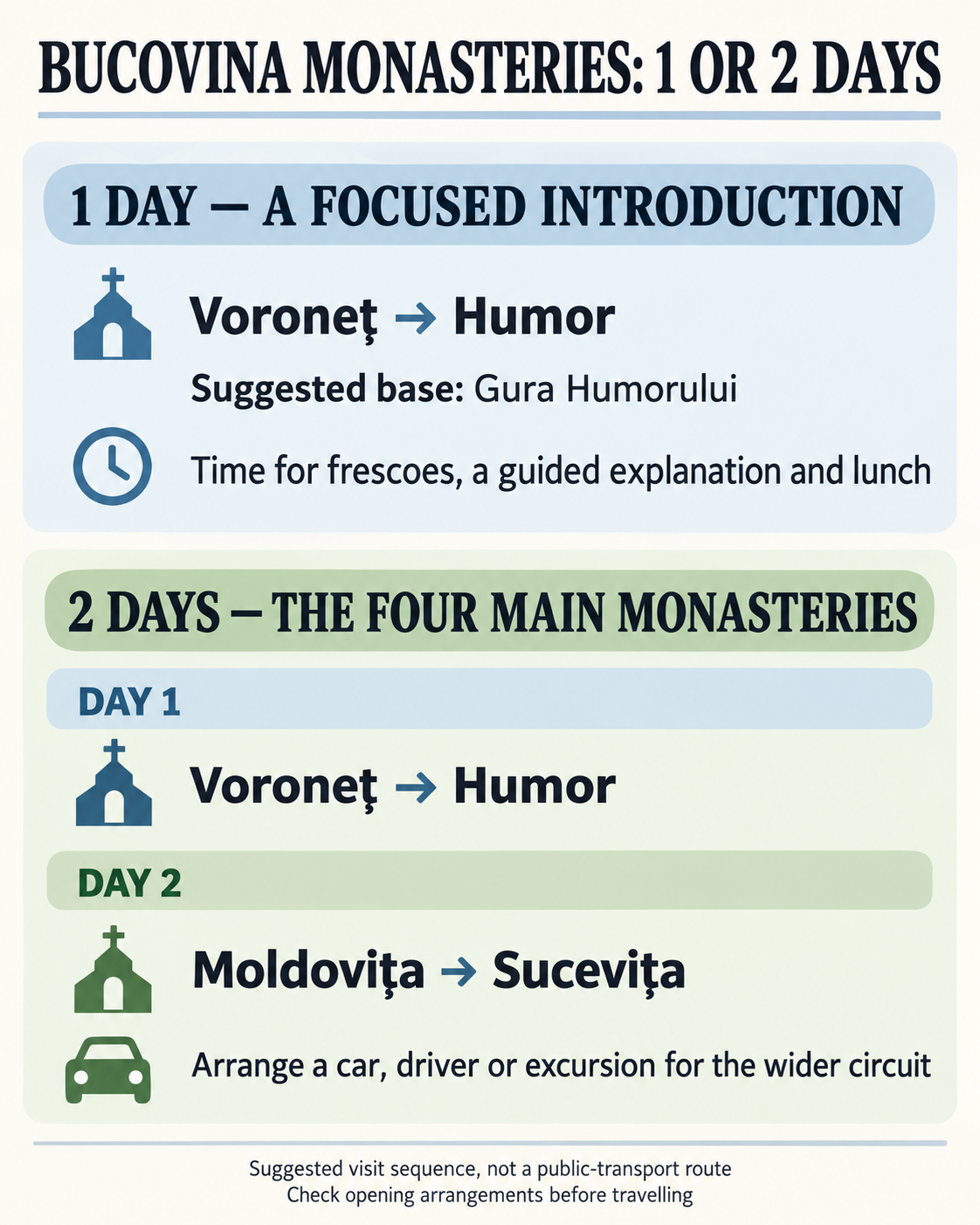
One- and two-day itineraries for visiting the painted monasteries of Bucovina

Day Main visits Suggested approach
Day 1
Voroneț and Humor
Stay near Gura Humorului and leave time for a guided explanation and lunch
Day 2
Moldovița and Sucevița
Use a car, driver or organised excursion; check the road route and opening arrangements beforehand

Day 1: Voroneț and Humor

Follow the one-day plan above. This is the easier day to adapt around an arrival, although a late arrival may leave time for only one monastery.

Stay a second night if you want the following day to remain focused on sightseeing rather than a long onward journey.

Day 2: Moldovița and Sucevița

From Gura Humorului, visit Moldovița before continuing to Sucevița, subject to current road conditions and access hours. Arrange the return journey before you leave your accommodation.

Keep lunch and short breaks in the schedule. Do not treat the transfer between monasteries as empty time that can always be compressed.

If you are starting in Suceava, ask your driver or guide to arrange the order around your pickup point and the day’s visiting conditions. There is no need to copy the same sequence regardless of where you are staying.

The two-day plan is a suggested grouping, not a timed tour. Confirm the journey times for your actual accommodation and travel date.

Where to Stay: Gura Humorului or Suceava?

Choose your base according to how you will arrive and how you plan to visit the monasteries.

Base Best suited to Main consideration
Gura Humorului
A monastery-focused stay, especially Voroneț and Humor
You still need transport for the wider circuit
Suceava
Arrival by rail or air, city facilities and arranged excursions
Allow for transfers out to the monastery region
A village guesthouse near a monastery
Travellers with a car who prefer a rural stay
Check access, evening meals and driving distances before booking

Choose Gura Humorului for a Monastery-Focused Stay

Gura Humorului is our preferred starting point for the two-day plan above. It keeps the first pair of visits relatively close and lets you separate them from the longer second-day excursion.

Check the exact accommodation address. A property advertised as being “near Gura Humorului” may be outside the town, which matters if you are relying on taxis or arriving without a car.

Choose Suceava for Arrival Connections

Suceava has a railway gateway and a nearby airport, making it a practical option when your journey into the region determines where you need to stay. Suceava visitor information outlines the city and its transport connections.

If you book an excursion, confirm whether pickup is available from your accommodation. A tour advertised as departing from Suceava should not automatically be assumed to collect passengers in Gura Humorului.

How to Reach and Travel Between the Monasteries

The important distinction is between getting to the region and getting between the churches. A train to a nearby town does not solve every part of the monastery circuit.

By Train

Use the Infofer journey planner to check connections for your travel date. Search the relevant arrival stations around Suceava or Gura Humorului and confirm where your train actually stops.

Then arrange the final journey to your accommodation and monastery visits.

Avoid copying train times from an old blog post. Timetables, connections and journey lengths depend on the date and service.

By Car

A car gives you flexibility over visit length and makes the two-day grouping easier to manage.

Before leaving:

  • save the exact monastery locations;

  • check the road route, weather and expected journey times;

  • leave room for village traffic, parking and breaks;

  • plan the return journey as carefully as the outward one.

Use a live navigation service for driving estimates. Distances on a regional map do not tell you how quickly you can travel between sites.

With a Guide or Driver

An arranged excursion is useful if you want to see several monasteries without driving. A knowledgeable guide can also explain the paintings rather than simply provide transport.

Before booking, ask:

  • Which monasteries are included?

  • How much time is allowed at each?

  • Are admission and photography fees included?

  • Is guiding inside the sites included, and in which language?

  • Where does pickup take place?

  • What happens if a church or museum cannot be visited?

Compare the actual itinerary rather than choosing solely by the number of monasteries advertised.

By Local Bus or Minibus

Public transport requires more preparation. Check the exact village, stop location, operating day and return departure directly with the operator.

Do not assume that separate services to two villages form a workable connection between monasteries. A route may require backtracking through a town or a substantial wait.

For a first visit without a car, we recommend either a limited plan around Gura Humorului with confirmed transfers, or an organised excursion for the wider circuit.

Tickets, Opening Hours and Photography

Admission arrangements are set locally. Do not assume that a price, concession or photography rule at one monastery applies to the next.

Verified Example: Voroneț

The official Voroneț visitor page lists the following charges, checked in October 2026:

Item Published charge
Adult admission
10 RON
Children, school pupils and students
5 RON
Non-professional exterior photography or filming
10 RON

The monastery states that admission includes the church exterior and interior. Guidance can be requested at the entrance without an additional fee, but is not provided during religious services. Ask about language and availability.

Photography and recording are permitted only outside the church and require the monastery community’s permission. Professional work requires a separate agreement.

These are Voroneț’s published conditions, not a regional price list. Recheck before travelling.

What to Confirm at the Other Monasteries

For Humor, Moldovița and Sucevița, confirm:

  • current admission charges and concessions;

  • whether the museum has separate hours or admission;

  • photography restrictions and any additional fee;

  • access during services;

  • any restoration work affecting the visit.

Keep some Romanian lei in cash rather than relying entirely on card payment.

For your total budget, separate admission from transport, parking, lunch and optional guiding. If hiring a driver, obtain a quote for the complete route, including waiting time and return travel.

Dress, Etiquette and Accessibility

These are religious sites as well as cultural attractions. Plan your visit around that shared use.

A conservative choice is clothing that covers shoulders and knees. Follow any additional instructions displayed at the entrance, and carry an extra layer if you are unsure.

Keep voices low, silence your phone during services and stay within areas open to visitors. Ask before photographing people, particularly worshippers and members of the monastic community.

Do not touch frescoes or lean against painted walls.

If you have mobility requirements, contact each site before travelling. Ask specifically about the route from parking to the church, thresholds, steps, surfaces, seating and toilets. General descriptions such as “accessible grounds” may not cover the interior or museum.

Best Time to Visit the Painted Monasteries

For a first visit focused on exterior frescoes and driving between sites, late spring and early autumn are sensible planning choices. Allow for changeable weather rather than expecting every day to be dry.

Summer offers longer daylight, which helps with a wider circuit, but leave flexibility around visitor groups and religious events.

Winter can suit a slower stay, but shorter daylight and possible snow or ice make ambitious multi-stop days less appealing. Check conditions before committing to the longer drive between monasteries.

Orthodox Easter and other major religious dates can be meaningful times to visit, but worship takes priority over sightseeing. Confirm arrangements if your trip depends on seeing interiors or joining a guided visit.

For a broader seasonal comparison, read our guide to the best time to visit Romania.

Frequently Asked Questions

Which painted monastery should I choose if I can visit only one?

Voroneț is our recommendation for a first visit because its blue frescoes and Last Judgment provide a clear introduction to the region’s painted churches. If you are staying closer to another monastery, consider the travel time before making a long detour.

Is one day enough for the painted monasteries of Bucovina?

One day works well for a focused introduction, particularly Voroneț and Humor. Two sightseeing days are a more comfortable choice for adding Moldovița and Sucevița.

Can I visit without a car?

Yes, but plan the local transfers as well as your arrival in the region. A guided excursion or prearranged driver simplifies a multi-monastery visit. Public transport needs date-specific checking, especially for the return journey.

Are Bucovina and Bukovina the same place?

They are alternative spellings used for the historical region. This guide covers monastery visits in its Romanian part.

Is Putna one of the UNESCO painted churches?

No. Putna is not one of the eight churches in the Churches of Moldavia World Heritage property. It can be a separate addition for visitors interested in the region’s religious history.

Can I photograph the frescoes?

Ask at each monastery. Exterior photography may require permission or a fee, and interior photography can be prohibited. Do not assume that paying an entrance charge includes photography rights.

Should I visit all eight UNESCO churches?

Only if that is a particular interest and you have allowed enough time. For a first trip, the four main monasteries in this guide offer a useful introduction without turning the visit into a checklist.

Planning Your Visit

Start by deciding how much time you want to spend looking at the paintings, not how many monasteries you can fit into a day.

For a short stay, choose Voroneț and Humor. For a fuller introduction, spend two days visiting those churches plus Moldovița and Sucevița. Arrange transport before you arrive, confirm access to the places that matter most to you, and leave enough flexibility to stay longer when a particular fresco catches your attention.

Leave a Comment

Your email address will not be published. Required fields are marked *