
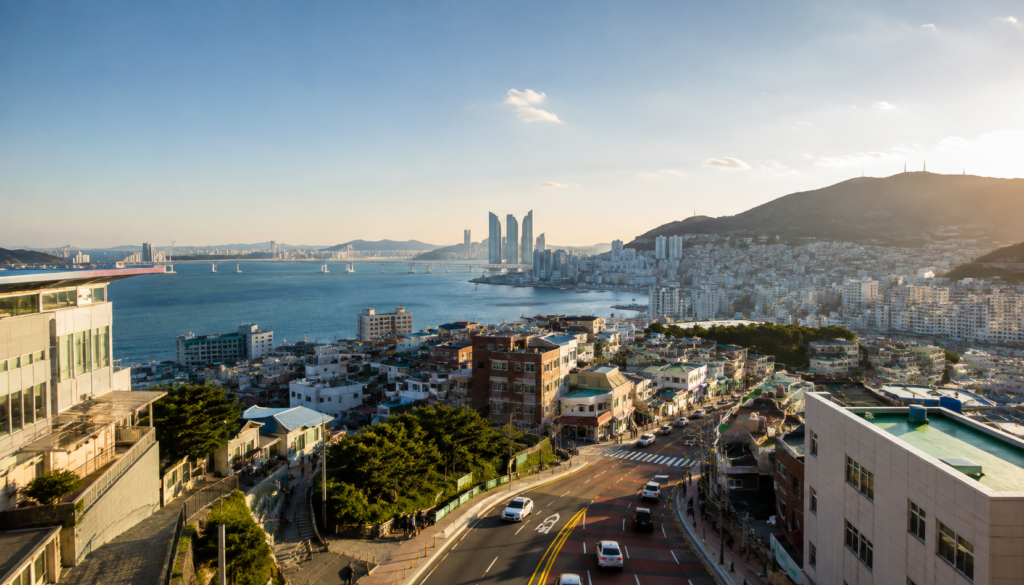
Coastal cityscape of Busan at the end of a journey from Seoul

Seoul to Busan: How to Travel by KTX, Bus, Flight or Car

Travelling from Seoul to Busan is one of the most common long-distance journeys in South Korea. The two cities are separated by roughly 325 kilometres in a straight line, while rail and road routes cover approximately 400 kilometres.

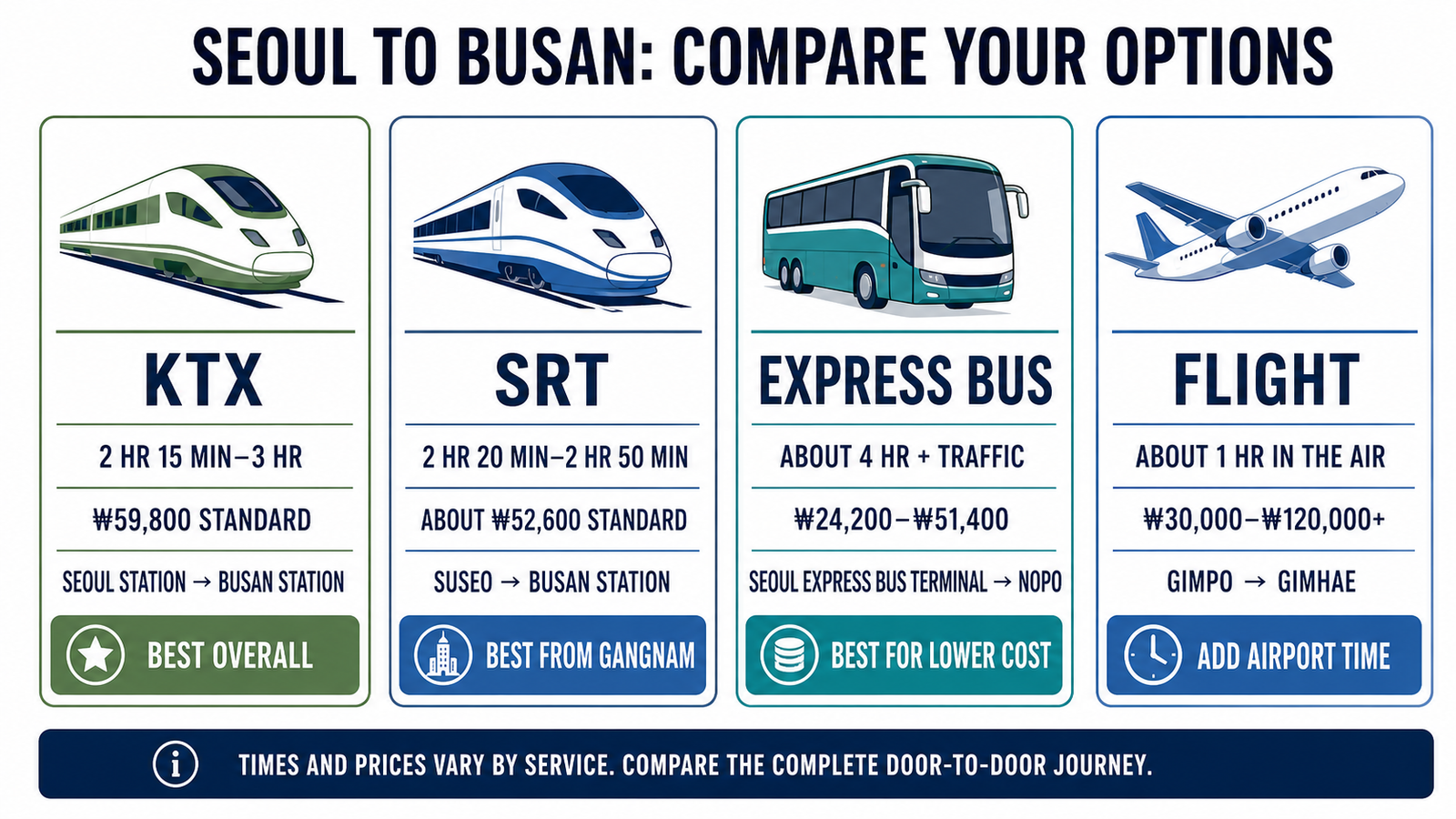
For most visitors, the best way to travel from Seoul to Busan is the KTX high-speed train. It connects Seoul Station directly with Busan Station in approximately 2 hours 15 minutes to 3 hours, avoids airport procedures and arrives close to central Busan.

The fastest option is not automatically the best for everyone, however. SRT can be more convenient from Gangnam, an express bus costs less, and a flight may make sense when connecting through Gimpo Airport. This guide compares the complete journey rather than only the time spent on board.

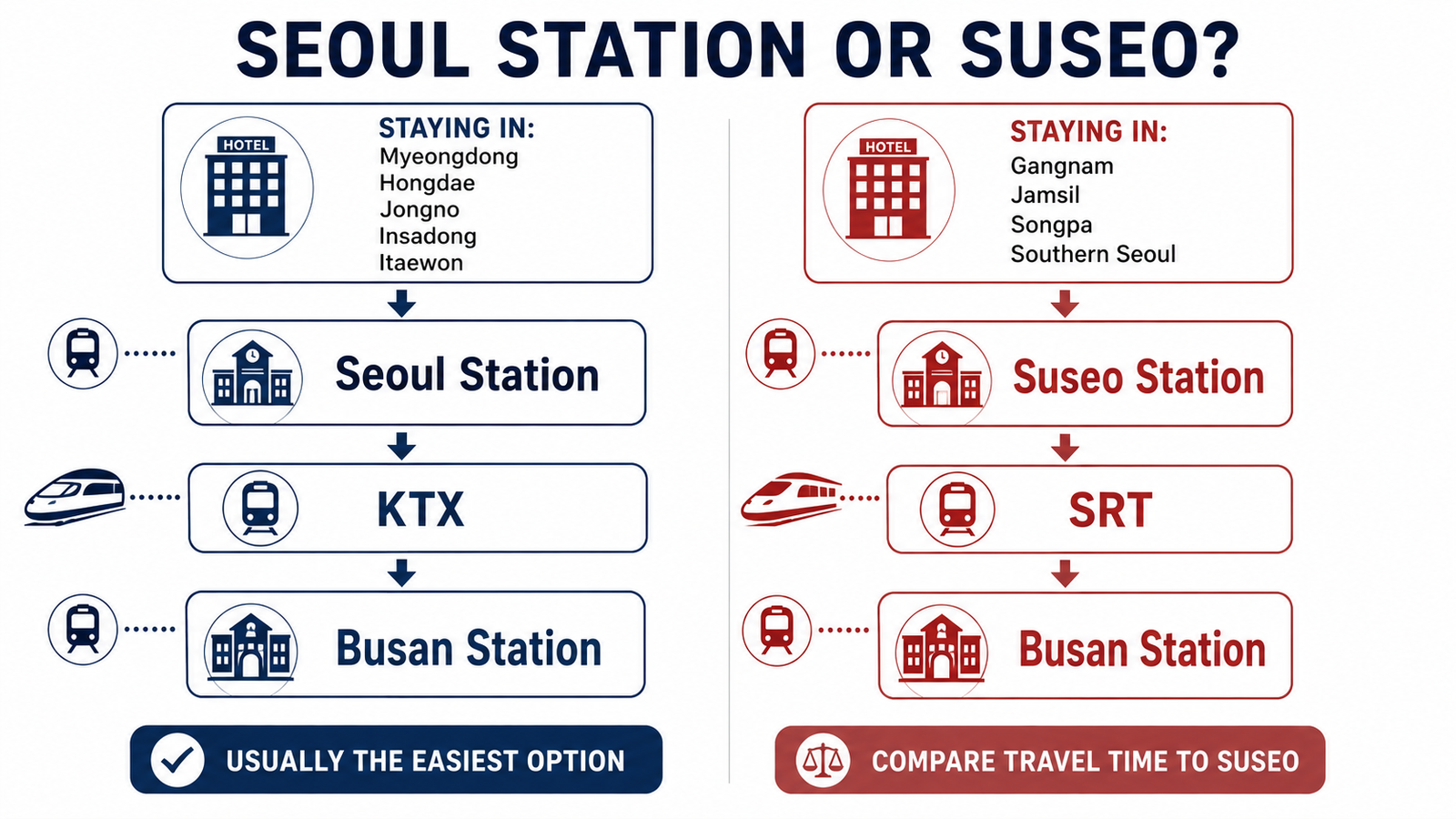
Quick answer: Take the KTX from Seoul Station if you are staying in Myeongdong, Hongdae, Jongno or central Seoul. Consider the SRT from Suseo if you are staying around Gangnam or Jamsil. Choose the express bus mainly to save money, and fly only when your wider itinerary already brings you close to Gimpo Airport.

Prices and schedules in this guide were checked in August 2026. Always confirm your exact departure on the operator’s website before paying.

Seoul to Busan Transport Options Compared

Option Departure and arrival Time on board Typical one-way cost Realistic door-to-door time Best for
KTX
Seoul Station → Busan Station
2 hr 15 min–3 hr
₩59,800 Standard; up to ₩83,700 First Class
3–4 hr
Most first-time visitors
SRT
Suseo Station → Busan Station
About 2 hr 20 min–2 hr 50 min
About ₩52,600 Standard; approximately ₩76,000 Special Class
3–4¼ hr
Gangnam and Jamsil
Express bus
Seoul Express Bus Terminal → Busan Central Bus Terminal
About 4 hr without major delays
₩24,200–₩51,400
5½–7 hr
Travellers prioritising price
Flight
Gimpo Airport → Gimhae Airport
About 1 hr
Commonly ₩30,000–₩120,000+ before extras
3½–5½ hr
Airport connections or exceptional fares
Rental car
Seoul → Busan
Approximately 4½–6+ hr
About ₩80,000–₩150,000 in fuel and tolls, before rental fees
5–7+ hr
Multi-stop road trips

Comparison of KTX, SRT, express bus and flight from Seoul to Busan 

The train and flight prices are not directly comparable. A flight fare may exclude checked luggage, while reaching Gimpo Airport and travelling from Gimhae Airport add time and expense. KTX takes you from one central railway station to another without check-in or baggage collection.

For a wider estimate covering accommodation, meals, local transport and intercity journeys, use our South Korea trip cost guide.

KTX from Seoul to Busan: The Best Choice for Most Travellers

The Seoul to Busan KTX runs along the Gyeongbu high-speed corridor. Most services depart from Seoul Station and terminate at Busan Station.

The fastest trains complete the journey in a little over 2 hours 15 minutes. Other services make more intermediate stops and can take closer to three hours. Stops may include Gwangmyeong, Cheonan-Asan, Osong, Daejeon, Gimcheon-Gumi, Dongdaegu, Gyeongju and Ulsan, but the exact pattern varies.

This is why two KTX trains with the same departure and arrival stations may have different journey times. Check the duration shown beside the individual service rather than assuming every train is equally fast.

KTX ticket prices from Seoul to Busan

The usual adult fare for a direct KTX using the high-speed route is:
Class Typical adult one-way fare
Standard Class
₩59,800
First Class
₩83,700

Some slower KTX departures can be priced differently because they use a different combination of conventional and high-speed tracks. Promotional discounts may also appear on selected services.

Treat ₩59,800 as the normal planning figure for Standard Class rather than expecting a last-minute discount.

Is KTX First Class worth paying for?

Standard Class is adequate for the journey and will be the sensible choice for most travellers. Seats are reserved, the carriage is air-conditioned and the trip is short enough that the additional space is not essential.

First Class can be worthwhile when:

  • you want a quieter carriage;
  • you prefer wider seats and more personal space;
  • you need to work during the journey;
  • Standard Class is unavailable on your preferred train;
  • comfort matters more than the approximately ₩24,000 fare difference.

Paying for First Class does not make the train faster.

Seoul Station or Suseo: Which Station Should You Use?

The most useful distinction is not simply KTX versus SRT. It is the location of your accommodation relative to Seoul Station and Suseo Station.

If you have not chosen a base yet, compare neighbourhoods and station access in our guide to where to stay in Seoul.

Choose Seoul Station and KTX if you stay in:

  • Myeongdong;
  • Hongdae;
  • Jongno;
  • Insadong;
  • Itaewon;
  • central or western Seoul.

Seoul Station is served by subway Lines 1 and 4, the Airport Railroad and the Gyeongui-Jungang Line. It is therefore particularly convenient for travellers arriving from Hongdae or central Seoul.

Choose Suseo Station and SRT if you stay in:

  • Gangnam;
  • Jamsil;
  • Songpa;
  • southern Seoul;
  • accommodation close to Subway Line 3 or the Suin-Bundang Line.

SRT trains do not leave from Seoul Station. They depart from Suseo, southeast of the city centre, and use the same high-speed corridor toward Busan after joining the main route.

If reaching Seoul Station takes an hour but Suseo is only 20 minutes away, SRT can produce the shorter complete journey even when its train time is similar.

Starting area Usually more convenient
Myeongdong or Jongno
KTX from Seoul Station
Hongdae
KTX from Seoul Station
Itaewon
Usually KTX from Seoul Station
Gangnam
Compare SRT from Suseo with KTX
Jamsil
Usually SRT from Suseo
Incheon Airport
AREX to Seoul Station, then KTX

Choosing Seoul Station for KTX or Suseo Station for SRT to Busan

Check SRT departures and current fares through the official multilingual SRT booking website.

How to Buy Seoul to Busan KTX Tickets

The safest first choice is the official KORAIL reservation website or the KorailTalk application.

Enter:

  • departure: Seoul;
  • arrival: Busan;
  • travel date;
  • approximate departure time;
  • number and age of passengers;
  • direct journey;
  • KTX/KTX-Sancheon if you want only high-speed services.

Do not accidentally select a similarly named station such as Bujeon, Gupo or Shinhaeundae unless it genuinely suits your journey.

KORAIL normally opens reservations at 07:00 one month before departure. The website allows passengers to choose a specific seat during online booking. KTX tickets can also be bought from station counters and ticket machines, but the desired departure may no longer have seats.

KORAIL has expanded multilingual booking and payment support for international visitors. Foreign-issued cards are also accepted at supported railway ticket machines and counters, although online payment compatibility can still depend on the card issuer. VISITKOREA’s current transportation guide summarises the available booking and payment options.

How early should you reserve?

Use the following practical rule:

Travel period Recommended booking time
Ordinary weekday
Several days ahead is generally sufficient
Friday evening or Sunday afternoon
1–2 weeks ahead
Cherry blossom and autumn foliage weekends
As soon as your itinerary is fixed
Seollal or Chuseok
Book when the special holiday reservation period opens
Major event or festival in Busan
As early as sales permit

Holiday tickets may follow a special sales schedule instead of the normal one-month booking process. Check KORAIL announcements if your date is close to a national holiday.

Our South Korea festival guide can help identify periods when intercity transport is likely to be busier.

Do you need to print the ticket?

A valid mobile or digital ticket is normally sufficient when purchased through an official supported channel. Keep the ticket available on your phone, including the train number, carriage and seat.

There are no airport-style boarding gates. Find the platform on the departure board and board the correct carriage. Staff may check tickets during the journey.

Luggage on the Seoul to Busan Train

KTX does not use an airline-style checked-baggage system. You carry your belongings onto the train yourself.

Smaller bags fit on the rack above the seats. Larger suitcases can be placed in the luggage areas near the ends of the carriage where available.

Practical advice:

  • arrive 15–25 minutes before departure when carrying a large suitcase;
  • board promptly because large luggage spaces are limited;
  • keep passports, money and electronics at your seat;
  • do not block the aisle or carriage doors;
  • check that you are entering the carriage printed on your ticket.

There is no reason to arrive an hour early for security screening, but reaching the station only a few minutes before departure creates unnecessary risk. Korean high-speed trains depart punctually, and doors can close shortly before the listed time.

Is SRT Better Than KTX from Seoul to Busan?

SRT is a genuine alternative, not a slower regional train. It uses high-speed trains between Suseo and Busan, with a journey time broadly comparable to KTX.

Its main advantage is location. Suseo is much more convenient than Seoul Station for some parts of southern Seoul.

Its disadvantages are:

  • SRT tickets use a separate reservation system;
  • Suseo may be inconvenient from Hongdae or Myeongdong;
  • SRT is excluded from the standard KORAIL Pass;
  • payment behaviour for foreign cards can vary between the website, application and station facilities.

Use SRT because Suseo is convenient—not simply because its base fare is several thousand won lower. A long taxi or cross-city subway journey can eliminate the saving.

Seoul to Busan by Express Bus

Direct buses depart from the Gyeongbu section of Seoul Express Bus Terminal and arrive at Busan Central Bus Terminal, also known as Nopo Terminal.

The scheduled ride is approximately four hours, normally including a rest stop. Traffic leaving Seoul, approaching Busan or building up around holiday periods can extend the trip substantially.

Recent listed adult fares for this route ranged from approximately:

Bus class Approximate one-way fare
Standard
₩24,200
Excellent/Luxury
₩36,000
Premium
₩39,800
Late-night services
₩39,600–₩51,400

Schedules and classes vary by day, so use these figures for budgeting rather than as a guaranteed quotation.

The official tourism guidance explains that long-distance buses can be purchased from terminal counters and machines or through supported booking platforms. Check current procedures in the VISITKOREA express and intercity bus guide.

The hidden disadvantage: arriving at Nopo

Busan Central Bus Terminal is connected to Nopo Station on Busan Metro Line 1. It is located in northern Busan, not beside the main tourist waterfront.

After arriving, allow approximately:

  • 30–40 minutes to Seomyeon;
  • 45–60 minutes to Nampo;
  • 55–75 minutes to Haeundae.

Actual times depend on transfers and waiting. This extra urban journey is the main reason the bus is less convenient than its four-hour scheduled duration suggests.

The bus is worthwhile when saving approximately ₩20,000–₩35,000 matters more than travel time, or when its departure location is significantly more convenient than Seoul Station.

Should You Fly from Seoul to Busan?

Direct domestic flights normally connect Gimpo International Airport with Gimhae International Airport. The flight itself takes approximately one hour, but this figure does not represent the complete journey.

You must also account for:

  1. travel from your Seoul accommodation to Gimpo Airport;
  2. check-in and baggage drop;
  3. security screening;
  4. boarding;
  5. baggage collection in Busan;
  6. travel from Gimhae Airport to your accommodation.

A realistic centre-to-centre journey frequently takes 3½–5½ hours. That means flying can require more total time than KTX despite spending less time in the air.

Airfares change dynamically. One-way fares may appear from approximately ₩30,000 during quieter periods but can exceed ₩120,000 on busy dates, before checked baggage and airport transfers.

Flying makes the most sense when:

  • you are already at or near Gimpo Airport;
  • a particularly low fare includes the luggage you need;
  • KTX departures are sold out;
  • your Busan accommodation is closer to Gimhae Airport than Busan Station;
  • the flight is part of a larger air itinerary.

For a straightforward trip from central Seoul to central Busan, KTX is normally simpler.

Important: Search for flights from Gimpo Airport, not only Incheon Airport. Ordinary Seoul–Busan domestic services primarily use Gimpo. Do not assume you can arrive at Incheon and board a regular domestic flight to Busan without checking the exact ticket conditions.

Driving from Seoul to Busan

The driving distance from Seoul to Busan is roughly 400 kilometres, depending on the starting point, destination and selected motorway. The historic Gyeongbu Expressway corridor itself extends for approximately 416 kilometres.

Without serious congestion, the journey commonly takes 4½–6 hours. Weekend and holiday traffic can make it considerably longer.

A reasonable one-way budget is:

Driving expense Approximate amount
Fuel
₩55,000–₩80,000
Motorway tolls
Approximately ₩20,000–₩30,000
Rental car
Commonly ₩60,000–₩150,000+ per day
Parking and possible one-way fee
Additional, provider-dependent

Therefore, driving is rarely economical for one or two people travelling directly between the cities. It becomes more reasonable for a group or a route with stops in places such as Daejeon, Daegu or Gyeongju.

Check current motorway tolls through the Korea Expressway Corporation, and confirm one-way rental charges before reserving a car.

For driving licence requirements and broader information about trains, buses and rental cars, see our guide to getting around South Korea.

What Is the Cheapest Way from Seoul to Busan?

A standard express bus is normally the cheapest direct option, with fares around ₩24,200 when that class is available.

However, the cheapest ticket does not necessarily produce the cheapest complete journey. Consider:

  • transport to the departure terminal;
  • transport from Nopo to your Busan accommodation;
  • food during the longer journey;
  • potential taxi costs after a late arrival;
  • the value of losing two or three additional hours.

KTX Standard Class costs ₩59,800, approximately ₩35,600 more than the cheapest bus. In return, it saves several hours and arrives at a more convenient station for Nampo, Seomyeon and many central areas.

Travellers on a strict budget should compare the bus. Travellers with limited time will generally receive better overall value from KTX.
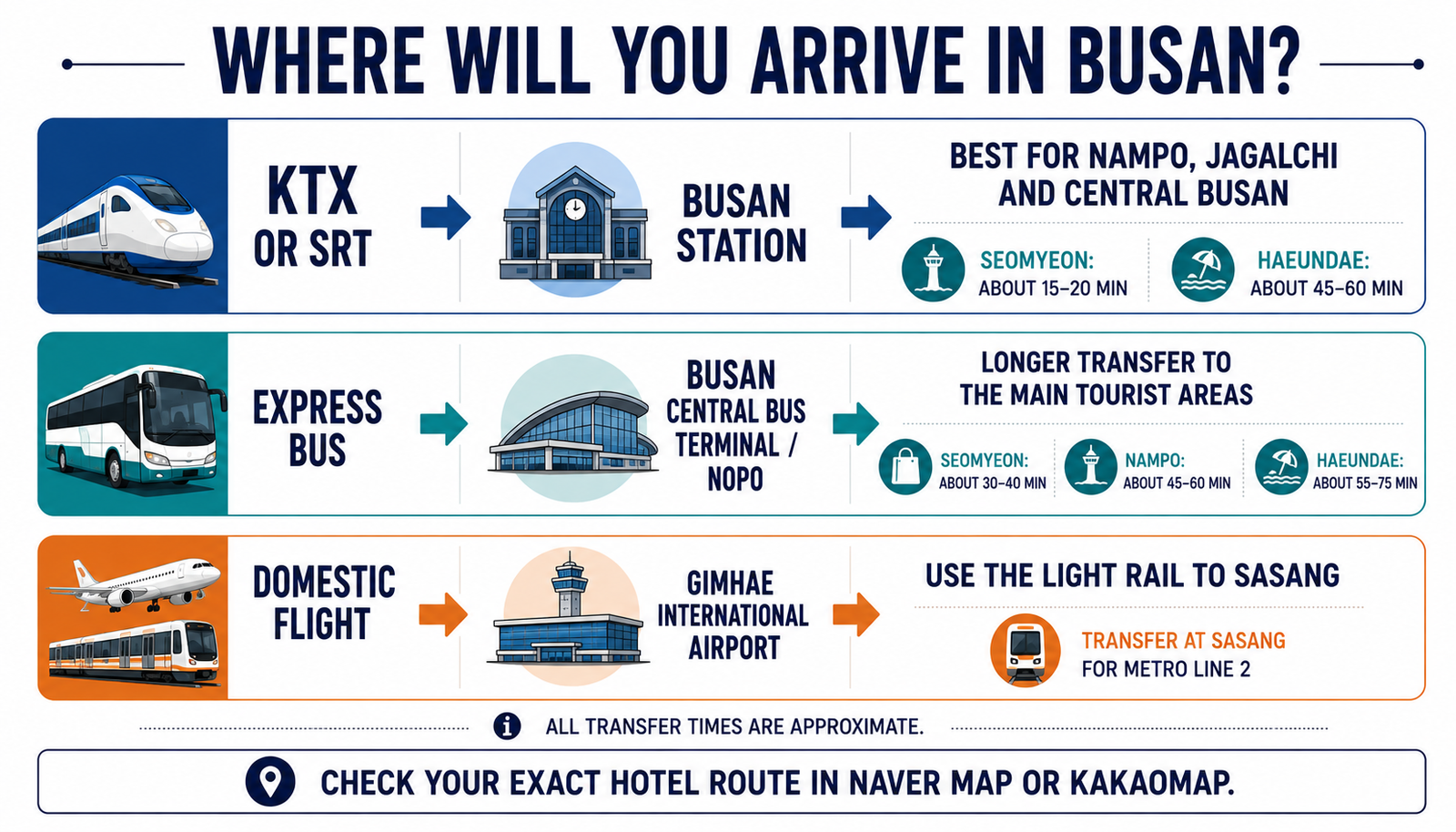
Busan arrival points for KTX, express bus and flights from Seoul

Arriving in Busan: Which Option Is Closest to Your Hotel?

Your arrival point can matter almost as much as the intercity journey.

Busan Station

KTX and SRT arrive at Busan Station, connected to Metro Line 1.

Approximate public-transport times:

  • Nampo: about 5–10 minutes;
  • Seomyeon: about 15–20 minutes;
  • Haeundae: approximately 45–60 minutes;
  • Gwangalli: approximately 35–50 minutes.

Busan Station is particularly convenient for Nampo, Jagalchi, Busan Port and the older central districts.

Busan Central Bus Terminal

Express buses arrive at Nopo, at the northern end of Metro Line 1.

Nopo works reasonably well for travellers continuing north or visiting places near the northern part of the city. It is less convenient for Nampo, Haeundae and the main coastal attractions.

Gimhae International Airport

The Busan–Gimhae Light Rail connects the airport with Sasang, where passengers can transfer to Metro Line 2.

The airport can be convenient for western Busan and Sasang. Reaching Seomyeon or Haeundae requires additional travel and at least one transfer.

Use Naver Map or KakaoMap to calculate the route from your arrival station to the exact accommodation rather than comparing only city names.

Can You Visit Busan as a Day Trip from Seoul?

A Seoul to Busan day trip is technically possible. An early KTX can reach Busan in the morning, and a late service can return to Seoul at night.

It is not the best way to experience the city.

Even with fast trains, the return journey uses approximately five to six hours. Busan is geographically spread out, and travelling between Busan Station, Haeundae, Gwangalli and other districts takes additional time.

A day trip works best if you:

  • choose two nearby areas rather than crossing the entire city;
  • reserve both trains in advance;
  • travel without large luggage;
  • accept an early departure and late return.

For a first visit, two or three nights provide a much more practical balance. Our South Korea itinerary shows how Seoul and Busan can fit into a longer trip.

Recommended Option by Traveller Type

Traveller Best option Why
First visit to Korea
KTX
Easiest central-to-central journey
Staying near Myeongdong or Hongdae
KTX
Convenient access to Seoul Station
Staying in Gangnam or Jamsil
SRT
Suseo may save cross-city travel
Lowest possible budget
Standard express bus
Cheapest direct fare
Connecting near Gimpo Airport
Compare flight and KTX
Airport location may change the calculation
Family with several large suitcases
KTX or private car
Easier luggage management than airport procedures
Multi-stop regional road trip
Rental car
Flexibility can justify the cost
Seoul–Busan day trip
Fast direct KTX
Maximises time in Busan

Frequently Asked Questions

What is the best way to get from Seoul to Busan?

KTX is the best option for most travellers. It takes approximately 2 hours 15 minutes to 3 hours from Seoul Station to Busan Station and avoids airport procedures and road congestion.

How much is the KTX from Seoul to Busan?

The normal adult Standard Class fare is approximately ₩59,800 for a direct high-speed service. First Class commonly costs ₩83,700. Confirm the displayed fare before payment because the route and available discounts can affect the price.

How long does the KTX from Seoul to Busan take?

Most direct KTX journeys take between approximately 2 hours 15 minutes and 3 hours. Trains making fewer intermediate stops are faster.

How far is Seoul from Busan?

The straight-line distance is approximately 325 kilometres. Road and railway routes are closer to 400 kilometres, depending on the exact route and starting point.

Should I book the Seoul to Busan train in advance?

Yes, particularly for Friday evenings, Sunday afternoons, festivals, autumn foliage weekends and national holidays. On an ordinary weekday, tickets may remain available closer to departure, but advance booking protects your preferred time and seat.

Does KTX depart from Incheon Airport?

Ordinary Seoul–Busan planning should not assume a direct KTX departure from Incheon Airport. The straightforward route is usually AREX from Incheon Airport to Seoul Station, followed by KTX to Busan.

Can I use a T-money card to ride KTX?

No. KTX requires a separate reserved train ticket. T-money can be used for eligible local transport before and after the intercity journey, but it does not replace the KTX ticket.

Is the KORAIL Pass worth it for Seoul to Busan?

Usually not for only one one-way journey. Compare the pass price with individual tickets if you plan a return trip plus additional long-distance KTX journeys. Seat reservations are still required, and SRT is not included.

Is Busan to Seoul covered by the same advice?

Yes. The same options operate in reverse. KTX from Busan Station to Seoul Station is normally the simplest choice, while SRT is useful when your final destination is near Suseo, Gangnam or Jamsil.

Final Recommendation

For most travellers, book a direct KTX from Seoul Station to Busan Station. Choose a departure lasting closer to 2 hours 15 minutes if the time suits your itinerary, and reserve early for weekends or holidays.

Use SRT when Suseo is substantially closer to your Seoul accommodation. Take the express bus when reducing the ticket price is more important than losing several additional hours. Consider flying only after calculating airport transfers, check-in time and luggage costs.

The correct comparison is not one hour in the air versus two and a half hours on a train. It is your Seoul hotel door to your Busan hotel door—and on that comparison, KTX usually wins.

Leave a Comment

Your email address will not be published. Required fields are marked *