
Price and admission arrangements can change between editions. “Mostly free” means that public viewing areas normally do not require a general ticket; workshops, reserved seats or individual attractions may still be paid.
Confirmed Dates and Current Festival Status
The following dates were published by official organizers when this guide was updated:
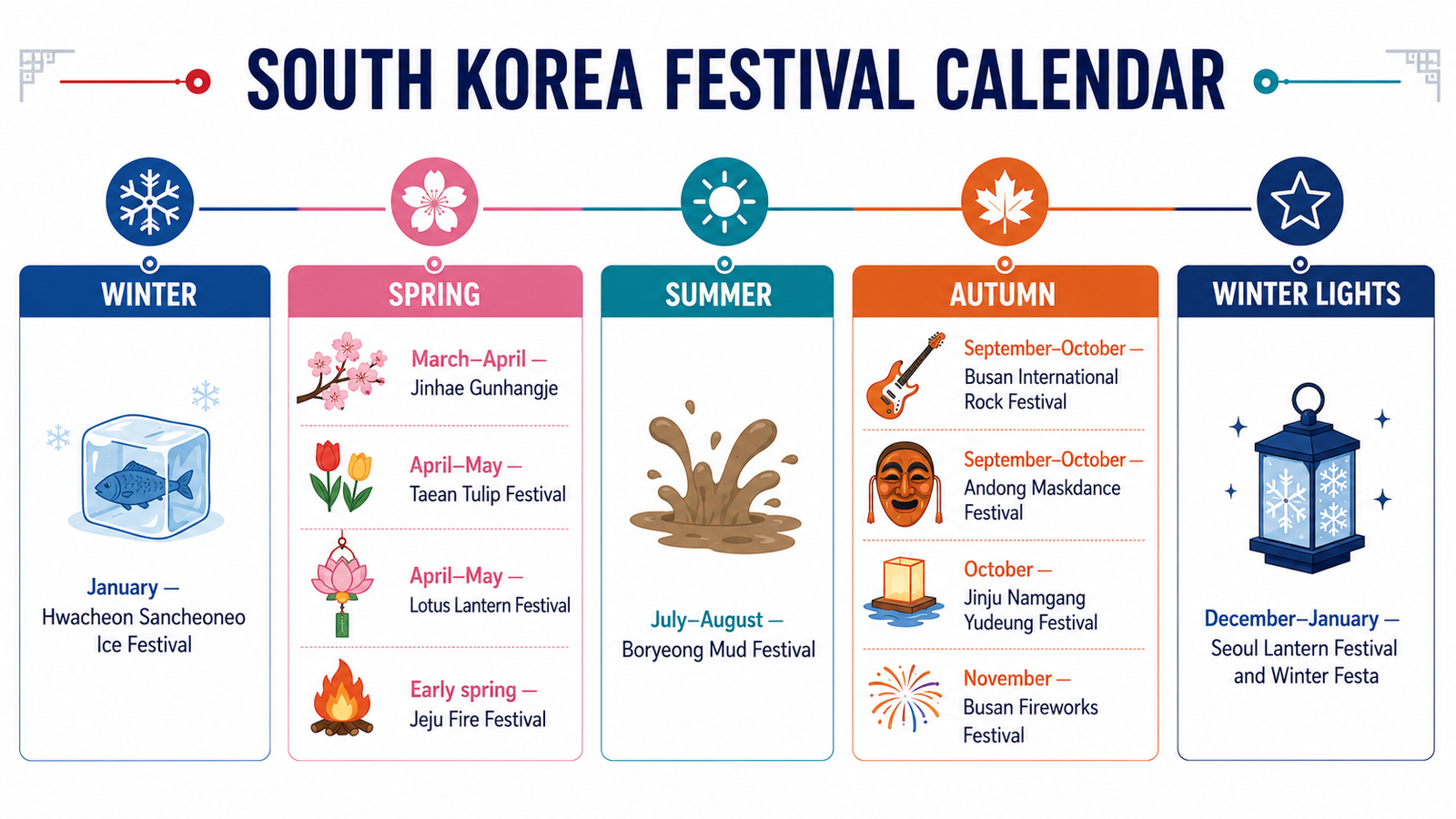
- Jinhae Gunhangje Festival 2026: March 27–April 5.
- Lotus Lantern Festival 2026: main parade and celebrations on May 16–17; Buddha’s Birthday ceremony on May 24.
- Boryeong Mud Festival 2026: July 24–August 9.
- Andong Maskdance Festival 2026: September 24–October 4.
- Hwacheon Sancheoneo Ice Festival 2027: January 9–31.
Past dates help show the usual seasonal pattern, but they should not be reused for a future trip without confirmation.
Winter Festivals in South Korea
Hwacheon Sancheoneo Ice Festival
The Hwacheon Sancheoneo Ice Festival is held in Gangwon Province and is built around mountain trout known as sancheoneo. Its best-known activity is ice fishing, but the program normally includes sledding, ice sculptures, night illuminations, food areas and activities for children.
The festival is a better choice for travelers who actively want a winter experience than for visitors who simply want to observe a cultural performance. Many activities take place outdoors for extended periods, so insulated shoes, gloves and wind-resistant clothing are essential.
The organizer has announced the next festival for January 9–31, 2027. Activity fees, reservations and shuttle arrangements should be checked on the official Hwacheon Sancheoneo Ice Festival website.
Practical considerations:
- Some fishing sessions may have separate reservation and walk-in areas.
- Weekend transport and activity queues are usually heavier.
- Ice conditions and weather can affect individual programs.
- A day trip is possible, but staying overnight reduces transport pressure.
Spring Festivals in South Korea
Jeju Fire Festival
The Jeju Fire Festival draws on the island’s pastoral traditions and the historic practice of burning old grass to control pests and prepare grazing land for a new season.
Modern programs may include cultural performances, torchlight activities, local food and large fire displays. Because the event involves open flames, its format is particularly sensitive to wind, dry conditions and safety restrictions.
Do not plan a trip around old photographs or an unofficial calendar. Confirm whether the main fire program will operate in the intended year through Visit Jeju and local government announcements.
Best for: travelers interested in Jeju traditions and seasonal cultural events.
Main risk: cancellation or major program changes because of weather and fire safety.
Jinhae Gunhangje Festival
Jinhae Gunhangje is South Korea’s largest-known cherry blossom festival and one of the country’s busiest spring events. The main areas include Yeojwacheon Stream, Gyeonghwa Station, Jungwon Rotary and other locations across Jinhae-gu in Changwon.
The 2026 edition ran from March 27 to April 5. Programs included military band performances, a parade connected with Admiral Yi Sun-sin, cultural events and limited access to naval locations that are normally closed to the public.
The blossoms are the main attraction, but their peak depends on weather rather than the official festival calendar. It is possible to arrive during the event and still miss the strongest bloom.
Check the current program through the official Gunhangje website or the VisitKorea Jinhae Gunhangje profile.
Getting there:
Jinhae does not function like a compact attraction with one entrance. Visitors commonly travel through Changwon or Masan and then use a local bus or taxi. Road closures and congestion can make taxis slower than expected.
Planning advice:
- Avoid arriving at midday on a peak weekend.
- Book accommodation in Changwon early.
- Allow time for walking between blossom areas.
- Do not rely on a single exact forecast made weeks in advance.
Lotus Lantern Festival in Seoul
The Lotus Lantern Festival, or Yeondeunghoe, is connected with Buddha’s Birthday and should not be confused with Seoul’s secular winter lantern displays.
The 2026 main lantern parade took place on May 16, following Jongno Street from Heunginjimun to Jogyesa Temple. Traditional cultural events and performances continued on May 17, while Buddha’s Birthday was observed on May 24.
The celebration includes lantern exhibitions, a large street parade, temple ceremonies, performances and hands-on cultural activities. Yeondeunghoe was inscribed on UNESCO’s Representative List of the Intangible Cultural Heritage of Humanity in 2020.
Use the official Lotus Lantern Festival schedule for current routes and times. Historical and cultural context is available from UNESCO.
Practical considerations:
- The street parade attracts large crowds.
- Arrive before road closures begin.
- Choose a viewing area before the parade reaches Jongno.
- Temple grounds are religious spaces, not only photographic attractions.
- Individual workshops may finish before the evening parade.
Taean Tulip Festival
The Taean tulip displays provide a quieter alternative to Jinhae’s urban cherry blossom crowds. The event is normally held at Korea Flower Park near the west coast and uses extensive designed flower fields rather than naturally blooming streets.
This is primarily a seasonal visual attraction. Admission is generally ticketed, and the quality of the displays depends on bloom conditions.
Check opening dates, admission and flower conditions through Korea Flower Park.
Summer Festivals in South Korea
Boryeong Mud Festival
The Boryeong Mud Festival is one of the most searched Korea festivals internationally. It takes place around Daecheon Beach and combines ticketed mud zones with water activities, performances and public events.
The 2026 festival runs from July 24 to August 9.
The official 2026 ticket page lists adult General Zone admission at:
- ₩12,000 from Monday to Thursday;
- ₩16,000 from Friday to Sunday.
The price includes a ₩5,000 Boryeong Love Gift Certificate distributed on-site. Specific zones have age, height and access rules, and the experience area is scheduled to close for a safety inspection on August 5.
Verify current prices, operating hours and closures through the official Boryeong Mud Festival website and its ticket information page.
Getting there:
Travel to Daecheon Station or Boryeong’s bus terminal, followed by a local bus or taxi to Daecheon Beach. Return transport becomes crowded after concerts and evening programs.
What to bring:
- clothes that can become permanently stained;
- secure water-friendly footwear;
- a waterproof phone pouch;
- sunscreen;
- dry clothes;
- a small towel.
Lockers, showers and zone rules should be checked before arrival. Do not carry an expensive camera into active mud areas unless it is properly protected.
Autumn Festivals in South Korea
Busan International Rock Festival
Busan International Rock Festival is a better fit for music-focused travelers than traditional culture seekers. The lineup normally includes Korean and international artists, with schedules and ticket tiers announced separately for each edition.
Unlike public lantern or blossom festivals, this is a ticketed music event. Accommodation near the venue and major subway connections can rise in price once the lineup is announced.
Check dates, venue and ticket releases through the Busan Festival Organization.
Fans building a longer music-themed trip can combine it with this K-Pop Seoul guide, while remembering that rock festival tickets and K-pop concert tickets use different platforms and sales systems.
Andong Maskdance Festival
Andong Maskdance Festival combines Korean mask dance, international performances, folk games, workshops and events connected with Hahoe culture.
The 2026 festival is scheduled for September 24–October 4, with venues including the area around the former Andong Station, downtown Andong and Talchum Park. Programs may also connect with Hahoe Folk Village, but visitors should not assume that every performance takes place there.
The official Andong Maskdance Festival website provides schedules, ticket information and venue details.
Getting there:
Andong is connected to Seoul by rail and intercity bus. Festival venues may be spread across the city, so confirm the location of a specific performance before choosing accommodation or requesting a taxi.
Best for: history, performance, traditional arts and travelers already planning to visit Hahoe Folk Village.
Jinju Namgang Yudeung Festival
Often searched for in English as the Jinju Lantern Festival, the Jinju Namgang Yudeung Festival takes place around the Namgang River and Jinjuseong Fortress. Large illuminated installations, floating lanterns and riverside programs turn the central area into an evening walking route.
The event’s historical theme is connected with the Japanese invasions of Korea in the 16th century, when lanterns were used for communication around the fortress and river.
Dates, ticketed areas and access arrangements change by edition. Check the current schedule through the official Jinju Namgang Yudeung Festival website.
Planning advice:
- Stay until after dark; daytime alone misses the central experience.
- Book a central hotel if visiting on a weekend.
- Expect crowd controls around riverside entrances.
- Check the final intercity train or bus before committing to a day trip.
Busan Fireworks Festival
Busan Fireworks Festival is centered on the coastline, historically around Gwangalli Beach. It combines large-scale fireworks with the night view of Gwangan Bridge.
Public viewing areas may be free, while reserved seating and packaged viewing options can be paid. The main practical challenge is not admission but crowd movement before and after the display.
Check the venue, date and seating arrangements through the Busan Festival Organization.
Practical considerations:
- Arrive several hours before the display.
- Do not expect to leave Gwangalli immediately after the finale.
- Use the subway rather than a taxi.
- Consider a viewing location slightly away from the central beach.
- Follow temporary station access and crowd-control instructions.
Seoul Lantern Festival vs Lotus Lantern Festival
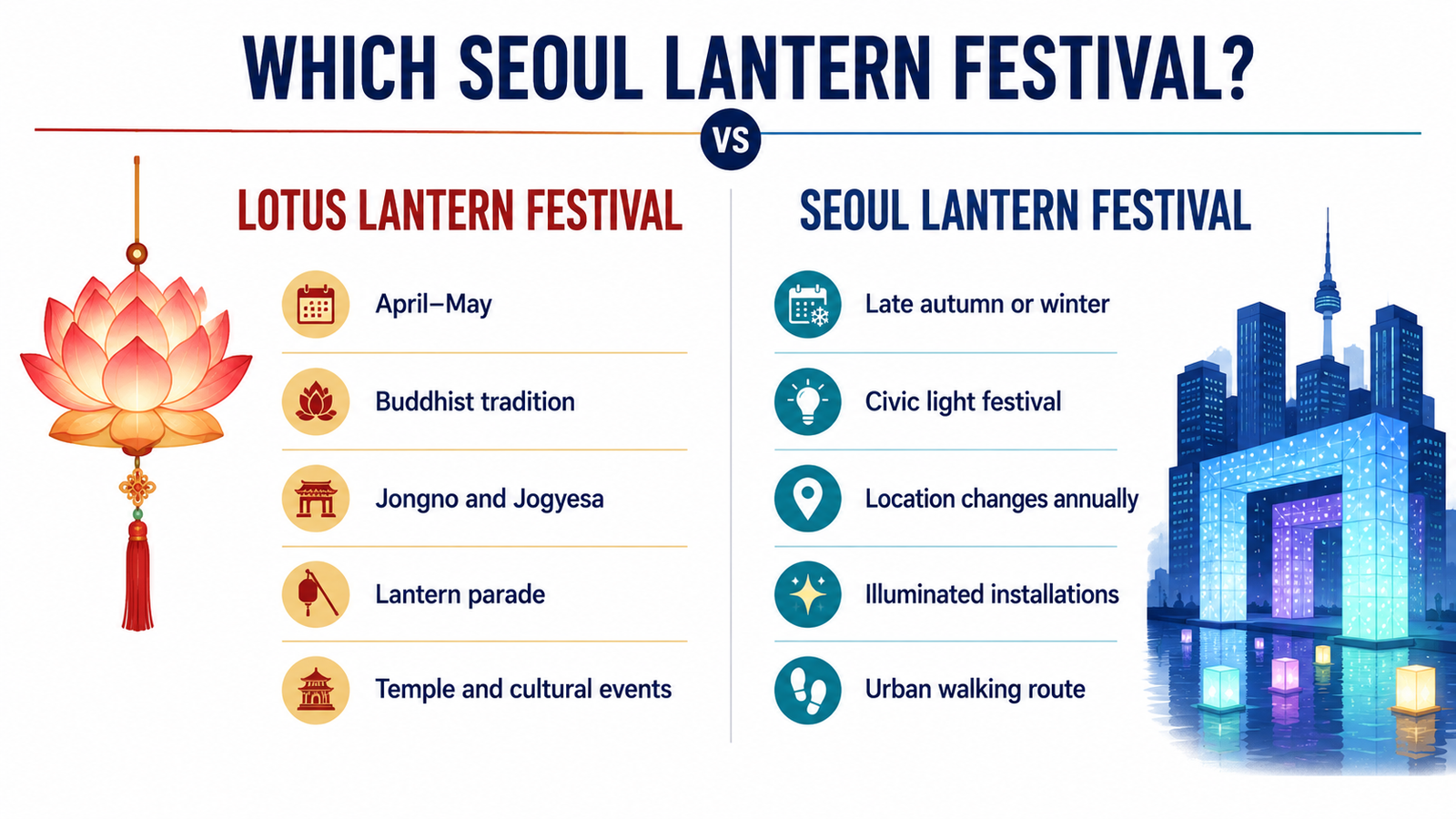
These two events are frequently confused, but they are not interchangeable.
Someone searching for lantern festival Seoul may mean either event. Check the month and organizer before building an itinerary.
The Lotus Lantern Festival is organized around Yeondeunghoe and Buddhist traditions. Seoul’s winter lantern displays are municipal cultural events and may be incorporated into a wider Seoul Winter Festa program.
Current winter venues and dates should be confirmed through the Seoul Metropolitan Government’s English website.
Visitors planning to continue the evening after the light displays can use the Seoul Nightlife Guide to compare districts, transport and typical costs.
Is Chuseok a Festival Tourists Can Attend?
Chuseok is one of South Korea’s most important traditional holidays, but it is not a single ticketed festival with one location.
Families travel to their hometowns, visit relatives, perform ancestral rites and share seasonal food. Museums and heritage sites may organize public cultural programs, but many businesses operate reduced hours or close.
For travelers, the practical effects are often more important than public celebrations:
- intercity train and bus tickets become difficult to obtain;
- domestic flights can sell out;
- traffic increases significantly;
- family-run restaurants may close;
- major attractions can use holiday schedules.
Do not treat Chuseok as an ordinary sightseeing event. Confirm transportation before booking accommodation in another city.
For an introduction to dishes visitors may encounter throughout the country, see this guide to the best Korean food.