
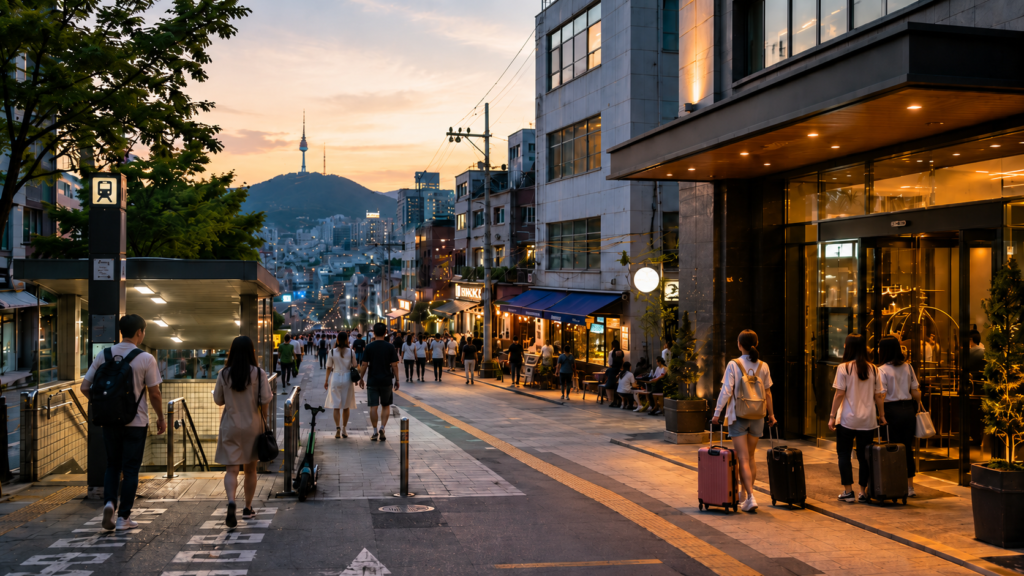
Lively Seoul neighbourhood with pedestrians, cafés, hotels and subway entrance

Where to Stay in Seoul: 7 Best Areas for First-Time Visitors

Choosing where to stay in Seoul can shape the entire trip. The city is enormous, attractions are spread across both sides of the Han River, and a hotel that looks central on a map may still require several transfers every day.

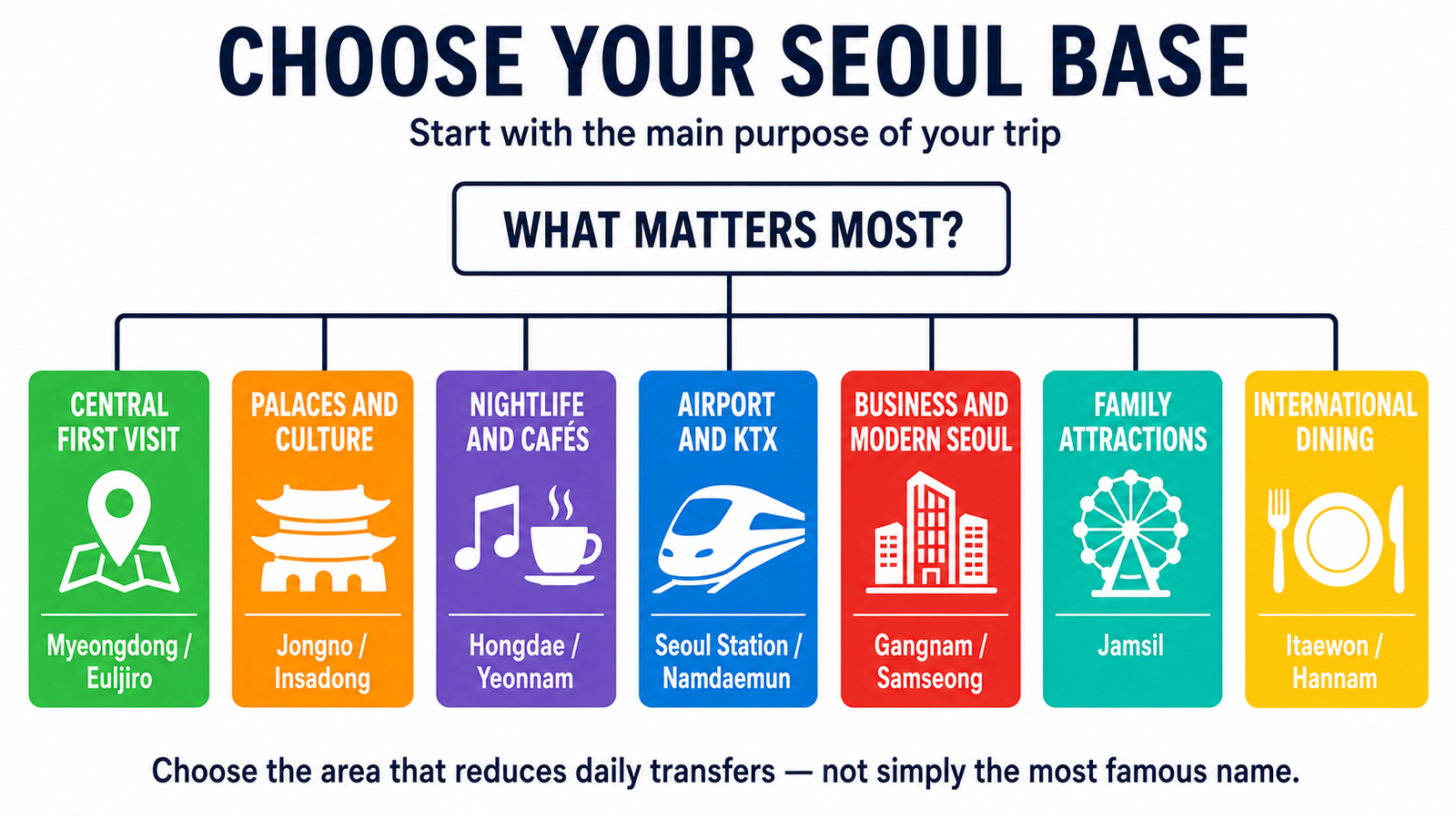
For most first-time visitors, the best area to stay in Seoul is Myeongdong or nearby Euljiro. Both provide relatively convenient access to the historic centre, shopping streets, Namsan, restaurants and multiple subway lines.

However, that is not the right choice for everyone:

  • choose Jongno or Insadong for palaces, traditional streets and cultural attractions;
  • choose Hongdae or Yeonnam for nightlife, cafés and a direct all-stop AREX connection;
  • choose Seoul Station or Namdaemun for airport access, KTX trains and intercity travel;
  • choose Gangnam or Samseong for business, clinics, shopping and modern Seoul;
  • choose Jamsil for Lotte World and a family-focused itinerary;
  • choose Itaewon or Hannam for international restaurants and nightlife.

The best location is not necessarily the district with the most famous name. It is the area that reduces transfers between the places you actually intend to visit.

Research note: This guide uses official Seoul tourism information, subway resources and Airport Railroad information. Accommodation prices are dynamic, so the price categories below should be treated as planning references rather than live quotations.

Best Areas to Stay in Seoul at a Glance

Area Best for Main advantage Main disadvantage Useful stations
Myeongdong and Euljiro
First visits and shopping
Central base with several subway options
Busy and tourist-oriented in places
Myeongdong, Euljiro 1-ga, Euljiro 3-ga
Jongno and Insadong
History and culture
Walkable access to palaces and traditional districts
Quieter after the main attractions close
Anguk, Jongno 3-ga, Gwanghwamun
Hongdae and Yeonnam
Nightlife and younger travellers
Evening atmosphere and AREX connection
Farther from the palace district
Hongik University
Seoul Station and Namdaemun
Airport and intercity transport
AREX, KTX and multiple subway connections
Less neighbourhood atmosphere
Seoul Station, Hoehyeon
Gangnam and Samseong
Business and modern Seoul
Shopping, clinics, COEX and southern attractions
Longer journeys to historic Seoul
Gangnam, Samseong, Bongeunsa
Jamsil
Families
Lotte World and family attractions
Far from western and historic districts
Jamsil
Itaewon and Hannam
International dining and nightlife
Diverse restaurants and evening options
Hills and fewer direct rail connections
Itaewon, Hangangjin

Accommodation Price Guide

To make the comparisons less subjective, this article uses the following approximate room-price categories:

  • Budget: below ₩100,000 per room per night;
  • Mid-range: approximately ₩100,000–₩200,000;
  • Higher-end: above ₩200,000.

These are broad planning bands, not guaranteed rates. Prices can rise considerably during cherry blossom season, autumn foliage weekends, major concerts, holidays and large events. Room type, neighbourhood, booking date and cancellation conditions also affect the final rate.

Map of the Best Seoul Areas

The map below shows the seven areas compared in this guide. Use the layer controls to show or hide individual areas; each layer includes useful subway stations and nearby attractions. The markers are planning anchors, not exact neighbourhood boundaries or hotel recommendations.

The Han River provides an important reference because it helps explain whether a hotel is better positioned for historic central Seoul or for the southern districts.

  • Myeongdong/Euljiro;
  • Jongno/Insadong;
  • Hongdae/Yeonnam;
  • Seoul Station/Namdaemun;
  • Gangnam/Samseong;
  • Jamsil;
  • Itaewon/Hannam.

The Han River should remain clearly visible because it explains one of the most important accommodation decisions: whether to stay close to historic central Seoul or base the trip in the southern districts.

Map of seven practical areas to stay in Seoul. Markers show useful transport anchors and nearby attractions, not exact neighbourhood boundaries or individual hotel recommendations.

1. Myeongdong and Euljiro: Best Overall for a First Visit

Myeongdong is the easiest default recommendation for travellers deciding where to stay in Seoul for the first time.

The district sits close to Namsan, Namdaemun Market, City Hall and the central shopping streets. It also provides relatively convenient access to the palace district, Dongdaemun and Seoul Station.

Myeongdong Station is on Line 4, while nearby Euljiro 1-ga and Euljiro 3-ga provide additional connections. This makes the wider Myeongdong–Euljiro area more flexible than choosing a hotel based only on the Myeongdong name.

Why stay here?

  • convenient for a first sightseeing itinerary;
  • large selection of hotels;
  • shopping and restaurants nearby;
  • useful access to Namsan and Namdaemun;
  • easier journeys to many central attractions;
  • tourist services are widely available.

Myeongdong is particularly suitable for travellers interested in cosmetics, department stores and Korean fashion. Our Seoul shopping guide explains what to buy and how the city’s main shopping districts differ.

What are the disadvantages?

The busiest streets can feel crowded and highly commercial. Restaurants and shops in the central pedestrian zone may be more tourist-oriented than those found in surrounding neighbourhoods.

Noise also varies significantly. A hotel directly above a busy shopping street can feel very different from one several blocks toward Euljiro or Chungmuro.

Which part should you choose?

Choose central Myeongdong if shopping and immediate access to the pedestrian district matter most.

Consider Euljiro if you want additional subway connections, older local streets and easier access to Jongno. Euljiro can feel less polished, but it may be a more practical base for travellers who care about transport more than the Myeongdong address.

Accommodation profile: mainly mid-range business hotels, international chains and some budget properties.

Best for: first-time visitors, shopping trips, short stays and travellers wanting a central base.

2. Jongno and Insadong: Best for History and Culture

Jongno and Insadong are among the best neighbourhoods to stay in Seoul for travellers whose itinerary focuses on palaces, museums, traditional streets and historic architecture.

Depending on the hotel location, visitors may be able to walk to:

  • Gyeongbokgung Palace;
  • Changdeokgung Palace;
  • Insadong;
  • Ikseon-dong;
  • Bukchon;
  • Gwanghwamun;
  • Jongmyo Shrine;
  • Cheonggyecheon.

The official Seoul tourist guide connects many of these attractions through walkable and public-transport itineraries. Seoul’s official guidebook is useful for planning the surrounding area.

Why stay here?

  • strong concentration of historic attractions;
  • useful for travellers who prefer walking;
  • traditional restaurants, tea houses and craft shops;
  • convenient access to central museums;
  • calmer evenings than Hongdae or Itaewon;
  • several subway options around Jongno 3-ga.

Jongno 3-ga is especially practical because multiple subway lines meet there. Anguk is better positioned for Insadong, Bukchon and the palace district but offers fewer direct line choices.

What are the disadvantages?

Some streets become quiet after shops and cultural attractions close. Visitors looking for clubs or late-night entertainment may prefer Hongdae or Itaewon.

Traditional guesthouses can also have smaller rooms, stairs and stricter house rules. A picturesque hanok stay should not automatically be treated as the most convenient option for large luggage or mobility needs.

Accommodation profile: guesthouses, hanok accommodation, boutique properties and budget-to-mid-range hotels.

Best for: cultural trips, palace itineraries, photographers and travellers who prefer walking.

3. Hongdae and Yeonnam: Best for Nightlife and Younger Travellers

Hongdae is the strongest alternative to Myeongdong. It offers cafés, live music, bars, casual restaurants, fashion, street activity and one of Seoul’s most recognisable youth districts.

Hongik University Station is served by Line 2, the Gyeongui–Jungang Line and the all-stop Airport Railroad service. This makes Hongdae particularly useful for travellers arriving through Incheon Airport.

The official AREX fare table lists both Hongik University and Seoul Station on the all-stop route. Timetables and fares should be confirmed through the Airport Railroad website before travelling.

Why stay here?

  • active evening atmosphere;
  • large selection of hostels and smaller hotels;
  • direct all-stop airport railway connection;
  • convenient access to western Seoul;
  • cafés, shopping and restaurants within walking distance;
  • suitable for nightlife and K-pop-focused itineraries.

Our Seoul nightlife guide explains how Hongdae differs from Itaewon, Gangnam and central nightlife areas. Travellers interested in Hallyu attractions can also use the K-pop and K-drama travel guide.

Hongdae or Yeonnam?

Stay close to the main Hongdae streets if nightlife and late evenings are priorities.

Choose Yeonnam-dong for cafés, residential streets and a somewhat calmer atmosphere while remaining within reach of Hongik University Station. Always check the actual walking route: a property marketed as “Hongdae” may be considerably farther from the station than its name suggests.

What are the disadvantages?

Hongdae is west of the main palace district. Visitors planning several days around Jongno, Myeongdong and eastern Seoul may spend more time on trains.

The busiest nightlife streets can also be noisy. Reviews mentioning street noise, club music and weekend crowds are more useful than the hotel’s overall rating alone.

Accommodation profile: hostels, guesthouses, boutique hotels and budget-to-mid-range rooms.

Best for: solo travellers, younger visitors, nightlife, cafés and airport convenience.

Hongdae vs Myeongdong: Which Is Better?

The choice between Hongdae and Myeongdong is one of the most common accommodation decisions for a first Seoul trip.

Priority Better choice Reason
First sightseeing trip
Myeongdong
More central for palaces, Namsan, markets and central attractions
Nightlife
Hongdae
More evening activity, bars, clubs and live entertainment
Airport access
Hongdae
Hongik University Station is on the all-stop AREX route
Shopping
Both
Myeongdong is stronger for cosmetics and tourist shopping; Hongdae for youth fashion
Historic attractions
Myeongdong
Shorter journeys toward Jongno and the palace district
Budget accommodation
Hongdae
Generally broader hostel and guesthouse selection
Quiet evenings
Depends on the street
Avoid the busiest pedestrian and nightlife streets in either area
Cafés and local atmosphere
Hongdae/Yeonnam
Wider café and neighbourhood-oriented environment

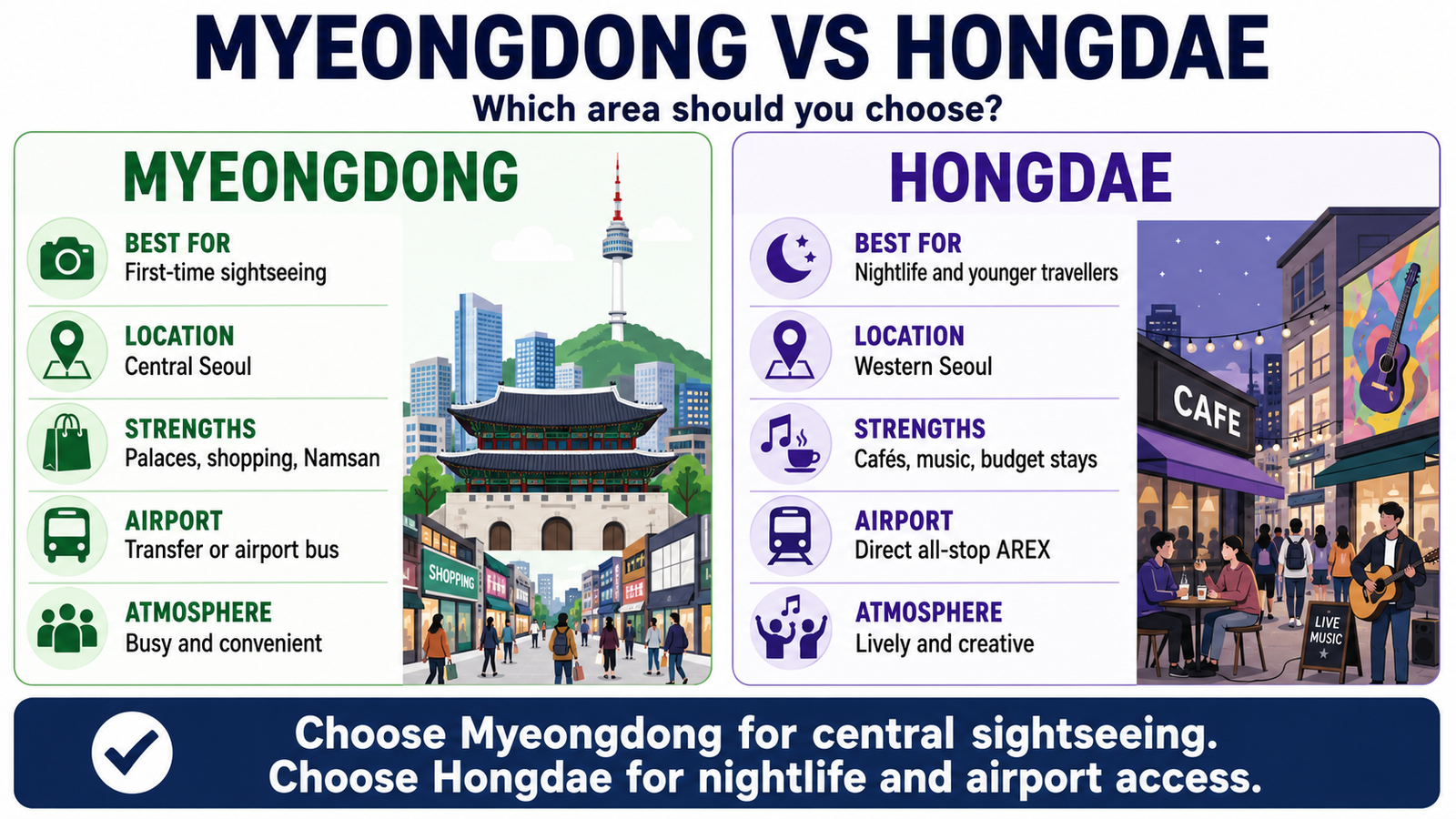
Myeongdong versus Hongdae comparison for choosing where to stay in Seoul

Choose Myeongdong if this is your first visit and most of the itinerary is in central or historic Seoul.

Choose Hongdae if nightlife, cafés, budget accommodation and airport access matter more than walking proximity to the palace district.

4. Seoul Station and Namdaemun: Best for Transport

Seoul Station is the most practical base for travellers prioritising transportation.

The area provides access to:

  • AREX services;
  • KTX and other intercity trains;
  • Seoul subway Lines 1 and 4;
  • buses and taxis;
  • Namdaemun Market;
  • Seoullo 7017;
  • central Seoul.

It can be particularly useful when the Seoul stay includes early trains, late arrivals or several day trips.

Why stay here?

  • strong connection to Incheon Airport;
  • convenient for KTX travel;
  • close to Namdaemun and central Seoul;
  • useful for multi-city itineraries;
  • wide choice of business hotels and serviced accommodation.

What are the disadvantages?

Seoul Station is a large transport complex, and crossing roads or navigating station exits with luggage may take longer than the map suggests.

The immediate surroundings also feel more transport-oriented than neighbourhoods such as Insadong or Yeonnam. Travellers looking for an active café or nightlife district may find the area functional rather than atmospheric.

Check which side of the station the hotel occupies and whether the walking route involves bridges, tunnels, stairs or large intersections.

Accommodation profile: business hotels, aparthotels and mid-range properties.

Best for: KTX trips, short stopovers, airport transfers and multi-city itineraries.

5. Gangnam and Samseong: Best for Modern Seoul and Business

Gangnam is internationally famous, but it is not automatically the best area to stay in Seoul for every tourist.

It works well when the itinerary concentrates on southern Seoul, including:

  • Gangnam Station;
  • COEX;
  • Bongeunsa;
  • Apgujeong;
  • Cheongdam;
  • cosmetic and medical appointments;
  • business meetings;
  • shopping and modern architecture.

Gangnam Station provides Line 2 and the Shinbundang Line. Samseong is useful for COEX, while Bongeunsa Station provides access from Line 9.

Why stay here?

  • extensive hotel selection;
  • business and conference facilities;
  • department stores and shopping centres;
  • restaurants and nightlife;
  • access to clinics and beauty services;
  • convenient for southern Seoul attractions.

Our Seoul architecture guide includes several modern buildings and design sites in this part of the city.

What are the disadvantages?

The Han River separates Gangnam from many historic attractions. If most days include Gyeongbokgung, Bukchon, Insadong, Myeongdong and Hongdae, the cumulative travel time becomes noticeable.

Gangnam is therefore best chosen deliberately—not because it is the most internationally recognisable district.

Accommodation profile: business hotels, international chains, serviced residences and higher-end properties.

Best for: business travel, medical tourism, shopping and itineraries focused on southern Seoul.

6. Jamsil: Best for Families and Lotte World

Jamsil is a practical option for families planning significant time around Lotte World, Lotte World Tower, Seokchon Lake and southeastern Seoul.

Jamsil Station is served by Lines 2 and 8, providing useful connections despite the area’s distance from central historic districts.

Why stay here?

  • immediate access to major family attractions;
  • shopping and restaurants inside large complexes;
  • convenient for Lotte World;
  • more straightforward for itineraries concentrated in southeastern Seoul;
  • family-oriented hotels and serviced accommodation.

What are the disadvantages?

Jamsil is far from Hongdae, the palace district and many western attractions. It is not the most efficient base for a first visit covering the entire city.

Families should compare the convenience of staying beside Lotte World against the additional transport required on other sightseeing days.

Accommodation profile: mid-range and upscale hotels, residences and family-oriented properties.

Best for: families, Lotte World visits and southeastern Seoul itineraries.

7. Itaewon and Hannam: Best for International Dining

Itaewon is known for international restaurants, bars, nightlife and a diverse visitor population. Nearby Hannam offers galleries, restaurants, boutiques and a more upscale atmosphere.

Itaewon Station is on Line 6. This is sufficient for moving around Seoul, but it is less universally convenient than staying at a major Line 2 interchange.

Why stay here?

  • international food choices;
  • bars and nightlife;
  • central position between northern and southern Seoul;
  • access to parts of Yongsan;
  • boutique and upscale accommodation options.

What are the disadvantages?

Parts of Itaewon and Hannam are hilly. A short map distance can involve a steep climb, which matters when carrying luggage.

Some journeys require additional transfers, and road traffic can make taxis slower than expected. Visitors should examine both the nearest station and the elevation around the hotel.

Accommodation profile: boutique hotels, guesthouses and mid-range-to-upscale properties.

Best for: international dining, nightlife, couples and repeat visitors.
Decision guide for choosing the best area where to stay in Seoul

Where to Stay in Seoul by Travel Style

First-time visitors

Choose Myeongdong/Euljiro or Jongno/Insadong. Both reduce the effort required to reach central attractions.

Solo travellers

Choose Hongdae for hostels, nightlife and social activity. Jongno is a better alternative for a quieter cultural trip.

Couples

Consider Jongno/Insadong for traditional streets, Yeonnam for cafés or Hannam for restaurants and galleries.

Families

Choose Jamsil if Lotte World is central to the itinerary. Otherwise, a central hotel near Myeongdong or Euljiro may reduce transport time across a broader sightseeing plan.

Nightlife

Choose Hongdae for a younger club and live-music environment, Itaewon for international nightlife, or Gangnam for southern Seoul.

Shopping

Myeongdong is the easiest all-round base. Hongdae suits youth fashion, while Gangnam works better for department stores, luxury shopping and beauty-focused visits.

History and culture

Choose Jongno or Insadong for the palaces, Bukchon, museums and traditional streets.

Airport convenience

Choose Hongdae for the all-stop AREX connection or Seoul Station for both all-stop and direct airport railway services.

KTX and multi-city travel

Choose Seoul Station if the itinerary continues to Busan, Gyeongju or another Korean destination.

Should You Stay in Two Different Seoul Areas?

Most visitors staying four to six nights do not need to change hotels. Packing, checking out, transporting luggage and waiting for another room can consume much of a sightseeing day.

A split stay becomes more reasonable when:

  • the Seoul visit lasts at least a week;
  • the itinerary has several days in both northern and southern Seoul;
  • the trip begins with nightlife in Hongdae and ends with an early train from Seoul Station;
  • part of the stay is built around Jamsil or Gangnam;
  • the second property offers a genuinely different experience.

For a normal first visit, one carefully chosen base near a convenient station is usually more efficient.

How to Choose a Hotel in Seoul

Check the actual station

“Near Myeongdong” or “Hongdae area” is not precise enough. Verify the nearest station, line and exit.

Examine the walking route

A 600-metre walk can involve hills, stairs, underground passages or major intersections. This matters with luggage, children or limited mobility.

Prefer useful lines over famous district names

A less famous hotel beside two or three subway lines may be more convenient than a prestigious address requiring transfers every day.

The Seoul Metropolitan Government subway guide provides an official network overview and tourist-planning tools.

Read reviews for specific problems

Look for recent comments about:

  • street noise;
  • room temperature;
  • window size;
  • cleanliness;
  • lifts;
  • luggage storage;
  • mattress comfort;
  • bathroom layout;
  • late check-in;
  • distance from the station.

Check the room size

Seoul hotel rooms can be compact. Compare the stated floor area rather than relying only on photographs.

Review cancellation conditions

A cheaper non-refundable rate may not be suitable when flights, visa requirements or travel dates remain uncertain.

Confirm airport transport

Do not assume that every airport bus route stops near every hotel. Check the current AREX timetable, airport limousine route or transfer instructions shortly before travelling.

Frequently Asked Questions

What is the best area to stay in Seoul for the first time?

Myeongdong or nearby Euljiro is the easiest all-round choice for most first-time visitors. Jongno and Insadong are better when palaces, history and traditional culture are the main priorities.

Is Myeongdong or Hongdae better?

Myeongdong is better for central sightseeing and historic attractions. Hongdae is better for nightlife, cafés, hostels and direct access to the all-stop airport railway.

Is Gangnam a good place for tourists?

Yes, when the itinerary focuses on southern Seoul, business, clinics, shopping or COEX. It is less efficient for a trip dominated by palaces, Bukchon, Insadong and other northern attractions.

Where should families stay in Seoul?

Jamsil is convenient for Lotte World, while Myeongdong/Euljiro provides a more central base for a varied family itinerary.

Where should solo travellers stay?

Hongdae offers hostels, nightlife and social activity. Jongno is more suitable for solo travellers wanting a quieter cultural experience.

How close should a hotel be to the subway?

There is no universal distance, but the walking route should be checked carefully. A slightly longer flat walk may be easier than a shorter route involving stairs or a steep hill.

Is it better to stay north or south of the Han River?

Most first-time sightseeing attractions are north of the river, making Myeongdong, Jongno, Hongdae and Seoul Station practical choices. Stay south of the river when Gangnam, COEX, Jamsil or southern appointments dominate the itinerary.

Final Recommendation

For most first-time visitors wondering where to stay in Seoul, choose Myeongdong/Euljiro for overall convenience or Jongno/Insadong for history and walkability.

Choose Hongdae when nightlife, cafés and airport access are more important. Select Gangnam, Jamsil or Itaewon only when their particular strengths match the itinerary.

Before booking, place every major attraction on a map and check the journey from the hotel during the time of day you expect to travel. Saving one transfer twice a day can matter more than choosing the most famous neighbourhood.

For help planning the rest of the journey, continue with our South Korea itinerary and travel guide and best time to visit South Korea.

Official Sources and Planning Resources

Leave a Comment

Your email address will not be published. Required fields are marked *