How to get around South Korea by train, bus and domestic flight

How to Get Around South Korea: Trains, Buses, Flights and Transport Cards

Understanding how to get around South Korea makes it much easier to plan a route beyond Seoul. The country has an extensive network of high-speed trains, regional buses, domestic flights and urban public transportation, but the best option changes with each destination.

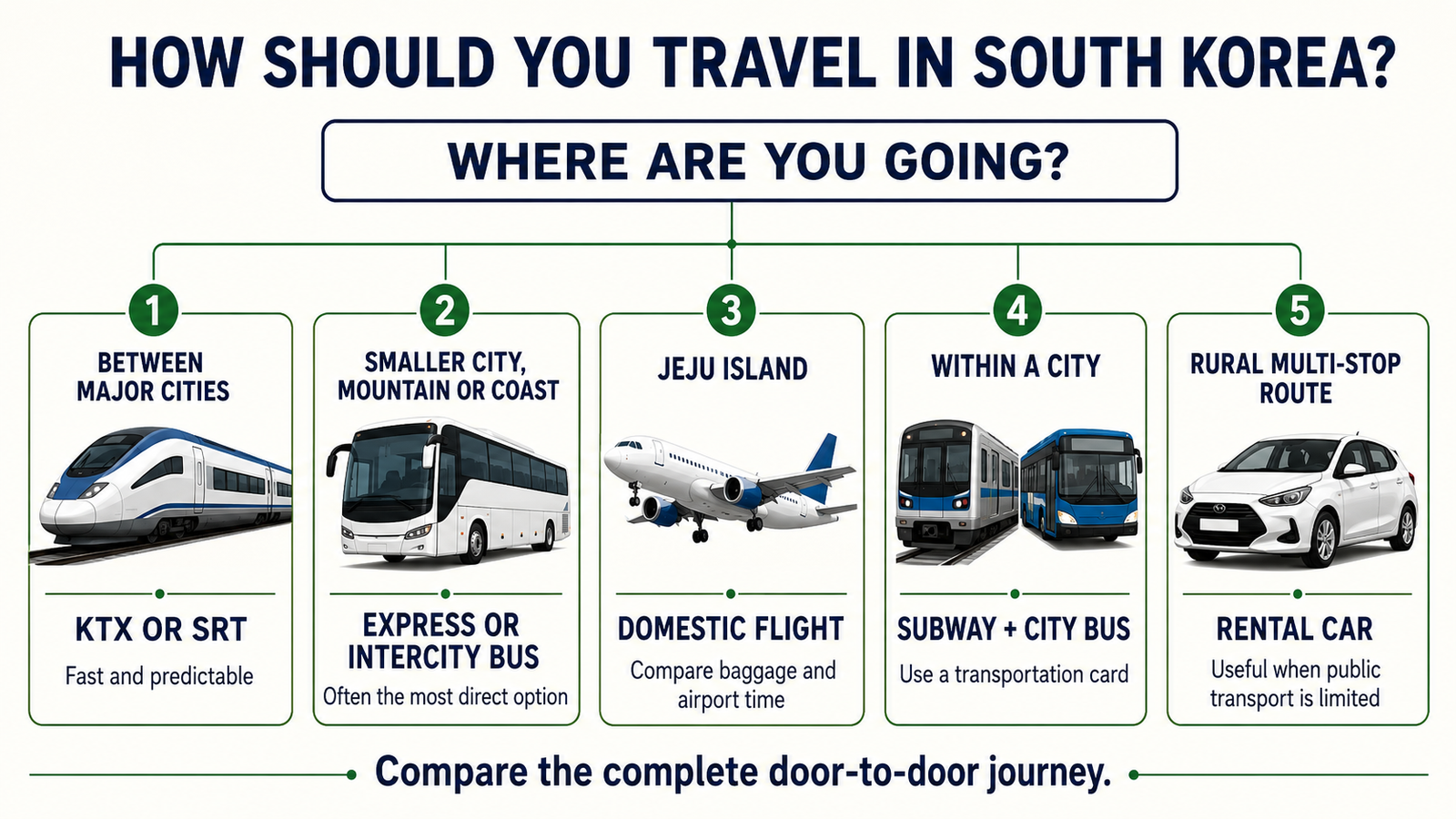
For most first-time visitors, the easiest way to get around South Korea is to combine KTX trains for major city-to-city journeys, express or intercity buses for places without convenient rail connections, and a rechargeable transportation card for subways and local buses.

A rental car is rarely necessary in Seoul or Busan. It becomes more useful on Jeju Island, in rural areas and when visiting several remote attractions in one day.

This guide explains how each system works, where to purchase tickets, which payment methods to prepare and how to choose the right transport for a South Korea itinerary.

Quick answer: Use KTX between Seoul, Gyeongju and Busan; take an intercity bus to places such as Sokcho; fly to Jeju; and purchase a T-money or EZL card for urban buses and subways.

How to Get Around South Korea at a Glance

Transport Best for Typical planning range Advance booking Main limitation
KTX or SRT
Fast travel between major cities
₩10,000–₩60,000+ one way
Recommended
Does not serve every destination
ITX or Mugunghwa
Slower regional train journeys
₩5,000–₩35,000 one way
Sometimes
Longer journey times
Express or intercity bus
Smaller cities, mountains and coastal destinations
₩5,000–₩40,000 one way
Recommended for busy periods
Terminals and booking systems vary
Domestic flight
Jeju and selected long-distance routes
₩30,000–₩150,000+ one way
Yes
Baggage and airport transfers may cost extra
Subway and city bus
Moving within major cities
₩1,300–₩3,000 per ride
No
Distance charges and transfer rules vary
Rental car
Jeju, rural areas and flexible road trips
₩50,000–₩150,000+ per 24 hours
Yes
Fuel, tolls, parking and some insurance may cost extra
Taxi
Short trips, late arrivals and heavy luggage
₩5,000–₩25,000 for a typical urban trip
Usually no
Airport, long-distance and late-night trips cost more

These are approximate planning ranges, not fixed fares. Prices vary by route, distance, ticket class, season and booking date. Rental-car estimates may not include fuel, road tolls, parking or optional insurance, while domestic flight prices may exclude checked baggage.

Decision guide for choosing transport in South Korea

South Korea Trains: KTX, SRT and Regional Services

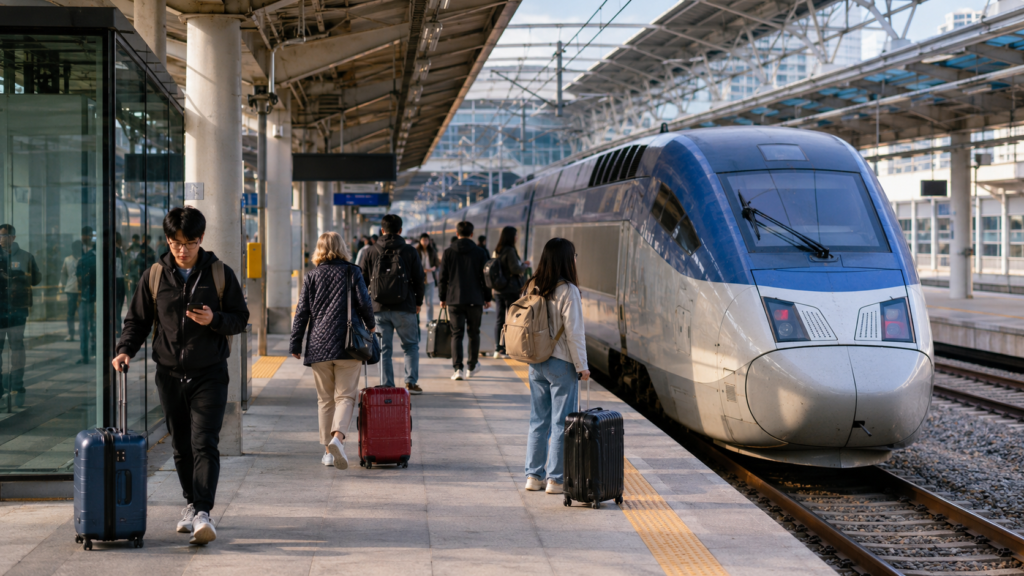
South Korea trains are usually the fastest way to travel between Seoul and the country’s largest cities.

The rail network is particularly useful for journeys to Busan, Daegu, Daejeon, Gyeongju, Jeonju, Gwangju, Gangneung and several other regional destinations.

KTX

KTX is South Korea’s principal high-speed rail service. It connects Seoul with major destinations on several national rail corridors.

For travelers, its main advantages are:

  • centrally located departure stations;
  • predictable journey times;
  • reserved seating;
  • space for regular travel luggage;
  • no airport security or early check-in;
  • connections with subways and local buses.

A direct KTX journey between Seoul and Busan generally takes approximately 2 hours 15 minutes to 3 hours, depending on the service and number of stops.

KTX is normally the most practical choice when traveling between central Seoul and central Busan. Flying takes less time in the air, but traveling to and from the airports can remove much of the advantage.

SRT

SRT is another high-speed railway operator. Its primary Seoul terminal is Suseo Station in the southeastern part of the city rather than Seoul Station.

SRT can be convenient when staying in Gangnam, Jamsil or another southern Seoul district. However, SRT tickets use a separate booking system and are not included in the standard KORAIL Pass.

Compare the location of Seoul Station and Suseo Station before choosing between KTX and SRT. A slightly shorter train journey may not save time if reaching the departure station requires a long subway transfer.

Tickets and schedules are available through the official SRT website.

ITX-Saemaeul and Mugunghwa Trains

Conventional trains are slower than KTX but can be useful when:

  • a destination is not served by high-speed rail;
  • the schedule is more convenient;
  • the journey is short;
  • KTX tickets have sold out;
  • saving money is more important than minimizing travel time.

Mugunghwa services are generally the slowest and least expensive long-distance trains. ITX services sit between regional trains and KTX in speed and comfort.

Do not assume that every station in a city is served by every train type. Large cities can have several railway stations, and some high-speed stations are outside the historic center.

How to Book Train Tickets in South Korea

KTX and other KORAIL-operated trains can be booked through:

SRT tickets are sold through the separate SRT website, app, machines and station counters.

Foreign-issued payment cards are accepted through many official online and station-based sales channels, but acceptance can depend on the card issuer and authentication method. If an online payment fails, try the official app, another card or a staffed counter.

When to Reserve

For an ordinary weekday journey, booking several days ahead is often sufficient. Reserve earlier when traveling:

  • on Friday or Sunday evening;
  • during cherry blossom or autumn foliage season;
  • immediately before or after a major festival;
  • during a long weekend;
  • around Seollal or Chuseok;
  • on a route with only a few direct services.

Ticket sales for major Korean holidays may follow special release schedules. Never assume that normal booking availability applies during Seollal or Chuseok. Seasonal demand can also affect transport availability and prices, so compare your dates with our guide to the best time to visit South Korea.

Is the KORAIL Pass Worth It?

The KORAIL Pass is designed for international travelers taking several eligible train journeys within a limited period.

Current pass formats include selected travel days that can be used within a defined validity window. Standard-class travel is covered on eligible KORAIL trains, but the pass does not cover:

  • SRT;
  • city subways;
  • every seasonal tourist train;
  • unlimited reserved seats without conditions.

The pass is not automatically cheaper than individual tickets. Before purchasing it:

  1. List every planned intercity train journey.
  2. Check the current point-to-point fares.
  3. Add the fares together.
  4. Compare the total with the pass price.
  5. Confirm that each train is operated by KORAIL.
  6. Check whether reservations remain available.

A traveler using only Seoul–Busan and Busan–Seoul may find normal tickets simpler. A traveler completing several long KTX journeys within a few days may receive better value from the pass.

KORAIL also introduced KORAIL PASS+, which combines eligible rail-pass functions with a rechargeable transportation-card feature. It should still be compared with purchasing train tickets and a regular T-money card separately. See the official KORAIL PASS+ explanation.

KTX, Bus or Flight: Which Should You Choose?

The following ranges are for initial planning only. Check the live timetable and fare before purchasing a ticket.

Route Usually best option Approximate journey time Typical one-way planning range Important detail
Seoul → Busan
KTX
2 hr 15 min–3 hr
₩50,000–₩65,000
Faster city center to city center than flying
Seoul → Gyeongju
KTX
About 2–2.5 hr
₩45,000–₩55,000
Local transfer needed from Gyeongju Station
Seoul → Jeonju
KTX
About 1 hr 40 min–2 hr
₩30,000–₩40,000
Some services depart from Yongsan
Seoul → Sokcho
Express/intercity bus
About 2.5–3.5 hr
₩17,000–₩30,000
Road traffic affects arrival time
Busan → Gyeongju
Bus or regional train
About 1–1.5 hr
₩6,000–₩15,000
Compare terminal and station locations
Seoul → Jeju
Domestic flight
About 1 hr 10 min in the air
₩30,000–₩150,000+
Baggage may cost extra
Busan → Jeju
Domestic flight
About 1 hr
₩30,000–₩120,000+
Usually faster than taking a ferry

The cheapest ticket is not always the best choice. Add the cost and time required to reach the station, terminal or airport.
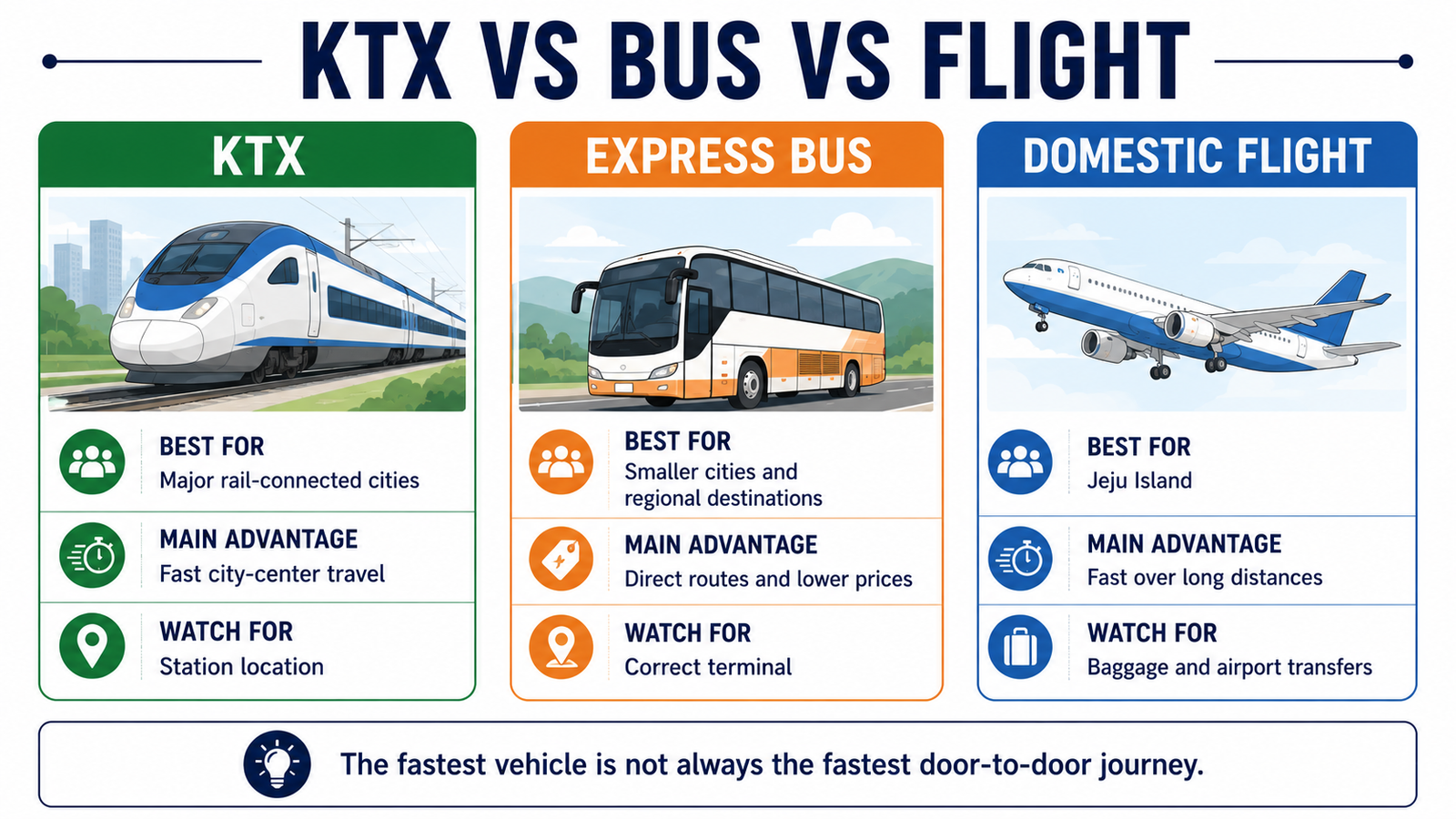
Comparison of KTX trains, buses and domestic flights in South Korea

Express and Intercity Buses in South Korea

Buses fill important gaps in the national railway network. They are often the most practical way to reach:

  • Sokcho and Seoraksan;
  • smaller coastal towns;
  • national parks;
  • rural counties;
  • destinations with inconvenient rail stations;
  • regional attractions outside major cities.

South Korea uses two overlapping long-distance bus categories.

Express Buses

Express buses primarily connect larger cities through major express bus terminals. Different seating classes may be available, including standard, excellent and premium services.

Intercity Buses

Intercity buses serve a wider range of regional destinations and may make additional stops. They can depart from a different terminal than the express buses serving the same city.

This distinction matters in Seoul, where terminals can be far apart. Always check:

  • the complete terminal name;
  • the Korean name of the destination;
  • departure platform;
  • whether the ticket says express or intercity;
  • the distance between the arrival terminal and your accommodation.

Official and commonly referenced booking services include:

Availability in English and acceptance of foreign cards can vary. The current official visitor transport guide also identifies Hanpass and selected international platforms as alternatives for some routes.

Bus Luggage

Long-distance coaches normally have luggage compartments beneath the passenger cabin. Keep passports, money, medication, electronics and other valuables with you.

For local city buses, large suitcases can be inconvenient during busy periods. A taxi may be more practical for a short journey between a railway station and accommodation.

Domestic Flights and Ferries

Domestic flights are most useful when Jeju Island is part of the itinerary.

Most Seoul–Jeju services use Gimpo International Airport, which is closer to central Seoul than Incheon International Airport. Flight schedules can change, so check both the airport and terminal before traveling.

A low advertised fare may exclude:

  • checked baggage;
  • preferred seating;
  • date changes;
  • refunds;
  • airport transportation.

Compare the complete door-to-door journey rather than flight duration alone.

Flying from Seoul to Busan is less compelling for travelers staying near central railway stations. KTX usually avoids airport transfers and lengthy predeparture procedures.

Ferries

Ferries connect Jeju with several mainland ports and also serve smaller Korean islands. They can be useful for a slow itinerary, island hopping or travelers carrying a vehicle.

However, ferries are more sensitive to:

  • weather;
  • sea conditions;
  • seasonal timetables;
  • port location;
  • longer journey times.

Do not make a ferry connection essential to a tight itinerary without checking the operator’s cancellation and rebooking rules.

T-Money Card in Korea: What Tourists Need to Know

T-money is a rechargeable stored-value transportation card used on many subways, city buses and other participating services. EZL is a comparable alternative.

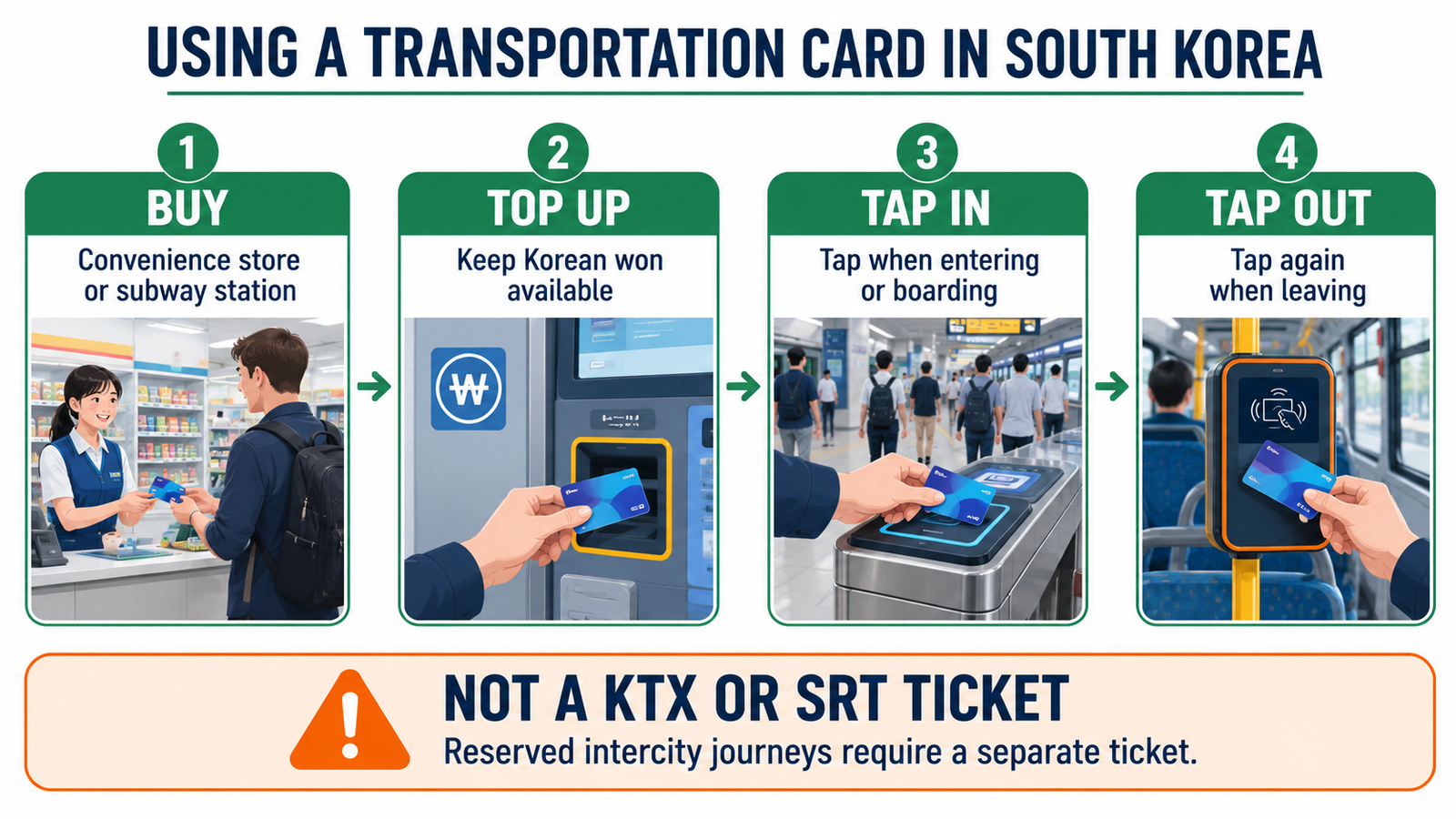
Cards can be purchased at many convenience stores and subway stations. The cost of the card itself does not normally include travel credit, so it must be topped up before use.

Carry Korean won because foreign-issued bank cards may not be accepted for purchasing or recharging a transportation card at many locations. The official 2026 visitor transport guide specifically advises travelers to expect cash-only T-money purchase or top-up in many cases.

What T-Money Can Usually Pay For

  • city subways;
  • city buses;
  • some airport transport;
  • participating taxis;
  • selected convenience-store purchases;
  • other participating local services.

How to use a transportation card on buses and subways in South Korea

What T-Money Does Not Replace

A regular T-money card does not function as an ordinary reserved KTX or SRT ticket. It also does not replace advance reservations for most long-distance coaches or domestic flights.

Think of it as a local public-transport wallet, not a universal national travel pass.

Tap When Leaving the Bus

When using a transportation card on a Korean city bus, tap when boarding and again when leaving. The second tap is important for calculating the correct fare and receiving eligible transfer discounts.

Transfer rules differ by city. Do not assume Seoul’s transfer window and limits apply everywhere else.

For current card types and conditions, consult the official VISITKOREA transportation-card guide.

Using Public Transportation in Korean Cities

Seoul

Seoul has an extensive subway and bus network. A transportation card is usually the simplest payment method.

Choose accommodation based partly on subway access: our guide to where to stay in Seoul compares seven areas and their transport connections.

The Airport Railroad provides all-stop and express services between Incheon International Airport and Seoul. The all-stop service also connects with Hongdae, while the express train runs directly to Seoul Station.

Busan

Busan has a metro, city buses and taxis, but its attractions are spread across a long coastal area. Staying in the wrong district can add considerable travel time.

Group nearby sights together instead of repeatedly crossing the city between Haeundae, Gwangalli, Seomyeon, Nampo and the railway station.

Gyeongju

Gyeongju’s main attractions are divided between the historic center and locations farther outside it. Buses reach many major sites, but frequencies can be lower than in Seoul.

A taxi can be useful when several people are traveling together or when visiting a remote attraction with limited time.

If Gyeongju is part of a cultural route, our guide to South Korea historical landmarks explains how it fits alongside Seoul, Suwon, Jeonju and Andong.

Jeju Island

Jeju has an extensive bus network, but attractions are distributed around the island. Public transport is possible when staying longer and organizing each day geographically.

A rental car becomes more attractive when the itinerary includes several natural attractions, trailheads or coastal stops in one day.
Before planning transport to national parks and trailheads, compare the routes in our guide to hiking in South Korea.

Should You Rent a Car in South Korea?

Most visitors do not need a car for a first trip based around Seoul, Gyeongju and Busan.

Destination Rent a car? Reason
Seoul
No
Dense transit, traffic and parking costs
Busan
Usually no
Metro, buses and taxis cover major areas
Gyeongju
Usually no
Bus and taxi combination is generally sufficient
Jeonju
No
Compact visitor area and good intercity connections
Sokcho/Seoraksan
Usually no
Intercity and local buses serve common routes
Jeju
Often useful
Attractions are widely distributed
Rural or mountain road trip
Possibly
Public transport can be infrequent

Tourists renting a vehicle generally need:

  • a valid international driving permit accepted in South Korea;
  • a passport;
  • their domestic driving licence if requested;
  • a credit card in the driver’s name;
  • to meet the rental company’s age and experience requirements.

Official visitor guidance states that short-term tourists must generally be at least 21 and carry an appropriate international permit. Requirements can differ by nationality and rental company, so verify eligibility before paying.

South Korea drives on the right. Rental cars may use a Hi-Pass device for automated road tolls; confirm how toll charges will be settled when returning the vehicle.

For current requirements, consult VISITKOREA’s driving guide.

Essential South Korea Transportation Apps

Naver Map

Useful for:

  • public-transport routes;
  • walking directions;
  • driving navigation;
  • Korean addresses;
  • checking the location of station exits and bus stops.

KakaoMap

Provides another source of Korean public-transport, walking and driving information. When two apps produce different results, compare departure time, number of transfers and walking distance.

KorailTalk

The official KORAIL application for train schedules, reservations and tickets.

SRT App and Website

Used for SRT services departing from Suseo and other SRT stations.

Taxi Apps

Kakao T is widely used, while visitor-oriented platforms such as k.ride may offer a more accessible registration and payment process for some international travelers.

App availability, language support and foreign-card acceptance can change. Install and test essential applications before the day of a long-distance journey.

Papago

Papago is not a transport application, but it is useful for translating terminal names, platform notices and messages from drivers.

Three Example Transport Plans

Seven Days: Seoul, Gyeongju and Busan

  • Incheon Airport → Seoul: AREX or airport limousine bus;
  • Seoul city travel: subway and bus with a transportation card;
  • Seoul → Gyeongju: KTX;
  • Gyeongju local travel: bus and occasional taxi;
  • Gyeongju → Busan: bus or train;
  • Busan city travel: metro and bus;
  • Busan → Seoul or Incheon: KTX plus airport transfer.

Ten Days: Add Jeonju

  • Seoul → Jeonju: KTX or express bus;
  • Jeonju → Gyeongju: compare bus connections with rail transfers;
  • continue to Busan by bus or train.

Do not force every segment onto KTX. A direct bus can be easier than taking two trains with a transfer.

Fourteen Days: Add Jeju or Sokcho

For Jeju:

  • fly from Gimpo or Busan;
  • use buses for a slow itinerary or rent a car for a more intensive route.

For Sokcho and Seoraksan:

  • take an express or intercity bus from Seoul;
  • connect to local buses or taxis for trailheads and accommodation.

Use our South Korea itinerary guide to compare complete seven-, ten- and fourteen-day routes.

Common Transportation Mistakes

Arriving at the Wrong Terminal

Cities may have separate express bus terminals, intercity terminals and railway stations. Search for the full terminal name rather than only the city.

Assuming T-Money Pays for Everything

T-money is primarily for local transport and participating purchases. Reserved intercity services normally require a separate ticket.

Using Only Google Maps

Google Maps can be useful for finding places, but its Korean public-transport and driving functionality may be less complete than local services. Compare routes in Naver Map or KakaoMap.

Forgetting Cash

Keep a small amount of Korean won for transportation-card top-ups, smaller terminals and situations where a foreign card is not accepted.

Booking Too Late

KTX, SRT and popular buses can sell out during weekends and major holidays. Flexible travelers should still reserve important segments before accommodation cancellation deadlines expire.

Ignoring Station Location

A high-speed station may be outside the visitor center. Compare the complete journey from hotel to hotel, including the final bus, subway or taxi.

Planning a Tight Connection

Allow additional time when transferring between:

  • separate railway stations;
  • a train and an intercity bus;
  • Gimpo and Incheon airports;
  • a ferry and another reserved service.

Frequently Asked Questions

What is the best way to get around South Korea?

For most first-time visitors, the best combination is KTX for major cities, express or intercity buses for destinations without convenient rail service, domestic flights for Jeju and a T-money or EZL card for local transport.

Is public transportation in South Korea easy for tourists?

Major cities and intercity routes are generally manageable with English-language booking sites and navigation apps. The most common difficulties involve payment cards, similarly named stations and different bus terminals.

Can I use T-money on KTX?

A regular T-money card does not replace a reserved KTX ticket. Purchase KTX tickets through KORAIL, the KorailTalk app, a machine or a station counter.

Is the KORAIL Pass worth buying?

It can be worthwhile for several expensive KORAIL journeys within a short period. Compare the current pass price with the combined cost of individual tickets. Remember that SRT and city subways are not included in the standard rail pass.

Do I need cash for transportation in South Korea?

It is sensible to carry Korean won. Many major tickets can be purchased with a foreign card, but transportation-card purchase and top-up may require cash.

Is KTX better than an express bus?

KTX is usually better for speed and predictable arrival times between major rail-connected cities. Buses can be cheaper and are often more convenient for destinations such as Sokcho or places without a central railway station.

Do I need a rental car in South Korea?

Not for a standard Seoul–Gyeongju–Busan itinerary. A car is more useful on Jeju Island or for rural and mountain routes with limited public transport.

How much should I budget for local public transport?

A traveler making several subway and bus journeys might spend approximately ₩5,000–₩10,000 per day, excluding taxis and intercity transport. Actual spending depends on distance, transfers and city.

Final Recommendation

When deciding how to get around South Korea, do not commit to a single type of transport for the entire trip.

Use high-speed trains where the rail network is strongest, buses where they provide a more direct connection, flights for Jeju and transportation cards for everyday city travel. Rent a car only when the additional flexibility outweighs parking, tolls and licence requirements.

Before purchasing any pass, calculate the price of the journeys you will actually take. A carefully planned combination of individual tickets is often more practical than forcing every route into a single pass.

Official Sources and Booking Resources

Leave a Comment

Your email address will not be published. Required fields are marked *