
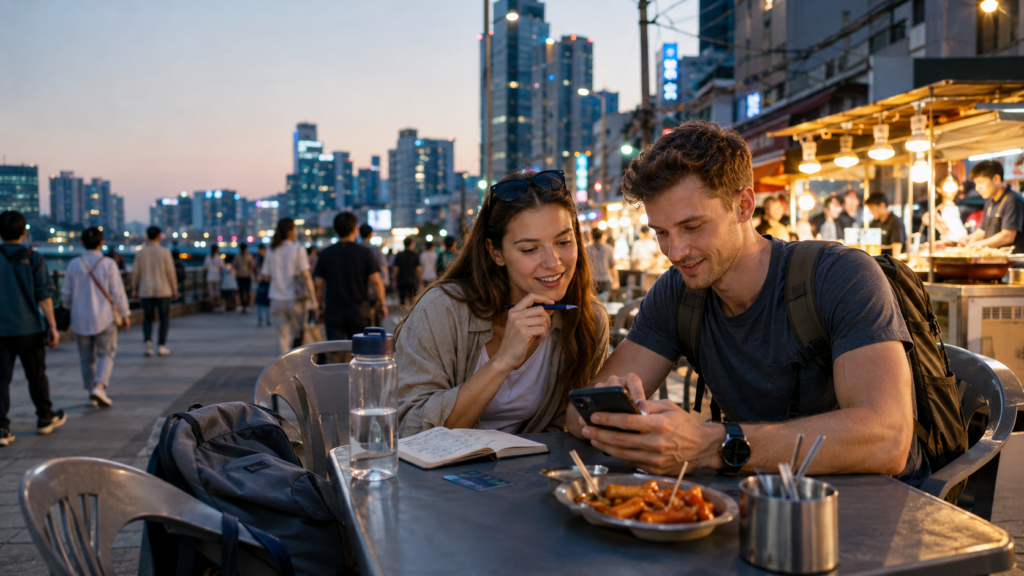
Travellers planning their South Korea trip budget in Seoul

South Korea Trip Cost: Daily Budget for 7, 10 and 14 Days

How much does a trip to South Korea cost? As a practical starting point, allow approximately ₩80,000–₩145,000 per person per day for a budget trip, ₩170,000–₩300,000 for a mid-range trip, or ₩340,000–₩580,000 or more for a comfortable trip.

These estimates include accommodation, meals, local transport, ordinary attractions, connectivity and an allowance for travel between cities. They do not include international flights, travel insurance or major shopping purchases.

A seven-day South Korea trip can therefore cost approximately ₩650,000–₩950,000 per person on a careful budget or ₩1,300,000–₩2,000,000 with a private room, more restaurant meals and paid attractions.

This guide uses Korean won because exchange rates change continuously. Convert the final total into your home currency only when you are ready to book.

Price-check note: Prices and planning ranges were reviewed in August 2026. Accommodation and airfares are dynamic, while transport fares, admission fees and individual business prices may change. Always check official booking pages before payment.

South Korea Travel Cost at a Glance

Travel style Daily cost per person 7 days 10 days 14 days
Budget
₩80,000–₩145,000
₩650,000–₩950,000
₩900,000–₩1,350,000
₩1,350,000–₩2,100,000
Mid-range
₩170,000–₩300,000
₩1,300,000–₩2,000,000
₩1,800,000–₩2,800,000
₩2,700,000–₩4,400,000
Comfortable
₩340,000–₩580,000+
₩2,600,000–₩4,000,000+
₩3,600,000–₩5,500,000+
₩5,300,000–₩8,200,000+

The trip totals are not simply daily costs multiplied by the number of days. They also account for the approximate number of hotel nights, intercity journeys and, in the 14-day example, a possible domestic flight or ferry connection.

International flights are excluded because a journey from Japan, Australia, Europe or North America can have entirely different pricing.

Convert Your South Korea Budget into Your Currency

Use the live converter below to translate Korean won into your home currency. Enter one of the totals from the table above and select your preferred currency.

Exchange rates shown by the converter are mid-market reference rates. Your bank, card provider, ATM or exchange office may apply a different rate and additional fees. All budgets in this guide remain in Korean won because local prices are charged in KRW.

What Is Included in These Estimates?

The calculations include:

  • accommodation;
  • everyday meals and drinks;
  • subway, bus and occasional taxi travel;
  • travel between cities;
  • regular museums and attractions;
  • a SIM, eSIM or similar connectivity allowance;
  • a small reserve for laundry, lockers and other minor expenses.

They exclude:

  • flights to and from South Korea;
  • travel insurance;
  • visa or electronic travel-authorisation costs;
  • extensive shopping;
  • luxury restaurants and nightlife;
  • private tours;
  • ski passes, diving, surfing lessons and other specialist activities.

If you are still deciding how long to stay and which cities to include, start with the South Korea itinerary and travel guide.

Average South Korea Daily Budget

The following table shows how the daily estimates are divided.

Expense Budget traveller Mid-range traveller Comfortable traveller
Accommodation
₩30,000–₩55,000
₩70,000–₩120,000
₩150,000–₩250,000+
Food and drinks
₩25,000–₩40,000
₩45,000–₩75,000
₩80,000–₩130,000+
Local transport
₩5,000–₩10,000
₩10,000–₩20,000
₩25,000–₩50,000
Attractions
₩0–₩15,000
₩15,000–₩35,000
₩35,000–₩70,000+
Intercity travel allowance
₩10,000–₩15,000
₩20,000–₩30,000
₩30,000–₩50,000
Connectivity and miscellaneous costs
₩5,000–₩10,000
₩10,000–₩20,000
₩20,000–₩30,000
Approximate daily total
₩80,000–₩145,000
₩170,000–₩300,000
₩340,000–₩580,000+

The accommodation figures are per person. Mid-range and comfortable calculations assume that two people share a room. Solo travellers who want a private room should expect a higher per-person cost.
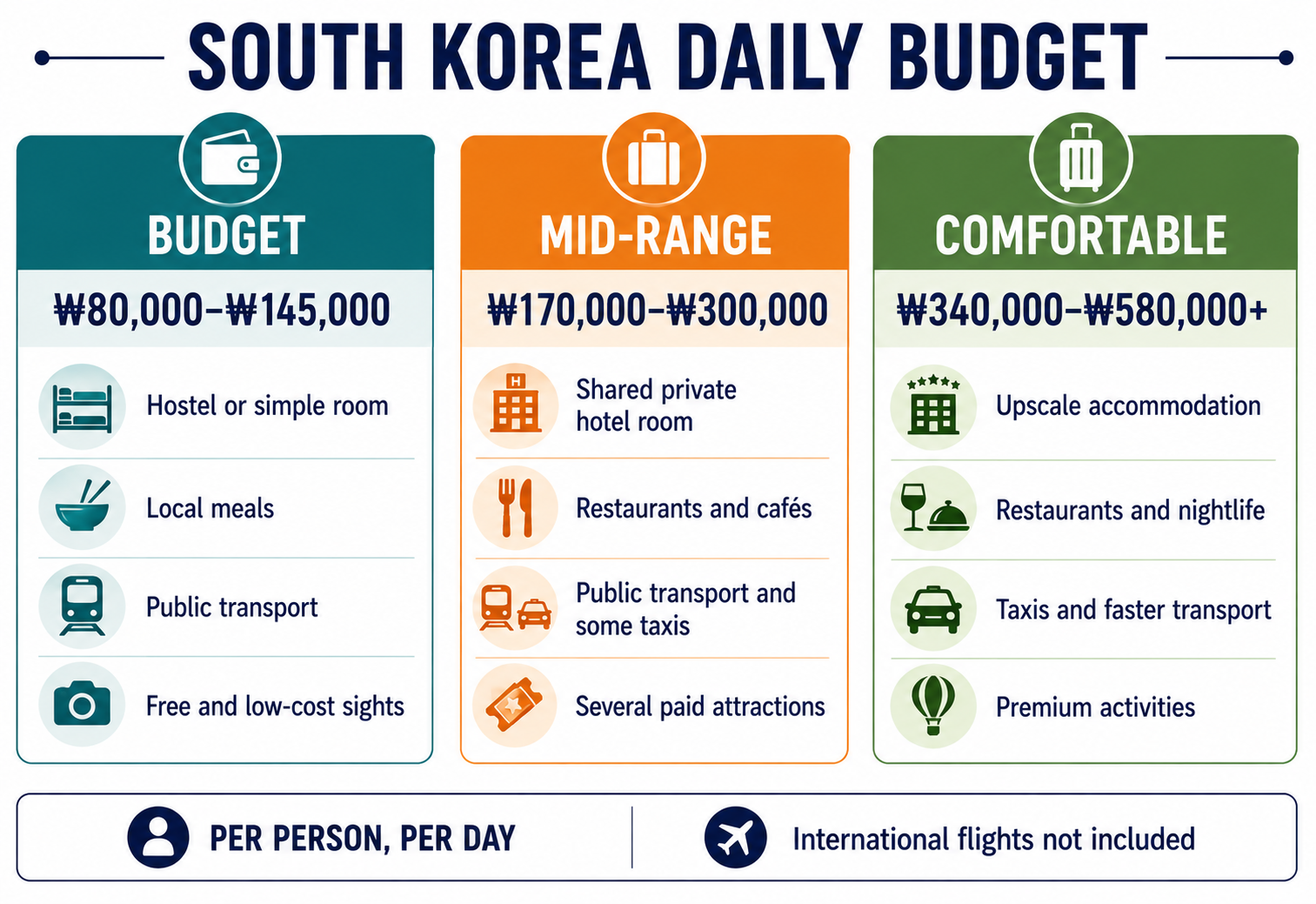
South Korea daily travel budget for budget, mid-range and comfortable trips

Accommodation Costs in South Korea

Accommodation is normally the largest part of a South Korea travel budget.

Accommodation type Typical price
Hostel dormitory bed
₩25,000–₩50,000 per person
Guesthouse or very simple private room
₩50,000–₩90,000 per room
Budget hotel
₩60,000–₩120,000 per room
Mid-range hotel
₩120,000–₩240,000 per room
Comfortable or upscale hotel
₩250,000–₩500,000+ per room
Hanok stay
₩100,000–₩300,000+ per room

Hotel prices change according to the day of the week, neighbourhood, booking conditions and season. Seoul business districts can sometimes be cheaper on weekends, while Busan beach hotels may become substantially more expensive during summer weekends.

Cherry blossom season, autumn foliage, major festivals and public holidays can also raise prices. Our best time to visit South Korea guide explains the main seasonal trade-offs.

For Seoul neighbourhoods, transport connections and accommodation types, use the separate Where to Stay in Seoul guide.

Solo Traveller Versus Couple

A couple does not necessarily spend twice as much as a solo traveller. The room price can be divided between two people, and taxi fares can also be shared.
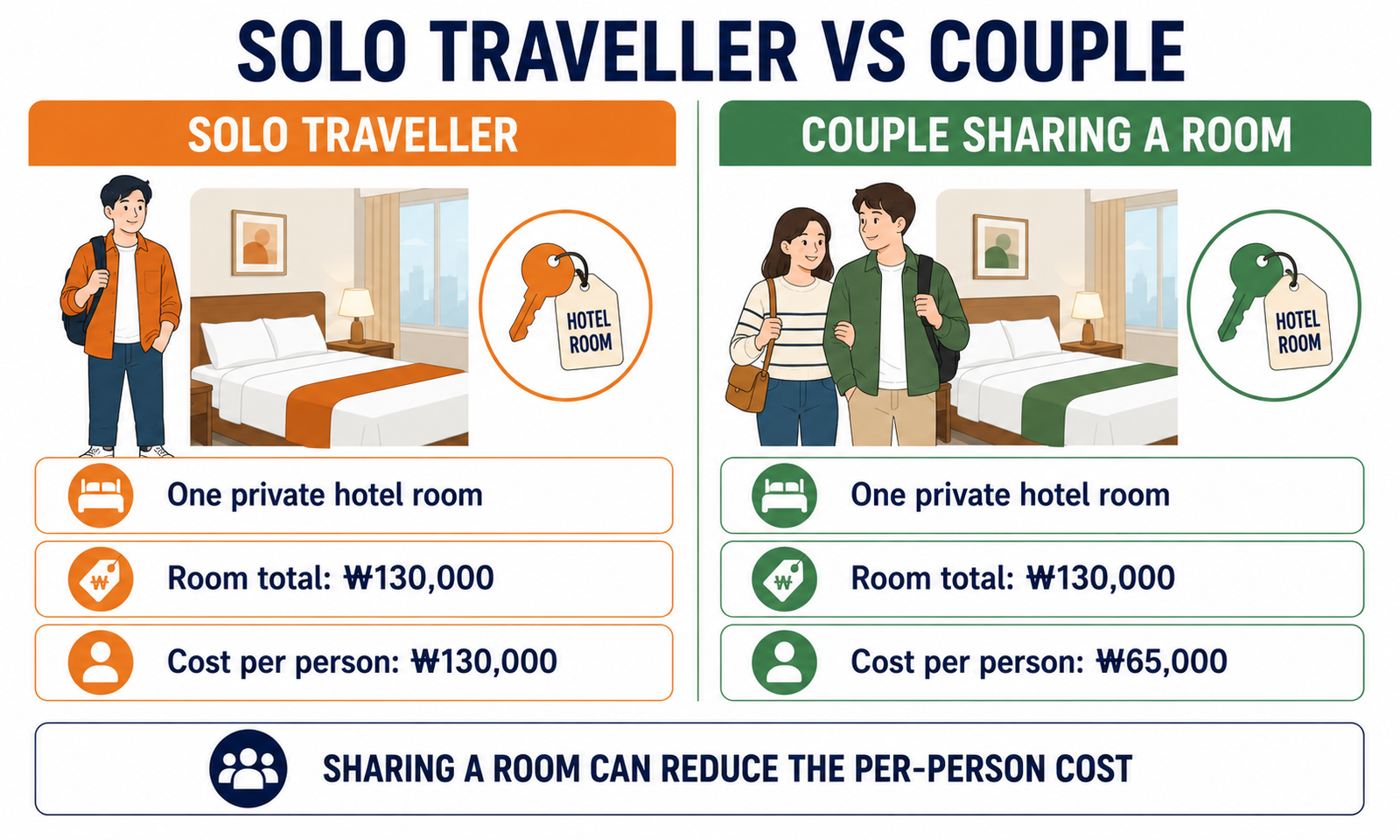
Accommodation cost comparison for a solo traveller and a couple in South Korea

For example:

  • one solo traveller paying ₩130,000 for a hotel spends ₩130,000 per person;
  • two travellers sharing the same room spend ₩65,000 each;
  • two dormitory beds, however, are normally charged individually.

For this reason, a solo traveller using private hotels may need to add approximately ₩40,000–₩100,000 per day to the mid-range per-person estimate.

Food Costs in South Korea

South Korea can be relatively affordable for everyday meals, but cafés, alcohol, Korean barbecue and fashionable restaurants can quickly increase the daily total.

Food or drink Typical planning range
Convenience-store breakfast
₩4,000–₩8,000
Gimbap, noodles or simple rice dish
₩5,000–₩12,000
Soup, stew or casual Korean meal
₩9,000–₩16,000
Bibimbap
₩10,000–₩19,000
Korean barbecue
₩20,000–₩45,000+ per person
Café drink
₩4,500–₩8,000
Dessert or bakery visit
₩5,000–₩15,000
Casual dinner with drinks
₩25,000–₩60,000+ per person

As a current point of reference, VISITKOREA lists examples of Jeonju bibimbap between ₩12,000 and ₩19,000, depending on the restaurant and version of the dish. VISITKOREA’s Jeonju bibimbap guide

Budget travellers can keep food expenses near ₩25,000–₩40,000 per day by combining convenience-store breakfasts, local lunch restaurants and inexpensive dinners. A budget based entirely on tourist cafés, barbecue and nightlife will be considerably higher.

See our guide to the best Korean food for dishes, typical prices and ordering advice.
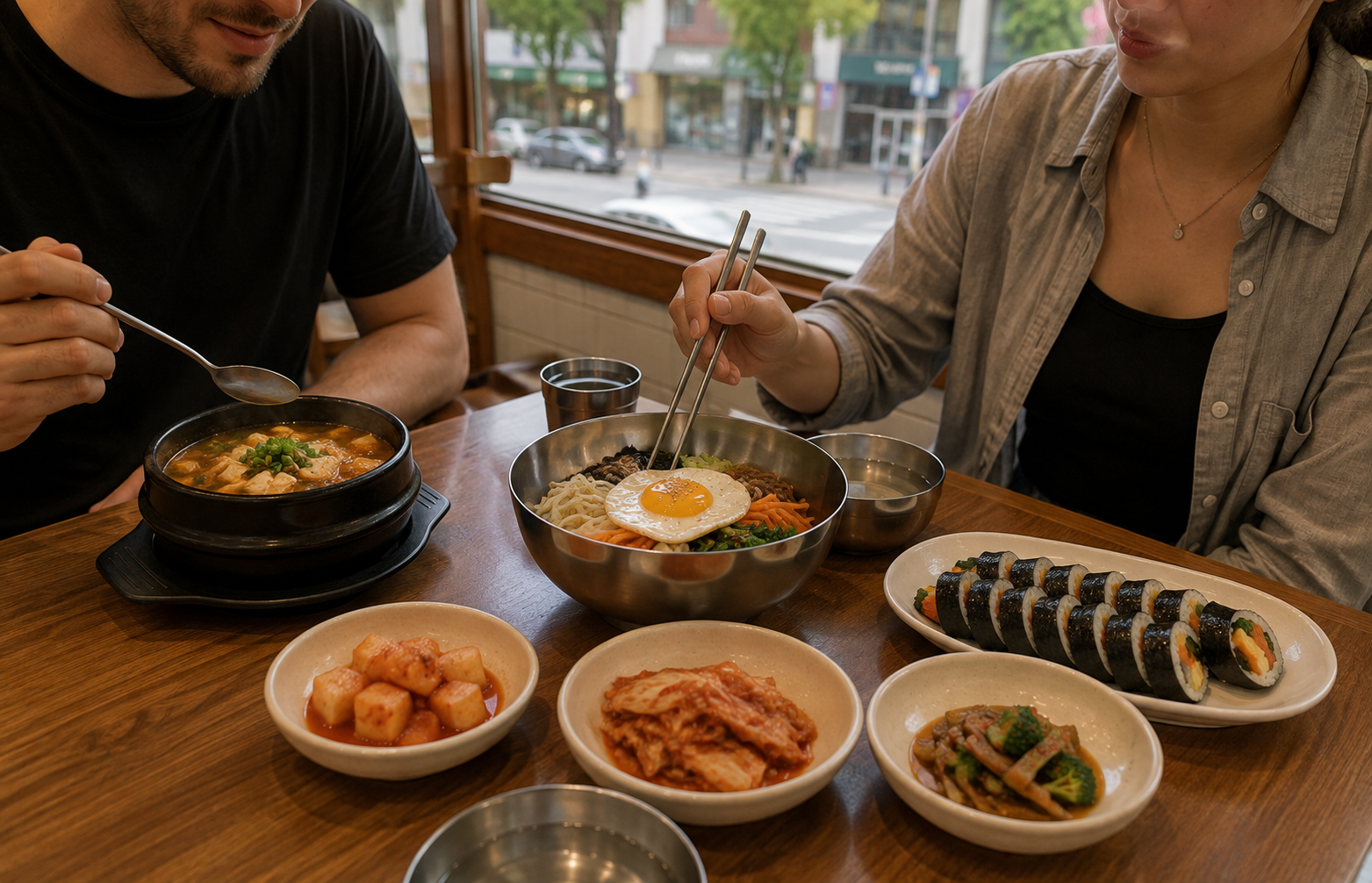
Affordable Korean meals at a local restaurant in South Korea

Local Transportation Costs

Public transport keeps daily costs manageable in Seoul, Busan and other large cities.

As of August 2026, the adult Seoul subway base fare is ₩1,550 with a transport card and ₩1,650 for a single-use ticket. Longer journeys cost more according to distance. Seoul Metropolitan Government subway fares

A traveller making three or four ordinary subway or bus journeys should generally budget around ₩5,000–₩10,000 per day. Add more if you expect to use taxis or travel repeatedly across the metropolitan area.

Seoul’s short-term Climate Card currently costs:

Pass Price
1 day
₩5,000
2 days
₩8,000
3 days
₩10,000
5 days
₩15,000
7 days
₩20,000

The physical card costs an additional ₩3,000, and coverage restrictions apply. A pass is not automatically cheaper for every visitor, so compare it with the number and location of your planned journeys. Official Climate Card information

Foreign-issued bank cards cannot normally be used directly to tap through ordinary subway and bus gates. The 2026 VISITKOREA transport guide also states that purchasing or topping up a regular T-money card generally requires cash or a Korean-issued card. VISITKOREA transportation guide

Our South Korea transportation guide explains trains, buses, transit cards, booking systems and rental cars in more detail.

Intercity Transportation Costs

Moving between several cities can noticeably change the total trip cost.

Journey type Typical one-way planning range
Regional or slower train
₩10,000–₩35,000
Express or intercity bus
₩10,000–₩45,000
KTX or SRT high-speed train
₩25,000–₩65,000
Domestic flight
₩30,000–₩150,000+
Airport transfer
₩5,000–₩20,000 by public transport

For a concrete example, a standard Seoul–Busan KTX ticket is normally around ₩59,800 one way. A return journey therefore adds roughly ₩119,600 before local transport. Bus travel can cost less but takes considerably longer.

Compare stations, fares and door-to-door journey times in our Seoul to Busan guide.

Domestic flights to Jeju fluctuate according to the date, luggage allowance, airport and booking time. Check the total after baggage is added rather than comparing only the advertised base fare.

Attraction and Activity Costs

South Korea contains many free parks, neighbourhoods, markets, hiking trails and public museums. Historic attractions are often inexpensive.

For example, standard adult admission to Gyeongbokgung Palace is currently ₩3,000. Changdeokgung’s main palace admission is also ₩3,000, while its Secret Garden requires a separate ticket. Korea Heritage Service palace fees

A practical daily attraction budget is:

  • ₩0–₩15,000: free neighbourhoods, parks, trails, markets and one inexpensive museum or palace;
  • ₩15,000–₩35,000: several paid attractions or one larger museum experience;
  • ₩35,000–₩70,000: observation decks, performances and commercial experiences;
  • ₩70,000+: organised tours, theme parks and specialist activities.

Do not buy a city pass only because its total advertised discount looks large. List the attractions you will realistically visit, check their individual prices and compare that total with the pass.

SIM, eSIM and Other Small Expenses

Allow approximately ₩20,000–₩70,000 for mobile connectivity during a one- or two-week trip. The price depends on duration, data limits, voice service and whether you purchase an eSIM, physical SIM or portable Wi-Fi device.

Other commonly overlooked expenses include:

  • coin lockers;
  • luggage storage or forwarding;
  • hotel laundry;
  • ATM or foreign-card fees;
  • bottled drinks and café stops;
  • baggage fees on domestic flights;
  • late-night taxis;
  • transport-card purchase and unused balance.

These individually small costs justify keeping a miscellaneous reserve of at least ₩50,000–₩100,000 per person for a one-week trip.
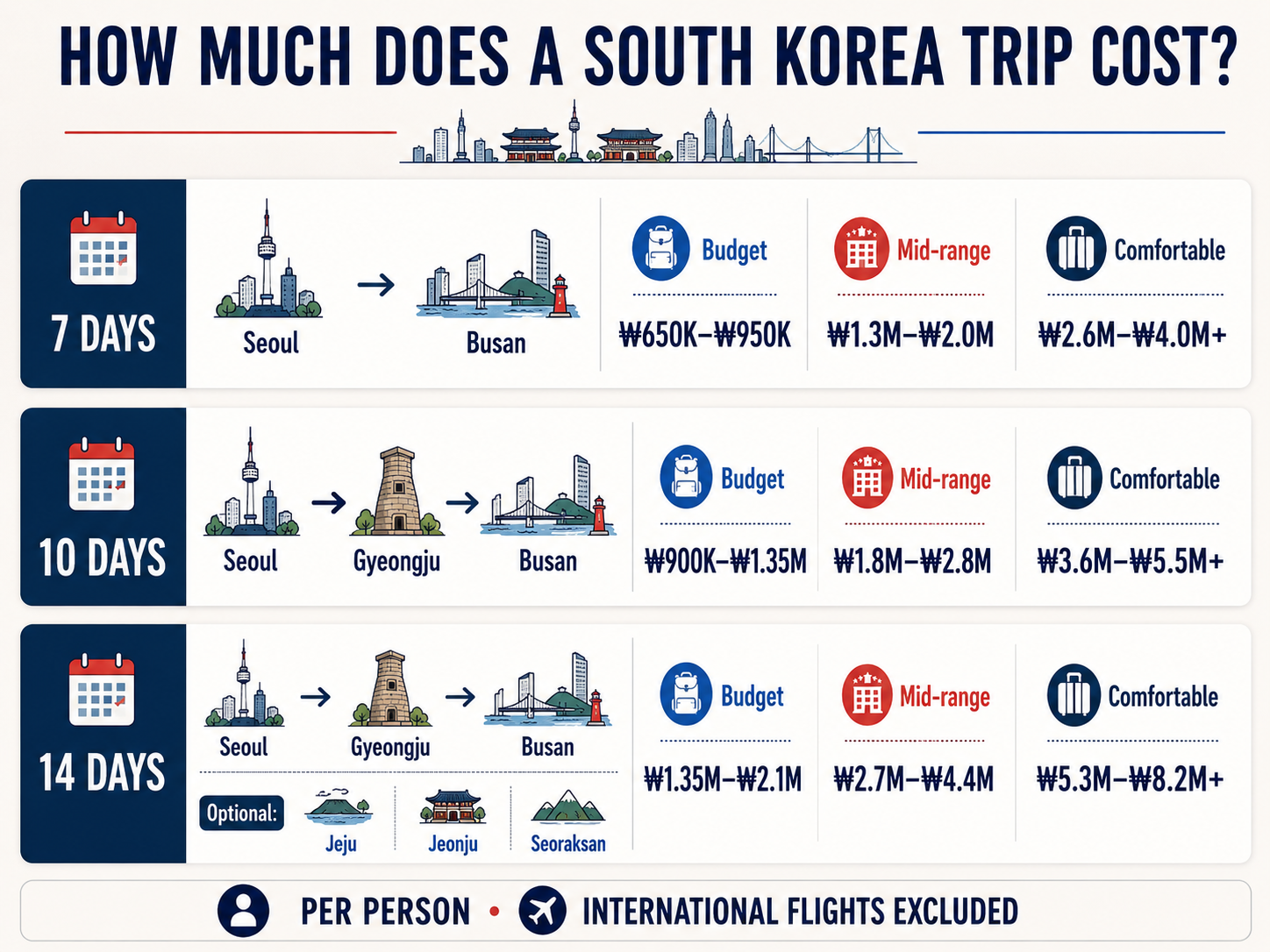
South Korea trip cost for 7, 10 and 14 days

7-Day South Korea Trip Cost

A first seven-day visit will usually focus on Seoul or combine Seoul with Busan.

Example: Seoul and Busan

Expense Budget traveller Mid-range traveller Comfortable traveller
Accommodation: 6 nights
₩210,000–₩330,000
₩420,000–₩720,000
₩900,000–₩1,500,000+
Food
₩175,000–₩280,000
₩315,000–₩525,000
₩560,000–₩910,000+
Local transport
₩35,000–₩70,000
₩70,000–₩140,000
₩175,000–₩350,000
Seoul–Busan transport
₩60,000–₩120,000
₩120,000–₩170,000
₩170,000–₩300,000
Attractions
₩20,000–₩70,000
₩80,000–₩200,000
₩250,000–₩600,000+
Connectivity and reserve
₩50,000–₩80,000
₩70,000–₩130,000
₩120,000–₩250,000

Estimated total

₩650,000–₩950,000

₩1,300,000–₩2,000,000

₩2,600,000–₩4,000,000+

The lowest budget assumes a hostel or shared inexpensive room, careful meal choices, public transport and mostly free or low-cost attractions.

10-Day South Korea Trip Cost

Ten days provide enough time for a route such as:

Seoul → Gyeongju → Busan

A reasonable per-person budget is:

Travel style Approximate 10-day total
Budget
₩900,000–₩1,350,000
Mid-range
₩1,800,000–₩2,800,000
Comfortable
₩3,600,000–₩5,500,000+

This estimate includes nine accommodation nights and two major intercity transfers. It does not include an international flight.

Travelling by express bus or slower train can reduce the transport portion. High-speed trains save time but should usually be booked in advance for weekends and major holidays.

14-Day South Korea Trip Cost

A two-week trip may combine Seoul, Gyeongju and Busan with Jeju, Jeonju or Sokcho and Seoraksan.

Travel style Approximate 14-day total
Budget
₩1,350,000–₩2,100,000
Mid-range
₩2,700,000–₩4,400,000
Comfortable
₩5,300,000–₩8,200,000+

The upper end assumes more private accommodation, several paid activities and either domestic flights or more expensive intercity transport.

Adding Jeju does not mean adding only the airfare. Account for:

  • travel to and from both airports;
  • checked baggage;
  • transport around Jeju;
  • possible car rental;
  • parking and fuel;
  • different weekend accommodation prices.

When Is South Korea More Expensive?

The most expensive periods commonly include:

  • late March to mid-April during cherry blossom season;
  • popular weekends in May and October;
  • July and August at beach and resort destinations;
  • late October and early November in foliage areas;
  • Seollal and Chuseok;
  • Christmas and New Year;
  • major festivals and concert weekends.

The entire country does not become equally expensive at the same time. A festival may affect accommodation in one city while rooms elsewhere remain reasonably priced.

Before changing your entire itinerary, compare the cost of shifting your arrival by one or two days or visiting a popular destination during the week.

How to Reduce Your Korea Travel Budget

Stay Close to a Useful Station

A slightly more expensive room near a well-connected station may reduce taxi fares and save time. Check the actual journey to the places you plan to visit instead of choosing accommodation only by district name.

Travel Between Cities Outside Peak Periods

Friday evenings, Sunday afternoons and public-holiday periods can have limited availability. Flexible travellers should compare KTX, SRT, express buses and domestic flights.

Use Free and Low-Cost Attractions

Palaces, neighbourhood walks, markets, riverside parks, hiking routes and public museums can fill several days without a high admission budget.

Make Lunch the Main Restaurant Meal

Combine a substantial local lunch with a lighter breakfast and dinner. This controls costs without reducing the trip to convenience-store food.

Check the Final Booking Price

Before paying for a hotel or flight, confirm:

  • taxes;
  • baggage;
  • cancellation rules;
  • breakfast;
  • payment currency;
  • foreign-card fees;
  • whether the listed price is per person or per room.

Keep Shopping Separate

Do not hide skincare, fashion, souvenirs or K-pop merchandise inside the daily food and transport allowance. Create a separate shopping budget using our Seoul shopping guide.

Cash, Cards and Emergency Money

International Visa and Mastercard cards are accepted by many hotels, shops and restaurants, but travellers should not rely on one card or one payment method.

Carry:

  • at least two payment cards stored separately;
  • approximately ₩30,000–₩50,000 in accessible cash;
  • additional cash when topping up a regular transport card;
  • an emergency reserve that is not part of the daily spending budget.

Check whether your bank charges foreign transaction or ATM fees. Paying in Korean won is often preferable to accepting a merchant’s conversion into your home currency, but confirm your own bank’s terms.

Is South Korea Expensive to Visit?

South Korea is not inherently a budget destination, but it does not need to be extremely expensive. Public transport, local meals, palaces, parks and museums can be affordable. Private accommodation in popular districts, cafés, nightlife, domestic flights and frequent high-speed rail travel create most of the larger increases.

The country is easiest to manage on a limited budget when you:

  • use public transport;
  • stay in guesthouses or simple hotels;
  • limit the number of long-distance transfers;
  • mix free sights with paid attractions;
  • travel outside peak weekends;
  • keep shopping separate from necessary expenses.

Frequently Asked Questions

How much money do I need for seven days in South Korea?

Allow approximately ₩650,000–₩950,000 per person for a careful budget trip or ₩1,300,000–₩2,000,000 for a mid-range trip. International flights are not included.

How much should I budget per day in South Korea?

A practical daily budget is ₩80,000–₩145,000 for budget travel, ₩170,000–₩300,000 for mid-range travel or ₩340,000–₩580,000 or more for a comfortable trip.

Is Seoul more expensive than the rest of South Korea?

Accommodation in popular Seoul districts can be expensive, but regional resort areas, Busan beaches and Jeju can equal or exceed Seoul during weekends and peak seasons. Food and local public transport remain available at several price levels.

Is ₩100,000 per day enough in South Korea?

It can be enough for a budget traveller using hostels or inexpensive shared accommodation, local restaurants, public transport and mostly low-cost attractions. It is unlikely to cover a private mid-range hotel, frequent taxis and major paid experiences.

Should international airfare be included in a Korea travel budget?

Add airfare separately. Its price depends much more on the departure country, season, baggage and route than on expenses inside South Korea.

How much cash should I carry?

Most travellers do not need to carry their entire budget in cash. Keep approximately ₩30,000–₩50,000 accessible for transport-card top-ups, small businesses and emergencies, with the rest available through more than one payment card.

Final Budget Checklist

Before booking, calculate these items separately:

International flight
+ Accommodation
+ Food
+ Local transport
+ Intercity transport
+ Attractions
+ SIM or eSIM
+ Insurance
+ Shopping
+ 10–15% emergency reserve
= Estimated South Korea trip cost

For most first-time visitors, the realistic middle ground is approximately ₩1.8–₩2.8 million per person for ten days, excluding the international flight. The final total depends less on one expensive meal or attraction than on accommodation choices, the number of cities visited and how often you use flights, taxis and high-speed trains.

Leave a Comment

Your email address will not be published. Required fields are marked *