
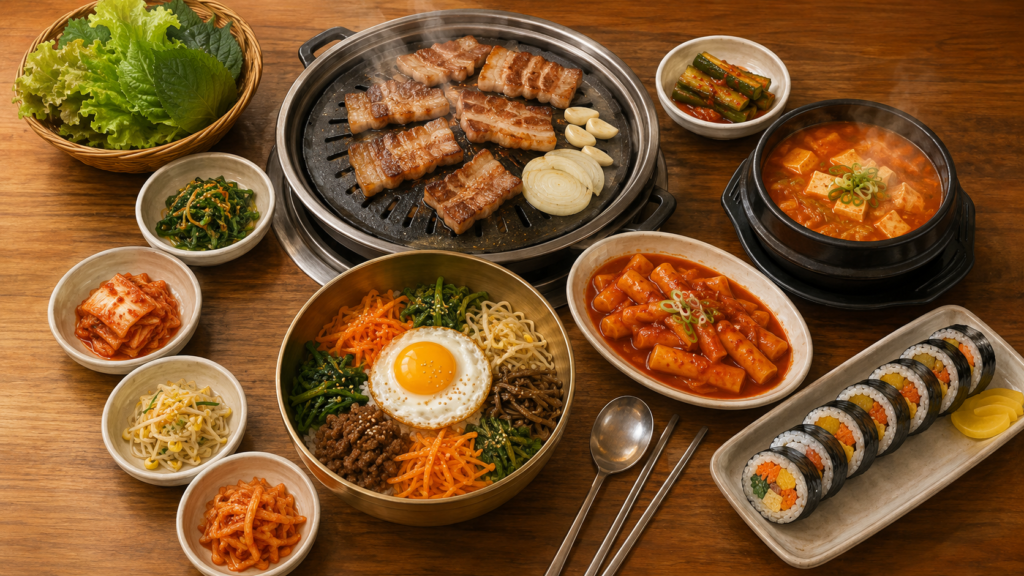
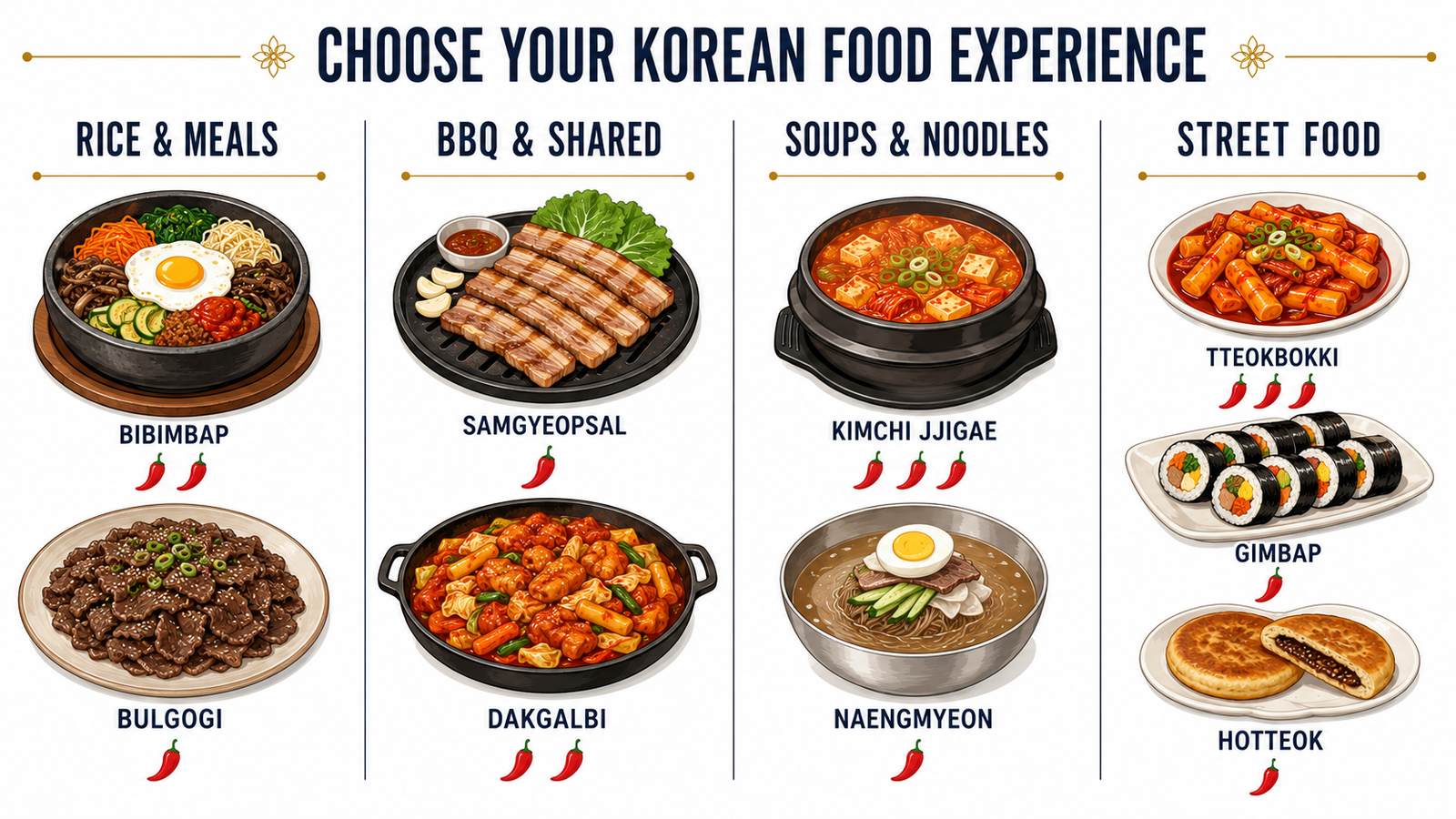
Spice levels are only general guidance. Recipes and sauces differ between restaurants, and a dish described as “mild” may still contain chili.
How Korean Meals Work
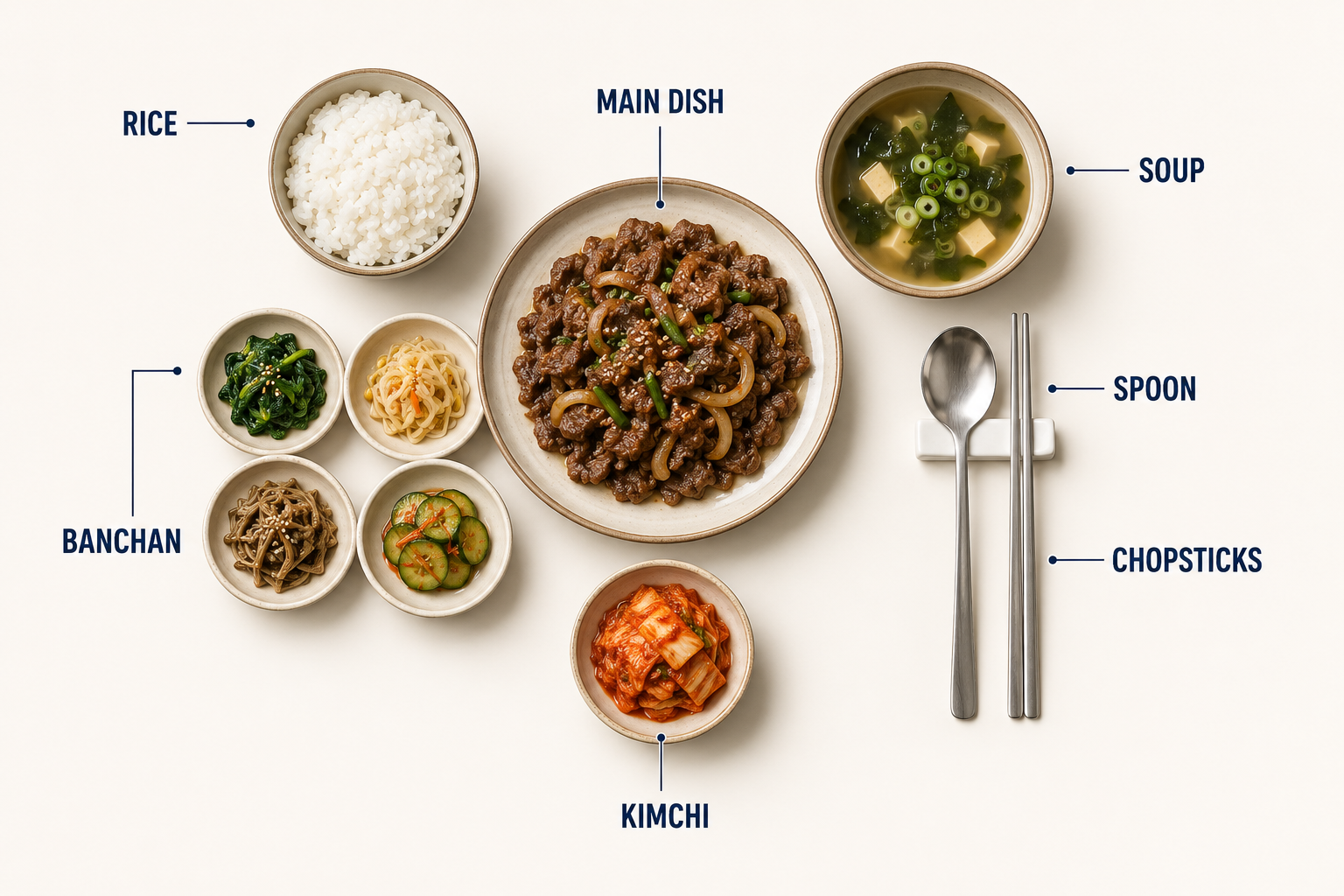
Korean food is often served as several dishes arranged together rather than as a single plate. Rice and soup are placed in front of the diner, while the main dish and small side dishes called banchan are shared or positioned around the table.
The Korea Tourism Organization’s guide to Korean food explains this traditional arrangement as han sang charim.
Kimchi is a common banchan, but it is only one of many possibilities. A restaurant may also serve seasoned vegetables, pickled radish, fish cake, seaweed or braised dishes.
Banchan is usually included in the meal price. Refills are common at many restaurants but should not be assumed to be unlimited or free everywhere. Look for a self-service station or ask the staff before taking more.
Shared Food and Minimum Orders
Korean BBQ, dakgalbi, bossam and large chicken dishes are commonly shared. Some restaurants require a minimum first order of two meat portions, even when only one person is seated.
A portion listed as 150–200 grams may not represent the complete minimum order. Look for wording such as:
2인분 이상 주문This means that an order of at least two portions is required.
Solo travelers will generally find rice bowls, soups, noodles, gimbap shops and bunsik restaurants easier than shared grill restaurants.
1. Bibimbap: The Easiest First Korean Meal
Bibimbap combines rice with vegetables, egg and frequently meat. Gochujang, a fermented red chili paste, is normally served with it or already added.
The ingredients are mixed before eating, producing a combination of rice, vegetables, sesame oil and chili paste. Add gochujang gradually if you are uncertain about spice.
A hot stone version called dolsot bibimbap continues cooking at the table and forms a crisp layer of rice at the bottom.
Where to Try It
Bibimbap is available throughout South Korea, but Jeonju has a particularly strong association with the dish. Representative Jeonju menus listed by VisitKorea place traditional versions around ₩12,000–₩19,000.
The official Jeonju bibimbap guide provides background and examples of local restaurants.
2. Bulgogi: A Mild Introduction to Korean Meat Dishes
Bulgogi consists of thin slices of beef marinated with ingredients such as soy sauce, garlic, sesame oil, sugar and pear.
The dominant flavor is sweet and savory rather than spicy, making it one of the easiest Korean dishes for first-time visitors.
Depending on the restaurant, bulgogi may be grilled, cooked in a pan or served with broth and vegetables. Some restaurants sell it as an individual meal, while others require a shared order.
3. Kimchi Jjigae: Korea’s Fermented Comfort Food
Kimchi jjigae is a bubbling stew commonly made with aged kimchi, tofu, pork and onions. Its flavor is spicy, sour and deeply savory.
It normally arrives with rice and banchan. Because it is widely available as an individual meal, kimchi jjigae is practical for solo travelers.
Vegetarian visitors should not assume that a tofu-and-kimchi stew is meat-free. Pork, anchovy stock or seafood ingredients may be used even when they are not obvious from the English menu.
4. Doenjang Jjigae: Earthy Soybean Paste Stew
Doenjang jjigae is made with fermented soybean paste and may include tofu, zucchini, mushrooms, seafood or meat.
It is generally less spicy than kimchi jjigae, although chili can still be added. The flavor is salty, earthy and fermented.
The stew may be ordered as an individual meal or included with Korean BBQ. Visitors with allergies should be aware that recipes can contain soy, shellfish or anchovy-based stock.
5. Samgyetang: Mild Chicken and Ginseng Soup
Samgyetang consists of a small whole chicken filled with rice, garlic, jujube and ginseng. It is served in a hot broth.
Despite arriving at a high temperature, it is traditionally associated with summer. Korean food culture includes the idea of restoring energy by eating hot, nourishing dishes during the hottest days of the year.
The flavor is mild rather than spicy. Salt and pepper may be provided separately so diners can season the meat themselves.
Samgyetang is served as an individual portion and is therefore convenient for solo visitors.
6. Samgyeopsal: The Classic Korean BBQ Experience
Samgyeopsal is thick-cut pork belly cooked on a tabletop grill. It is normally eaten with lettuce, garlic, ssamjang, kimchi and other banchan.
Place a piece of meat inside a leaf, add a small amount of sauce and accompanying ingredients, then fold it into a wrap called ssam.
Not every restaurant expects customers to cook the meat themselves. In some places, staff control the grill and cut the meat with scissors.
What to Check Before Ordering
- price per portion or per 100 grams;
- minimum number of portions;
- whether banchan and lettuce are included;
- whether the listed amount is for pork or premium Korean beef;
- whether the restaurant accepts solo diners.
Use the storage container under your chair, if provided, to protect your coat and bag from smoke and cooking smells.
7. Galbi: Marinated Ribs from the Grill
Galbi usually refers to ribs, most commonly beef or pork, cooked over a grill. Marinated versions have a sweet soy-based flavor, while unmarinated premium beef versions emphasize the meat itself.
Prices vary greatly. Pork galbi may be relatively affordable, while Korean hanwoo beef can cost several times more.
Suwon is particularly associated with large grilled beef ribs known as wanggalbi. This makes galbi a useful regional addition to a trip that already includes Suwon.
Like samgyeopsal, galbi restaurants frequently require an order of at least two servings.
8. Bossam: Pork Wrapped with Greens
Bossam consists of sliced boiled pork served with cabbage or lettuce, garlic, sauces and kimchi.
It is milder than grilled Korean BBQ and has no smoky flavor. The diner combines the pork and accompaniments in a wrap.
Bossam is normally sold in small, medium and large sets intended for sharing. A solo traveler may find it easier to order bossam as part of a lunch set or visit a restaurant that offers a single-person portion.
9. Dakgalbi: Chuncheon’s Spicy Chicken Dish
Dakgalbi combines chicken with cabbage, sweet potato, rice cakes and a red chili-based sauce. It is commonly cooked on a large pan in the center of the table.
The dish is associated with Chuncheon, where dedicated dakgalbi streets and restaurants can be found. The official VisitKorea regional guide identifies Chuncheon as the dish’s birthplace and main destination.
After most of the chicken has been eaten, diners often order fried rice to be mixed with the remaining sauce.
Dakgalbi is usually shared, and some restaurants require at least two portions.
10. Andong Jjimdak: Sweet and Savory Braised Chicken
Andong jjimdak is made with braised chicken, vegetables, potatoes, glass noodles and a soy-based sauce.
It is generally sweet and savory, although dried chili can produce a moderate level of heat. The dark color comes mainly from soy sauce rather than gochujang.
The dish developed in Andong’s market area during the 1980s. VisitKorea provides a detailed account in its official Andong jjimdak history.
Portions are large and intended for sharing. Even the smallest size may be excessive for one person.
11. Naengmyeon: Cold Noodles for Warm Weather
Naengmyeon uses thin, chewy noodles served cold.
The two main styles are:
- mul naengmyeon — noodles in a cold broth;
- bibim naengmyeon — noodles mixed with a spicy red sauce.
Mul naengmyeon is refreshing and tangy. Bibim naengmyeon is usually sweeter and considerably spicier.
The noodles can be difficult to bite cleanly. Restaurants may provide scissors or cut them before serving.
12. Kalguksu: Hand-Cut Noodle Soup
Kalguksu means “knife-cut noodles.” The noodles are served in a warm broth that may be based on anchovies, clams, chicken or other ingredients.
The dish is usually mild and filling. It is particularly useful for travelers who want a break from grilled meat and chili-heavy meals.
Because kalguksu is typically sold as an individual bowl, it is easy to order alone. Seafood-based stock is common, so vegetarian diners should confirm the ingredients.
13. Jajangmyeon: Korean-Chinese Comfort Food
Jajangmyeon consists of noodles covered with a dark sauce made from fermented black bean paste, onions and usually pork.
The dish belongs to Korean-Chinese cuisine. Its flavor is rich, sweet and savory rather than spicy.
It is one of the easiest and least expensive individual meals to order. It is widely available in Korean-Chinese restaurants, where it may appear alongside jjamppong, a spicy seafood noodle soup.
14. Japchae: Glass Noodles with Vegetables
Japchae is made with sweet potato glass noodles, vegetables, soy sauce and sesame oil. Meat is frequently included but is not essential to the basic concept.
The noodles are springy, and the flavor is mildly sweet and savory.
Japchae appears as a main dish, banchan or part of a set meal. It is also associated with celebrations and holidays.
A vegetable-heavy appearance does not guarantee that it is vegetarian. Meat or animal-based seasonings may still be present.
15. Korean Fried Chicken: Best Experienced as Chimaek
Korean fried chicken has a thin, crisp coating and comes with numerous sauces. Common options include plain fried, sweet-spicy yangnyeom and soy-garlic.
Chimaek combines chicken with beer: chi from chicken and maek from maekju, the Korean word for beer.
A whole order is often designed for two or more people. Some restaurants offer half portions, boneless boxes or half-and-half combinations.
Representative VisitKorea listings and 2026 festival menus place many chicken orders between approximately ₩16,000 and ₩25,000, although premium restaurants and large sets can cost more.
For more about late-night dining and drinking areas, see our Seoul Nightlife Guide.
16. Tteokbokki: Korea’s Famous Spicy Rice Cakes
Tteokbokki consists of chewy rice cakes cooked in a sweet and spicy red sauce. Fish cake and boiled egg are common additions.
Spice varies significantly. A bright red sauce is not a reliable measure because some sweet versions are mild while specialty chains can be extremely hot.
At markets and festivals, a portion commonly costs around ₩4,000–₩7,000. It is an accessible introduction to Korean street food, but the chewy texture may surprise first-time visitors.
The sauce may contain anchovy stock, even when no visible seafood is present.
For daily food allowances and complete seven-, ten- and fourteen-day budgets, see our South Korea trip cost guide.
17. Gimbap: The Most Practical Travel Meal
Gimbap consists of rice and fillings rolled in dried seaweed and sliced into bite-sized pieces.
Common fillings include egg, pickled radish, carrot, spinach, fish cake, ham, tuna or beef. The rice is normally seasoned with sesame oil.
Gimbap is inexpensive, portable and easy for solo travelers. It works well for train journeys, hiking days and quick meals between attractions.
Typical basic rolls cost approximately ₩3,000–₩6,000. Premium versions with tuna, cheese or large quantities of filling cost more.
18. Hotteok: Sweet Filled Pancakes
Hotteok is a fried or griddled pancake filled with brown sugar, cinnamon and sometimes nuts or seeds.
The outside is chewy and crisp, while the filling becomes extremely hot and liquid. Let it cool briefly before taking a large bite.
Hotteok is commonly associated with cooler weather and traditional markets. Prices generally fall around ₩2,000–₩4,000.
Visitors with nut allergies should ask about the filling rather than assuming it contains only sugar.
19. Eomuk: Fish Cake from a Street-Food Stall
Eomuk is processed fish cake, often folded onto a skewer and kept warm in broth.
It has a mild, salty flavor and a springy texture. A cup of broth may be provided with the order.
Busan has a particularly strong connection with fish cake, but eomuk stalls can be found throughout South Korea.
It is inexpensive and easy to eat while walking. However, it contains fish and may also contain wheat, soy or other ingredients.
20. Bindaetteok: Mung Bean Pancake
Bindaetteok is a thick pancake made from ground mung beans. Pork, kimchi, bean sprouts or other vegetables may be mixed into the batter.
The exterior is crisp and oily, while the center remains soft and dense.
Gwangjang Market in Seoul is particularly known for bindaetteok, along with gimbap, yukhoe and other market dishes. The official Visit Seoul market guide provides current opening information and a list of representative foods.
A pancake is often large enough to share, especially when sampling several market foods.
Regional Korean Food Worth Planning Around
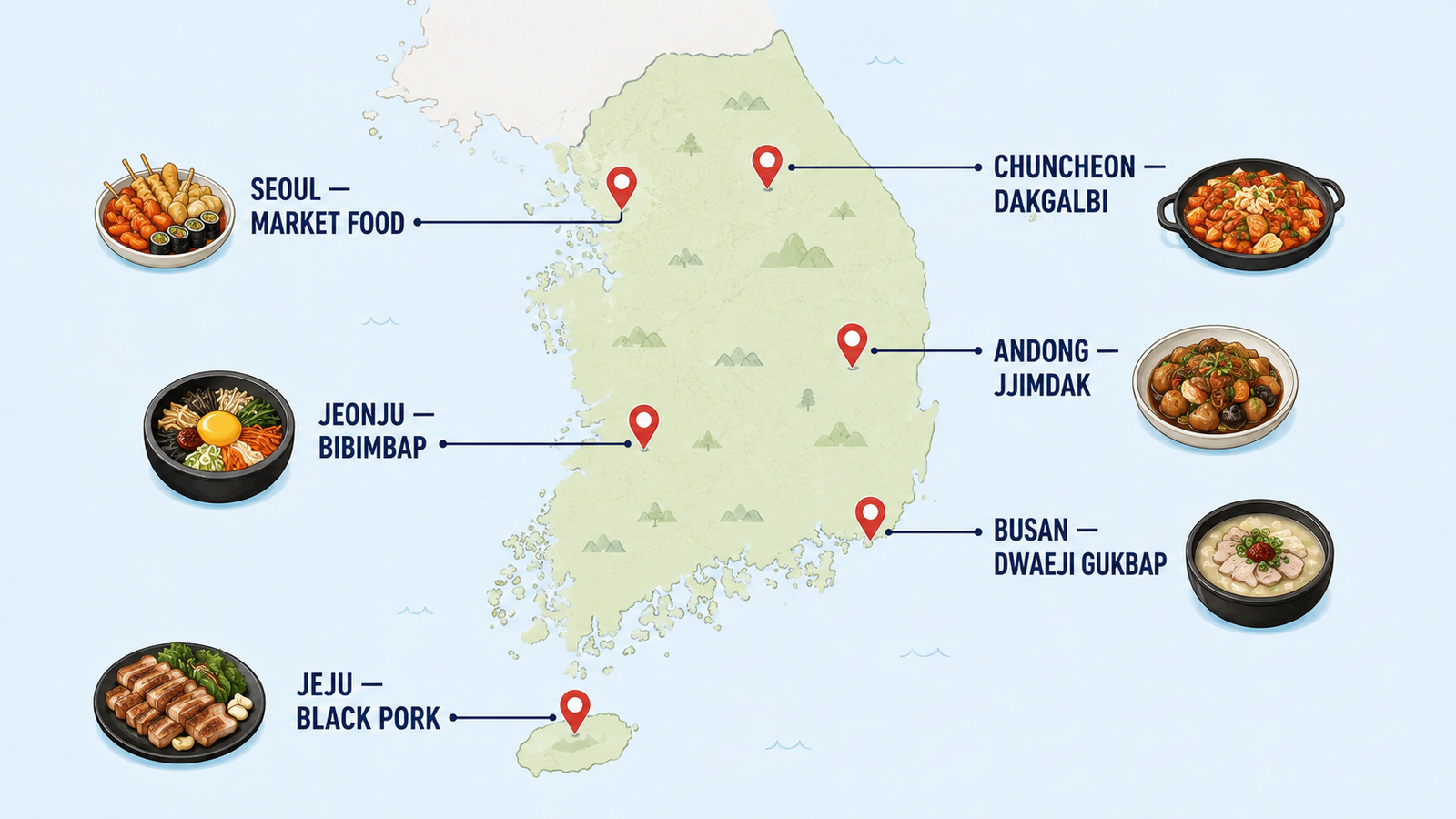
Korean cuisine changes significantly by region. The Korea Tourism Organization’s K-Local Food Trip 33 connects individual destinations with representative dishes.
Seoul
Seoul provides the widest selection rather than one exclusive specialty. Visitors can compare traditional markets, neighborhood restaurants, Korean BBQ, modern dining and food halls.
Gwangjang Market is convenient but increasingly tourist-oriented. Check displayed prices and avoid ordering without confirming the portion and cost.
Jeonju
Jeonju joined the UNESCO Creative Cities Network as a City of Gastronomy in 2012. UNESCO highlights the region’s rice, vegetables, wild greens, fermented food culture and traditional culinary education.
Beyond Jeonju bibimbap, look for:
- kongnamul gukbap, bean sprout and rice soup;
- makgeolli accompanied by numerous dishes;
- hwangpomuk, yellow mung bean jelly;
- local variations of banchan.
Read the official UNESCO profile of Jeonju before presenting it simply as Korea’s “food capital.”
Busan
Representative Busan foods include:
- dwaeji gukbap, pork and rice soup;
- milmyeon, wheat noodles served cold;
- eomuk, fish cake;
- seafood from markets and coastal districts.
Chuncheon
Chuncheon is the principal destination for dakgalbi. Makguksu, buckwheat noodles, is a common accompanying dish.
Andong
Andong is associated with jjimdak, Andong soju and traditional regional cooking. Portions of jjimdak are generally intended for groups.
Jeju
Jeju is known for black pork, seafood and ingredients shaped by island agriculture. Premium black-pork restaurants may be considerably more expensive than ordinary pork BBQ.
Vegetarian, Halal and Allergy Considerations
A dish that appears vegetable-based is not automatically vegetarian.
Possible hidden ingredients include:
- anchovy or seafood stock;
- fish sauce in kimchi;
- pork in kimchi jjigae;
- minced meat in dumplings and pancakes;
- meat-based seasoning;
- shellfish in fermented sauces.
VisitKorea maintains separate resources for vegetarian dining and Muslim-friendly restaurants. Restaurant classifications should still be checked individually because “pork-free,” “Muslim-friendly” and “halal-certified” are not interchangeable.
For serious allergies, use a professionally translated allergy card. Do not rely only on visual inspection or an automatic translation application.
Practical Korean Restaurant Tips
Check the Price Before Sitting Down
Menus displayed outside are useful for understanding prices and minimum orders. At markets, confirm both the food and price before accepting a prepared plate.
Expect Table Call Buttons
Many restaurants place a button on the table for calling staff. Pressing it is normal and does not imply impatience.
Water and Banchan May Be Self-Service
Look for a station with water, cups, tissues and additional side dishes. If the procedure is unclear, observe other diners or ask the staff.
Pay at the Counter
In many casual restaurants, customers pay near the entrance when leaving rather than asking for the bill at the table.
Use Naver Map or KakaoMap
Local map applications generally provide more complete Korean restaurant listings than Google Maps. Recent Korean-language reviews can also help verify opening status and menu changes.
Carry More Than One Payment Method
Card payments are widespread, but small market stalls may prefer cash or a local payment system unavailable to foreign visitors.