
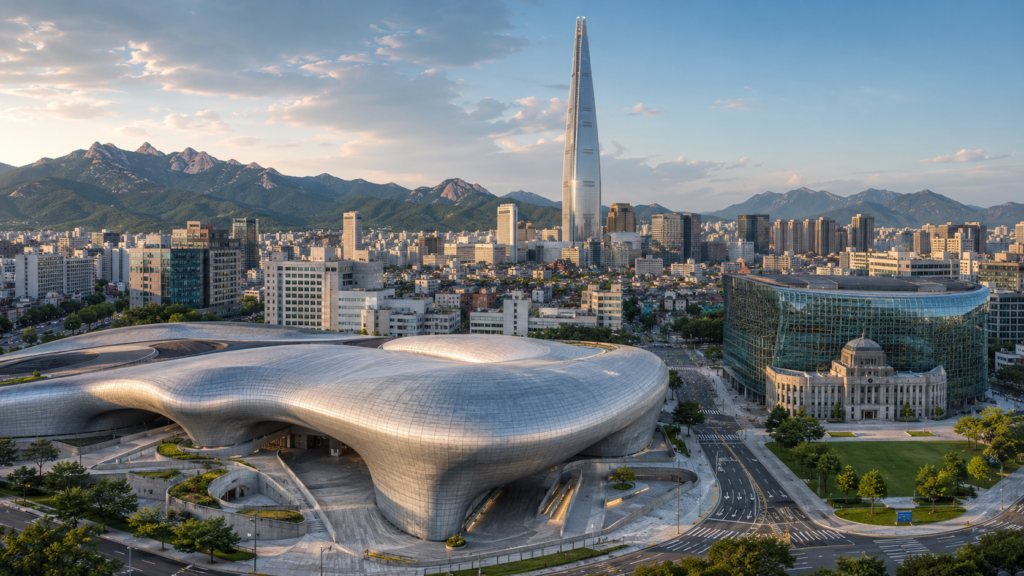
1. Dongdaemun Design Plaza: Seoul’s Best-Known Contemporary Landmark
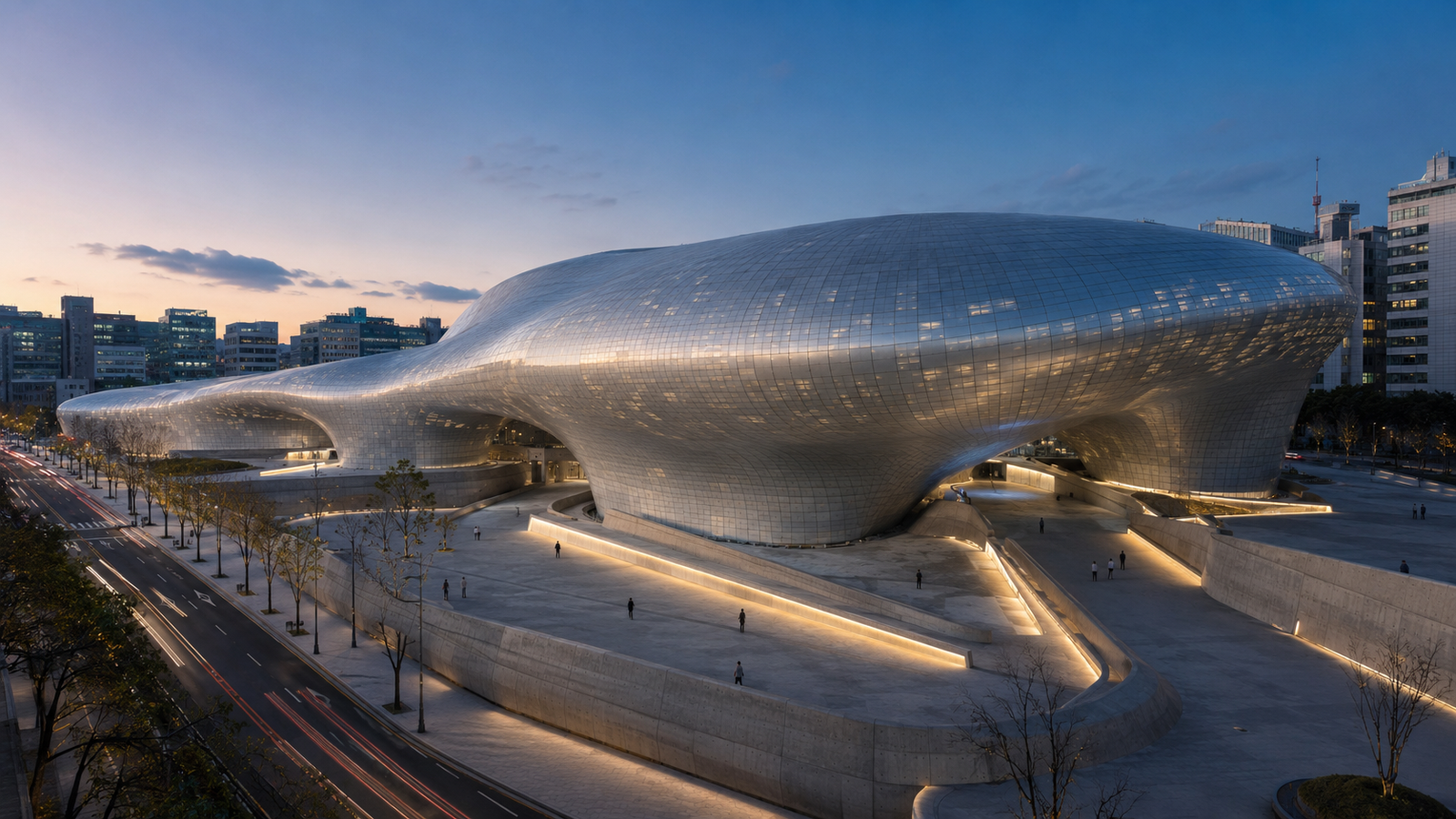
Dongdaemun Design Plaza, commonly called DDP, is one of the most recognisable examples of modern architecture in Seoul. The flowing aluminium exterior, large uninterrupted surfaces and curved interior passages were designed by Zaha Hadid Architects.
The building opened in 2014 on a site where archaeological remains connected with Seoul’s former city wall were discovered. Its design therefore had to accommodate both a futuristic cultural complex and traces of the city’s historical landscape.
DDP contains exhibition halls, design shops, event spaces and public areas. Visitors do not need an exhibition ticket to walk around the exterior, explore the public circulation areas or photograph the building. At night, lighting makes its curves easier to distinguish, although individual exhibitions and shops may already be closed.
The official Visit Seoul guide provides current visitor information. Zaha Hadid Architects also explains the project’s design and construction on its official DDP project page.
Practical information
- Nearest station: Dongdaemun History & Culture Park, Lines 2, 4 and 5
- Admission: exterior and general public areas are free
- Best time: late afternoon through early evening
- Allow: 1–2 hours, depending on exhibitions
DDP can be combined with Dongdaemun’s markets using our Seoul shopping guide.
2. Lotte World Tower: Vertical Architecture in Jamsil
At 555 metres and 123 storeys, Lotte World Tower is the dominant architectural landmark of southeastern Seoul. The tower was designed by Kohn Pedersen Fox with a tapered profile intended to appear lighter as it rises.
The building is a mixed-use complex rather than a conventional tourist monument. It includes offices, retail space, accommodation and Seoul Sky, an observation facility occupying its upper levels.
Visitors can examine the exterior and enter the connected shopping areas without buying an observatory ticket. Seoul Sky is the main paid architectural experience, providing views from approximately 500 metres above the city. On clear days, it also helps visitors understand Seoul’s scale and the relationship between the Han River, mountain ranges and dense urban districts.
According to the official Seoul Sky website, the observatory reaches the upper part of the 555-metre tower. Ticket prices and opening hours should be checked on the official ticket information and hours pages.
Practical information
- Nearest station: Jamsil, Lines 2 and 8
- Admission: shopping areas are free; Seoul Sky requires a ticket
- Best time: one hour before sunset, when visibility is good
- Allow: 1.5–2.5 hours
Because bad weather can substantially reduce the view, avoid booking solely on the basis of sunset time without checking the forecast.
3. Seoul City Hall: New Civic Architecture Beside the Former City Hall
Seoul City Hall demonstrates how the city places new architecture directly beside an older civic landmark. The current building opened in 2012 behind the former City Hall, which now houses the Seoul Metropolitan Library.
Its large curved glass façade appears to lean over the older stone building. Inside, one of its most distinctive features is a multi-storey vertical garden. The city describes the building as an environmentally conscious public facility, with a significant proportion of its interior allocated to citizen spaces.
The contrast is more informative than either building alone: visitors can see how Seoul retained an important twentieth-century civic structure while adding a substantially larger contemporary administration building.
Public access can be affected by government operations and events. Seoul also operates scheduled City Hall tours, so consult the official Seoul City Hall information and tour page before visiting.
Practical information
- Nearest station: City Hall, Lines 1 and 2
- Admission: public lobby areas are generally free
- Best time: weekday daytime
- Allow: 45–90 minutes
This stop works particularly well before walking toward Deoksugung, Seoul Station or Cheonggyecheon.
4. Ewha Campus Complex: Architecture Built into the Landscape
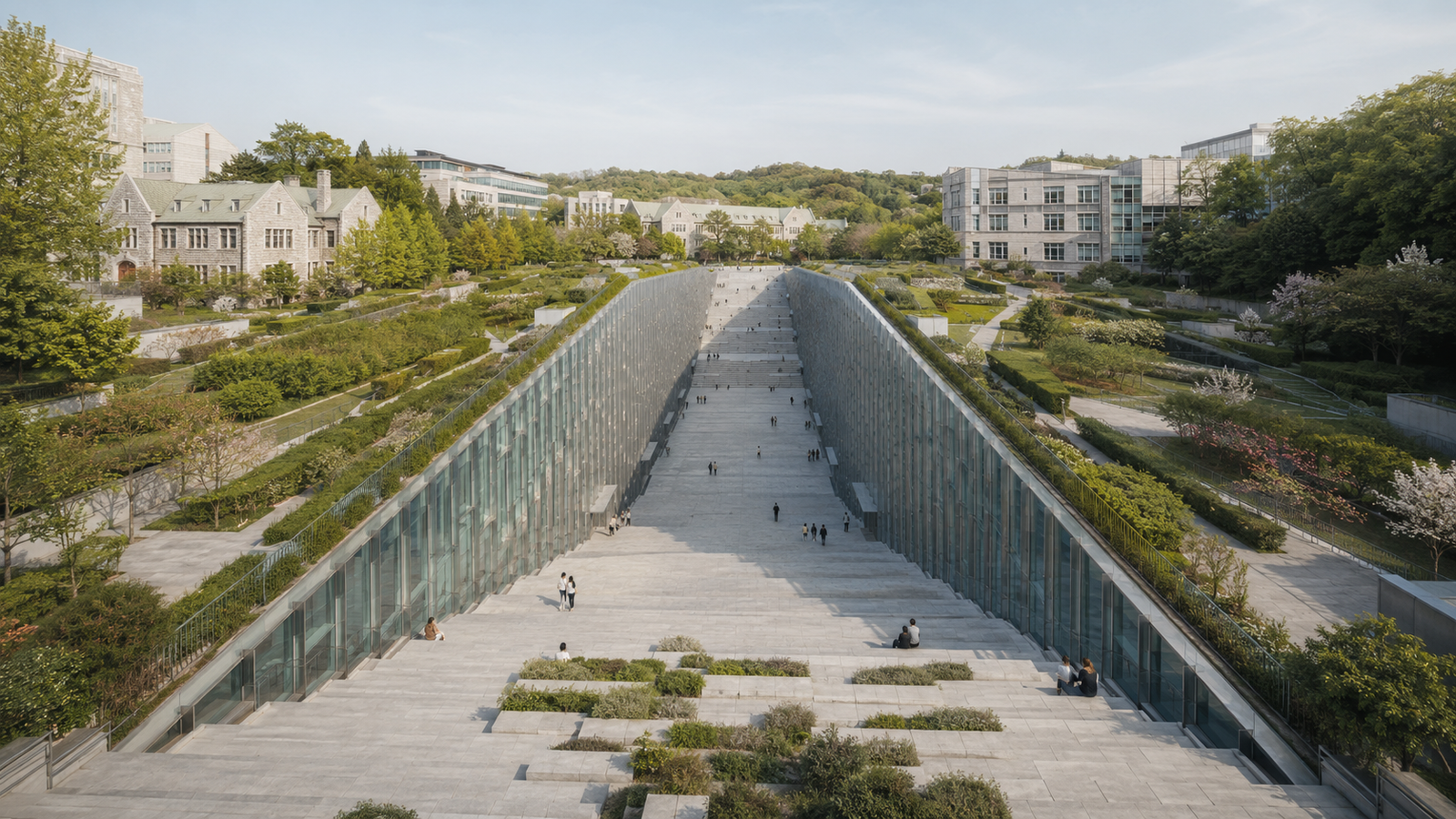
The Ewha Campus Complex is less like a freestanding building and more like an artificial valley cut into the university grounds. Designed by Dominique Perrault, the project places much of its interior below ground while two long glazed façades face a descending central walkway.
From above, landscaped roofs help the complex merge with the campus. From below, the long canyon-like space reveals entrances to educational, commercial and communal facilities.
Completed in 2008, the project is particularly useful for understanding how contemporary architecture can preserve open ground while placing a large volume of usable space beneath it.
Ewha Womans University remains an active educational institution, not a tourist attraction. Its official campus guidance states that access to classrooms, research facilities and other restricted areas is not permitted. Visitors should remain in public zones, avoid photographing individuals without permission and keep noise to a minimum.
Practical information
- Nearest station: Ewha Womans University, Line 2
- Admission: no general admission charge for public outdoor areas
- Access: educational and private areas are restricted
- Allow: 45–75 minutes
The university’s rules take priority over obtaining a particular photograph.
5. Amorepacific Headquarters: A Cube with an Interior Courtyard
The Amorepacific Headquarters in Yongsan was designed by David Chipperfield Architects and completed in the late 2010s. Its form is based on a large, restrained cube interrupted by openings that create terraces and bring light into the building.
Although it is a corporate headquarters, its lower levels include spaces intended for broader public use. The most relevant attraction for visitors is the Amorepacific Museum of Art, or APMA, which presents changing exhibitions inside the complex.
The building is worth examining from several positions. From a distance, it appears almost monolithic; closer to the façade, the vertical fins, recessed openings and public ground floor become clearer.
The architectural practice provides background on the design of the headquarters. Current exhibitions, reservations and opening hours are published by the Amorepacific Museum of Art.
Practical information
- Nearest station: Sinyongsan, Line 4
- Access: public ground-floor facilities and museum areas only
- Museum: normally closed on Mondays; verify the current exhibition
- Allow: 1.5–2.5 hours with a museum visit
Do not attempt to enter office floors or treat working areas as part of the attraction.
6. Leeum Museum of Art: Three Architects in One Museum Campus
Leeum Museum of Art offers one of Seoul’s clearest opportunities to compare different architectural approaches within a single cultural institution.
Museum 1, associated with traditional Korean art, was designed by Mario Botta. Museum 2, used for modern and contemporary art, was designed by Jean Nouvel. Rem Koolhaas and OMA designed the education and cultural component of the complex.
Their materials and spatial approaches differ, but the buildings function as a connected campus rather than three unrelated monuments. The museum’s hillside location also shapes the sequence between its exterior spaces, entrances and galleries.
The permanent collection of traditional art is generally free, while special exhibitions may require paid tickets. Reservations are recommended because availability and gallery access can vary. Current conditions are listed on the official Leeum visitor page.
Practical information
- Nearest station: Hangangjin, Line 6
- Walk: approximately five minutes uphill from Exit 1
- Opening pattern: normally Tuesday–Sunday, 10:00–18:00
- Allow: 2–3 hours
For more museums and gallery districts, continue with our South Korea contemporary art guide.
7. MMCA Seoul: Contemporary Galleries Around Open Courtyards
The Seoul branch of the National Museum of Modern and Contemporary Art opened in 2013 near Gyeongbokgung Palace. Instead of concentrating the museum in one monumental block, the complex uses multiple volumes, courtyards and connecting spaces.
This arrangement draws on the idea of the Korean madang—an open courtyard that connects different activities. The result feels more permeable than a conventional enclosed museum, with routes that repeatedly shift between galleries, circulation spaces and views toward the surrounding neighbourhood.
MMCA Seoul is therefore relevant both for its exhibitions and for the way it occupies a historically sensitive part of Jongno.
Opening hours are generally extended on Wednesday and Saturday evenings, but exhibition admission and free-entry periods vary. Check the official MMCA Seoul visitor information before visiting.
Practical information
- Nearest stations: Anguk, Gyeongbokgung or Gwanghwamun
- Admission: depends on the exhibitions being visited
- Best combination: Gyeongbokgung, Bukchon or Arario Museum
- Allow: 2–3 hours
This is also a good example of the relationship between the contemporary city and the sites described in our South Korea landmarks guide
8. Oil Tank Culture Park: Industrial Infrastructure Reused for Culture
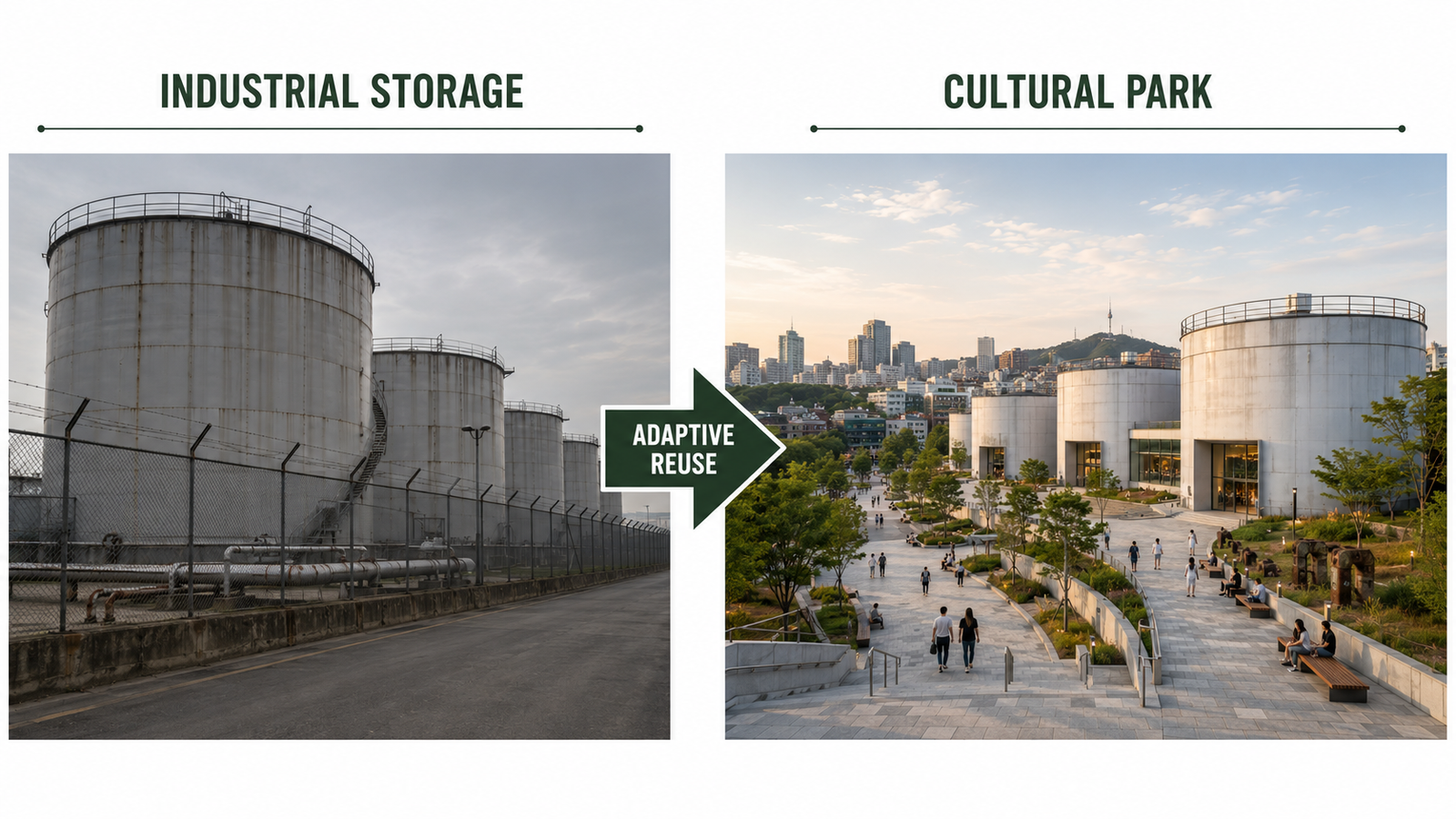
Oil Tank Culture Park demonstrates a different side of Seoul architecture. Rather than constructing a completely new landmark, the city converted former petroleum storage tanks into performance, exhibition and community spaces.
The original facility was created in response to the oil crises of the 1970s and remained closed to the public for decades. Its transformation preserved the industrial identity of the tanks while giving them new cultural functions.
The site is spread across a landscaped park, so the experience depends partly on current programming. Some tanks may contain exhibitions or performances, while others are best understood from outside.
The official Visit Seoul guide provides background and current visitor guidance.
Practical information
- Nearest station: World Cup Stadium, Line 6
- Walk: approximately ten minutes from Exit 2
- Admission: outdoor park areas are generally free
- Indoor access: depends on opening hours and events
- Allow: 1.5–2 hours
Check the programme before travelling specifically for an indoor exhibition.
9. Culture Station Seoul 284 and Seoullo 7017: Two Forms of Urban Reuse
The area around Seoul Station contains two different approaches to reusing the city’s existing infrastructure.
Culture Station Seoul 284 occupies the restored former Seoul Station building, originally completed in 1925. It now functions as a venue for exhibitions, performances and cultural programmes. The restored halls allow visitors to examine the building’s historic interior rather than viewing it only from the street.
Nearby, Seoullo 7017 converted a former elevated road into a pedestrian route. It creates new connections across an area previously divided by railway lines and major roads.
Together, the two sites show that architectural tourism does not have to focus exclusively on new buildings. Restoration and infrastructure reuse can change how people move through and understand a district.
Visitor programmes and architectural tours are listed by Culture Station Seoul 284.
Practical information
- Nearest station: Seoul Station
- Admission: Seoullo is public; Culture Station exhibitions vary
- Best time: late afternoon, continuing into the evening
- Allow: 1.5–2.5 hours
Seoullo is an outdoor route, so summer heat, rain and winter wind can materially affect the experience.
10. Arario Museum in Space: A Modern Korean Architectural Landmark
Arario Museum in Space occupies one of the best-known works of Korean architect Kim Swoo-geun. The original brick building was completed in the 1970s for the Space Group architectural practice and was later converted into a contemporary art museum.
Its relatively modest exterior conceals a dense interior of narrow stairs, changing floor levels and small interconnected rooms. This makes it substantially different from Seoul’s large purpose-built museums.
The building’s conversion preserved much of its spatial character, although that same complexity can make accessibility more difficult. Visitors primarily interested in architecture should still treat it as a functioning museum and follow its photography and circulation rules.
The building’s history and museum conversion are described by the Korean government’s Korea.net cultural feature.
Practical information
- Nearest station: Anguk, Line 3
- Admission: museum ticket required
- Access: confirm current hours and accessibility conditions
- Allow: 1–1.5 hours
- Best combination: MMCA Seoul and Changdeokgung
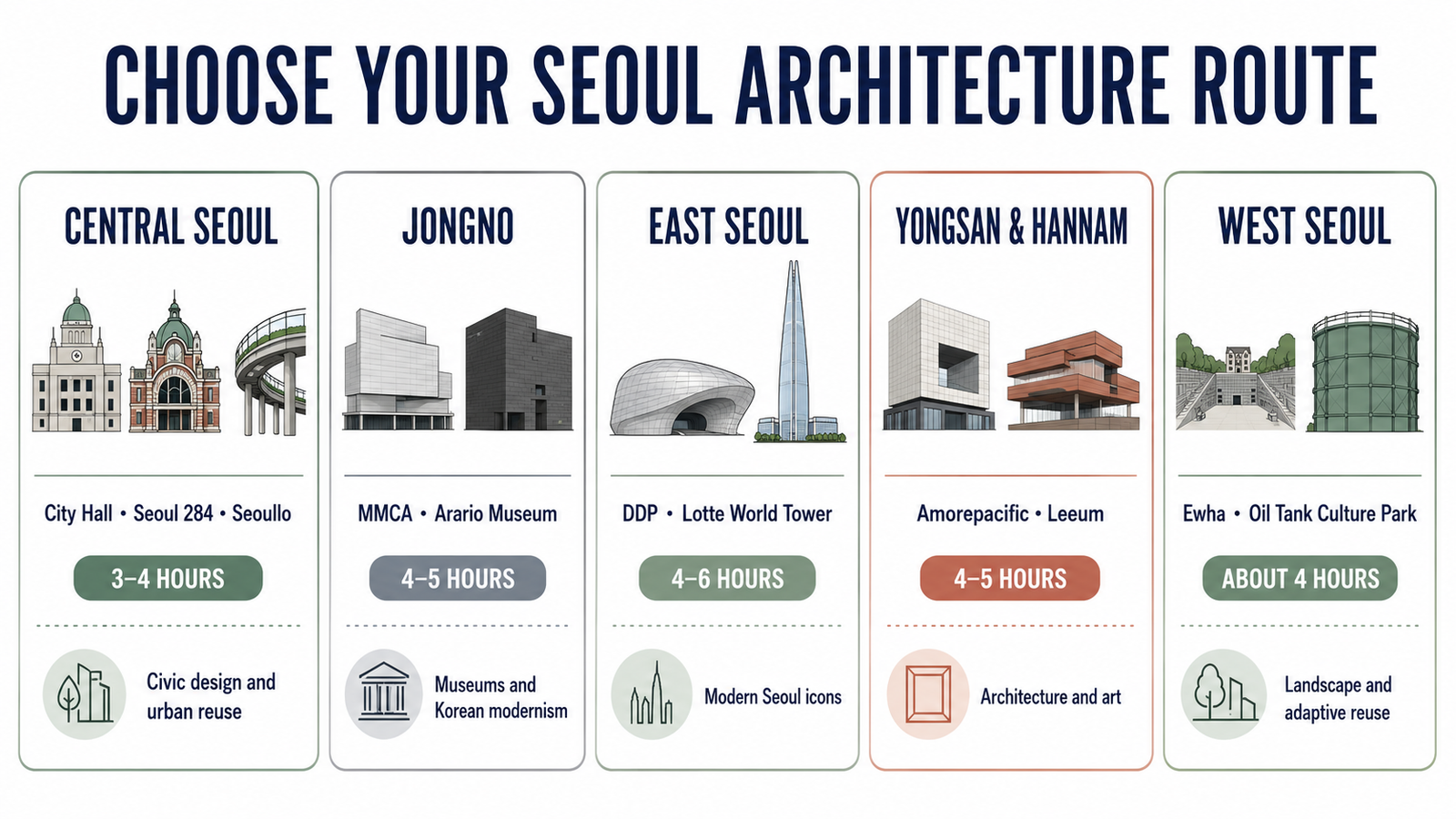
Self-Guided Seoul Architecture Routes
Trying to visit all ten places in one day would produce more time on the subway than meaningful time with the buildings. These shorter routes are more practical.
Central Seoul Architecture Route
Allow approximately 3–4 hours. This route compares civic architecture, historical restoration and infrastructure reuse.
Jongno Architecture and Art Route
Allow 4–5 hours with museum visits. Gyeongbokgung or Changdeokgung can be added if you want to compare contemporary buildings with traditional Korean architecture.
East Seoul Modern Icons Route
Allow 4–6 hours. Line 2 connects Dongdaemun History & Culture Park with Jamsil, making this the simplest route between two major modern landmarks.
Yongsan and Hannam Museum Route
Allow approximately 4–5 hours, including travel. Check both exhibition schedules before choosing the day.
West Seoul Design Route
Allow around 4 hours. This route compares landscape-integrated university architecture with industrial adaptive reuse.
Is Songdo Worth Adding?
Songdo is frequently associated with modern Korean architecture, but it is located in Incheon rather than Seoul. Reaching it and exploring the district takes a substantial part of a day.
For that reason, Songdo should not be presented as another stop on a central Seoul architecture route. Add it only as a separate day trip if you are specifically interested in master-planned cities, large-scale business districts and contemporary urban development.