
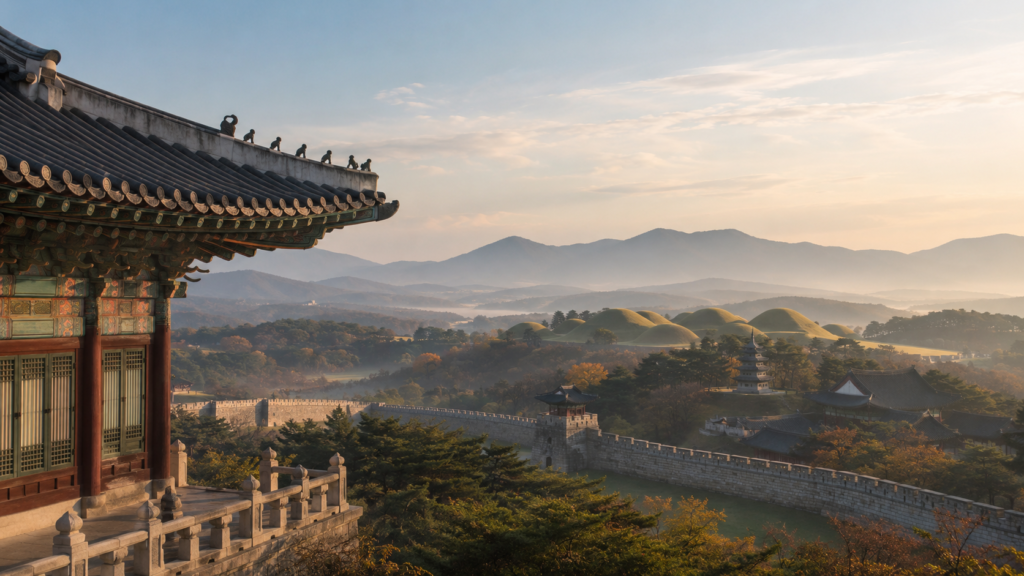
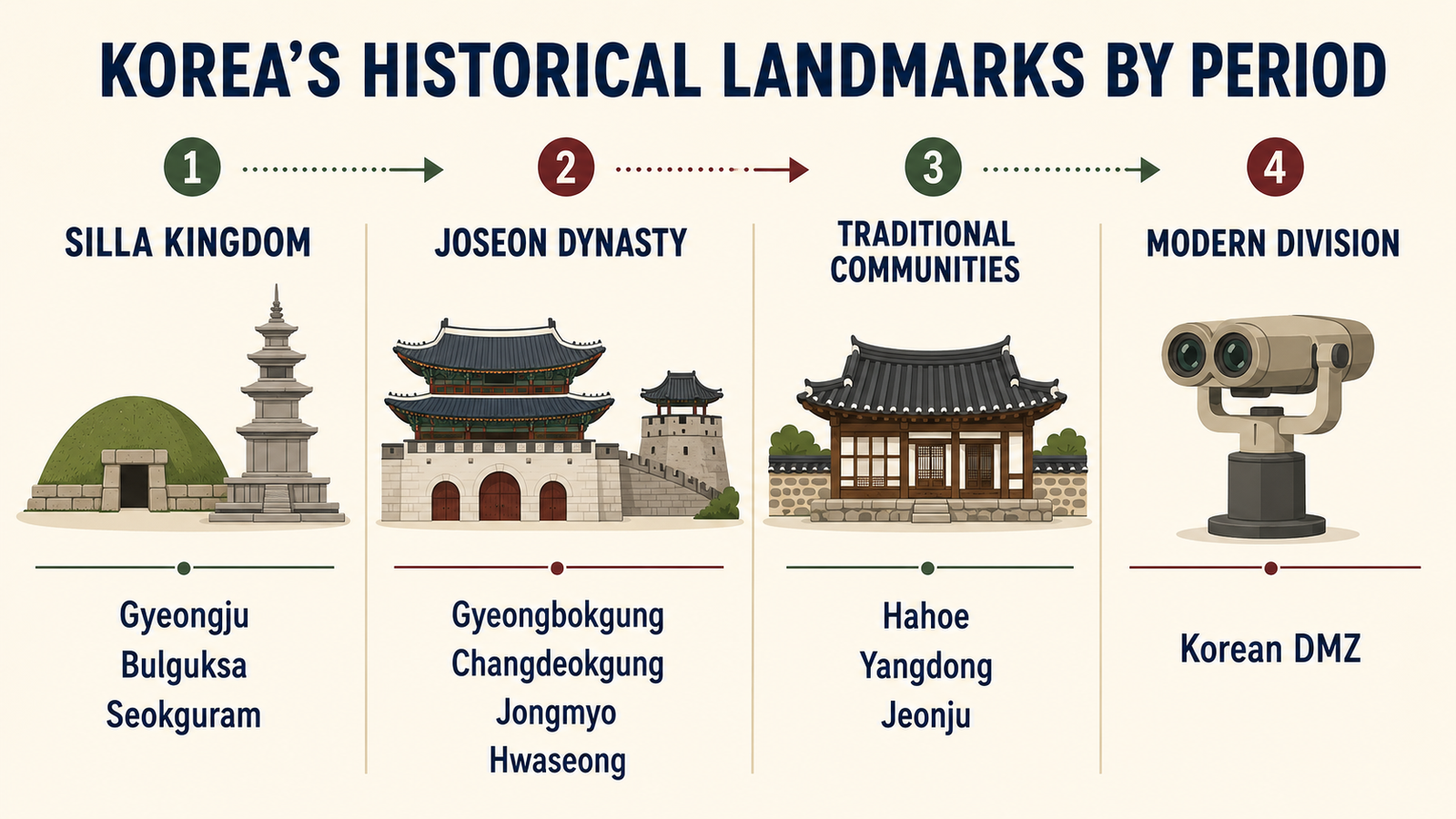
Of the sites in this guide, Changdeokgung, Jongmyo, Hwaseong Fortress, the Gyeongju Historic Areas, Bulguksa and Seokguram, and the historic villages are included on South Korea’s UNESCO World Heritage List. UNESCO currently lists 17 World Heritage properties in the country. Check the official UNESCO list.
How These Historical Sites Were Selected
The list is not intended to include every palace, temple or fortress in Korea. The sites were selected using four practical criteria:
- historical importance;
- value for understanding Korean culture;
- accessibility for international travelers;
- ability to combine the site with a realistic travel itinerary.
The result covers several major periods: ancient Silla, the Joseon dynasty, the early modern development of traditional urban neighborhoods and the division of the Korean Peninsula after 1945.
1. Gyeongbokgung Palace: The Best First Palace in Seoul
Gyeongbokgung is the most recognizable of Seoul’s royal palaces and the easiest introduction to Joseon history. It was established in 1395, shortly after the Joseon dynasty made Seoul—then called Hanyang—its capital.
The complex has been destroyed, rebuilt and restored several times. Rather than presenting one perfectly preserved moment, it shows how Korea has repeatedly reconstructed its relationship with the royal past.
The main ceremonial gate, Geunjeongjeon Hall and Gyeonghoeru Pavilion communicate the scale of the court better than a quick photograph at the entrance. The National Palace Museum of Korea and National Folk Museum of Korea are also nearby.
Practical information:
- Allow approximately 2–3 hours for the palace and more if adding a museum.
- Gyeongbokgung is usually closed on Tuesdays.
- The standard adult admission listed by the Royal Palaces and Tombs Center is ₩3,000.
- Gyeongbokgung Station on Seoul Subway Line 3 is the most convenient stop.
- The changing-of-the-guard ceremony may be altered or canceled because of weather or special events.
Check current hours, admission and notices through the Royal Palaces and Tombs Center.
Best for: Travelers visiting a Korean royal palace for the first time.
Combine with: Gwanghwamun Square, Bukchon or Insadong.
Explore the courtyards of Gyeongbokgung Palace in the interactive panorama below.
2. Changdeokgung Palace and Huwon: The Best Palace for Gardens
Changdeokgung was built as a secondary royal palace but became an important seat of government for long periods of the Joseon dynasty. Unlike the more formal geometry of Gyeongbokgung, its buildings were arranged to respond to the natural terrain.
This relationship between architecture and landscape helped the palace complex earn UNESCO World Heritage status in 1997.
The most distinctive part is Huwon, often called the Secret Garden. Pavilions, ponds and wooded paths were used for study, ceremonies and royal leisure. Access is controlled separately from general palace admission.
Practical information:
- Allow approximately 90 minutes for the main palace.
- Add another 70–90 minutes for Huwon.
- The palace ticket and Huwon ticket are separate.
- The official adult price is currently ₩3,000 for the palace and ₩5,000 for Huwon.
- Huwon entry is limited to scheduled time slots.
- Online reservations open several days before the visit, while a limited number of same-day tickets may be sold at the palace.
Huwon places are especially likely to sell out during spring foliage and autumn color seasons. Verify the current system through the official palace admission and reservation information.
Best for: Travelers interested in traditional architecture, landscape design and photography.
Combine with: Jongmyo Shrine or Ikseon-dong.
3. Jongmyo Shrine: A Quiet Counterpoint to Seoul’s Palaces
Jongmyo was the royal ancestral shrine of the Joseon dynasty. While the palaces represented living royal authority, Jongmyo was created for rituals honoring deceased kings and queens.
Its long, restrained buildings can initially seem plain compared with the colorful palace halls. That simplicity is deliberate. The architecture supports a ceremonial landscape built around hierarchy, movement and Confucian ideas about ancestry.
UNESCO recognizes both the shrine and the continuing ritual tradition associated with it.
Practical information:
- Allow 60–90 minutes.
- Jongmyo is close to Jongno 3-ga Station.
- The listed adult admission is ₩1,000.
- It is normally closed on Tuesdays.
- Depending on the day, access may be through a scheduled guided visit rather than unrestricted entry.
Check the current timetable before arriving, because the admission system has changed at different times. Use the Royal Palaces and Tombs Center as the primary source.
Best for: Visitors who want to understand the religious and political ideas behind the Joseon court.
Combine with: Changdeokgung and Ikseon-dong.
View the restrained architecture and ceremonial courtyard of Jongmyo Shrine.
4. Suwon Hwaseong Fortress: The Best Historic Day Trip from Seoul
Hwaseong Fortress surrounds part of central Suwon, approximately 30 kilometers south of Seoul. King Jeongjo commissioned the complex in the late eighteenth century as part of an ambitious political and urban project connected with the tomb of his father, Crown Prince Sado.
The fortress combines defensive engineering with gates, observation posts, command structures and long sections of walkable wall. UNESCO highlights its integration of military knowledge from Korea, China and Japan.
Unlike a compact palace, Hwaseong is best understood by walking part of its perimeter.
Practical information:
- Allow 3–5 hours for the principal gates and wall sections.
- A full circuit is roughly 5.7 kilometers.
- Paldalmun and Janganmun are useful starting points.
- Suwon Station is connected to Seoul by subway and rail, but a local bus or taxi is normally required from the station.
- Some individual attractions or experiences around the fortress may charge separately even when walking the wall is free.
Wear comfortable shoes: several sections include slopes and stairs.
Best for: Travelers who prefer active sightseeing and open-air architecture.
Combine with: Haenggung Palace and Suwon’s traditional market area.
Explore a section of Suwon Hwaseong Fortress in the interactive panorama below.
5. Gyeongju Historic Areas: The Best Place for Ancient Korean History
Gyeongju was the capital of the Silla kingdom, which ruled for almost a thousand years and played a central role in the unification of much of the Korean Peninsula.
The UNESCO-listed Gyeongju Historic Areas are not one enclosed attraction. They consist of several archaeological and monumental zones spread across the city. This makes Gyeongju feel less like a single landmark and more like an open historical landscape.
A practical central route can include:
- Daereungwon Ancient Tomb Complex;
- Cheomseongdae Observatory;
- Gyerim Forest;
- Woljeonggyo Bridge;
- Donggung Palace and Wolji Pond.
These central attractions lie close enough to connect on foot. Gyeongju’s official tourism service describes a compact heritage route of approximately two kilometers between several of the principal sites. See the official Gyeongju historical route.
Practical information:
- Reserve at least one full day for central Gyeongju.
- Two days are better if adding Bulguksa and Seokguram.
- Bicycles and local buses can reduce walking time.
- Individual attractions maintain separate hours and ticket rules.
- Donggung and Wolji is particularly popular after sunset.
Best for: Anyone who wants to explore the period before the Joseon dynasty.
Combine with: Bulguksa Temple, Seokguram Grotto and the Gyeongju National Museum.
View the Tomb of King Muyeol and its surrounding Silla burial landscape.
Do not call it simply “Gyeongju Historic Areas,” because the panorama shows one specific part of the much larger UNESCO property.
6. Bulguksa Temple: The Most Important Temple Near Gyeongju
Bulguksa is one of South Korea’s most important Buddhist temples. Its present form reflects extensive reconstruction, but significant stone structures survive from the Unified Silla period.
The temple is known for the contrasting Dabotap and Seokgatap pagodas, stone stairways and terraces that organize the religious complex into symbolic spaces. Together with Seokguram Grotto, it was inscribed on the UNESCO World Heritage List in 1995.
Bulguksa should not be treated only as a photography stop. It remains an active religious site, so visitors should keep voices low and avoid interrupting worship.
Practical information:
- Allow 1.5–2 hours.
- The temple is outside central Gyeongju.
- Local buses connect central Gyeongju with the Bulguksa area.
- The temple is generally open year-round.
- VisitKorea currently lists regular entry to Bulguksa as free, but parking and special programs can have separate costs.
Check the latest information on the official VisitKorea Gyeongju National Park page.
To experience Korean Buddhist culture beyond a sightseeing visit, compare programs, prices and participation rules in our Temple Stay Korea guide.
Best for: Buddhist architecture, stone craftsmanship and religious history.
Combine with: Seokguram Grotto on the same day.
7. Seokguram Grotto: A Small Site with Exceptional Cultural Value
Seokguram is an artificial stone grotto on the slopes of Tohamsan Mountain. Its central seated Buddha and surrounding reliefs represent the technical and artistic achievements of eighth-century Silla Buddhism.
The grotto is much smaller than many visitors expect. The value lies in the sculpture and construction rather than the amount of time spent inside. A protective glass barrier limits the view, and photography inside the chamber is generally prohibited.
Seokguram is approximately three kilometers from Bulguksa by hiking trail and about nine kilometers by road. VisitKorea confirms the distance and historical context.
Practical information:
- Allow 1–1.5 hours at the site.
- Add transport time from Bulguksa.
- Bus services can be infrequent, so check the return schedule before leaving the temple.
- The approach includes a short uphill walk.
- Mist and low cloud can obscure the mountain view.
Best for: Travelers interested in Buddhist sculpture and ancient engineering.
Combine with: Bulguksa rather than treating Seokguram as a separate day trip.
8. Hahoe and Yangdong: Traditional Villages with Different Logistics
Hahoe and Yangdong form one UNESCO World Heritage property, but they are separate villages in different parts of the country. Most travelers should choose one rather than attempting both during the same day.
Hahoe Folk Village
Hahoe is located outside Andong and developed as a clan village during the Joseon period. Traditional houses, Confucian academies and the surrounding landscape illustrate the social organization of an aristocratic rural community.
Some buildings remain private residences. Visitors should stay on public paths and avoid photographing people through windows or entering closed courtyards.
Choose Hahoe if Andong is already part of your itinerary or if you are particularly interested in Confucian culture and mask traditions.
Yangdong Historic Village
Yangdong lies closer to Gyeongju and can fit more naturally into a Gyeongju-based itinerary. The village preserves tiled-roof aristocratic houses, thatched buildings and a layout shaped by both social hierarchy and the surrounding hills.
Choose Yangdong if you are staying in Gyeongju and want a traditional village without adding Andong to the route.
Practical information:
- Allow at least half a day for either village.
- Public transport requires more planning than for central Seoul or Gyeongju.
- Check the final return bus before traveling independently.
- Remember that these are inhabited cultural landscapes, not open-air film sets.
Use the official Hahoe visitor information or Gyeongju tourism information when planning.
Best for: Traditional architecture and Joseon-period social history.
9. Jeonju Hanok Village: Traditional Architecture and Everyday Culture
Jeonju Hanok Village contains around 700 hanok buildings and is one of Korea’s largest concentrations of traditional-style urban architecture. However, it should not be presented as an untouched medieval settlement.
The present district developed primarily during the early twentieth century around older cultural sites such as Gyeonggijeon Shrine and the Jeonju Confucian school. Today it combines residences, guesthouses, workshops, cultural attractions, restaurants and extensive visitor infrastructure.
This makes Jeonju more commercial than Hahoe or Yangdong, but also easier to experience without a car.
Practical information:
- Allow at least half a day.
- Stay overnight in a hanok if Jeonju is more than a brief stop.
- Visit early in the morning for quieter streets.
- Add Gyeonggijeon Shrine for clearer historical context.
- Expect the main streets to be busy on weekends.
VisitKorea describes the district as having approximately 700 hanok and lists its official address and tourism website. See the Jeonju Hanok Village information.
Jeonju is also closely associated with bibimbap and the wider food culture of Jeolla Province. Continue with our guide to the best Korean food.
Best for: Travelers combining architecture, crafts and regional food.
10. The Korean DMZ: Understanding Korea’s Modern Division
The Demilitarized Zone is fundamentally different from the palaces and temples in this guide. It is not one ancient landmark, but a restricted border region created after the Korean War armistice in 1953.
A typical Paju-area tour may include Imjingak, the Third Infiltration Tunnel and an observation point. The exact itinerary depends on military access, weather and operating conditions.
It is important to distinguish an ordinary DMZ tour from a Joint Security Area tour. A product labeled “DMZ tour” does not automatically include the JSA, and JSA access may be suspended or severely limited.
Practical information:
- Bring the physical passport or identification required by the operator.
- Access to controlled areas normally requires an authorized tour.
- Tours can be altered or canceled with little notice.
- Do not assume every attraction advertised by a booking platform will be accessible that day.
- Check exactly which observation point, tunnel and border sites are included.
- Follow all photography and security instructions.
The Korean government’s 2026 DMZ Peace Trail program demonstrates how access varies by route, season and nationality; several official walking routes are limited to Korean citizens. Read the 2026 government notice.
Best for: Travelers interested in the Korean War, contemporary history and the division of the peninsula.
How to Build a Historical South Korea Itinerary
You do not need to visit all ten places in one trip. Their locations make several smaller routes more practical.
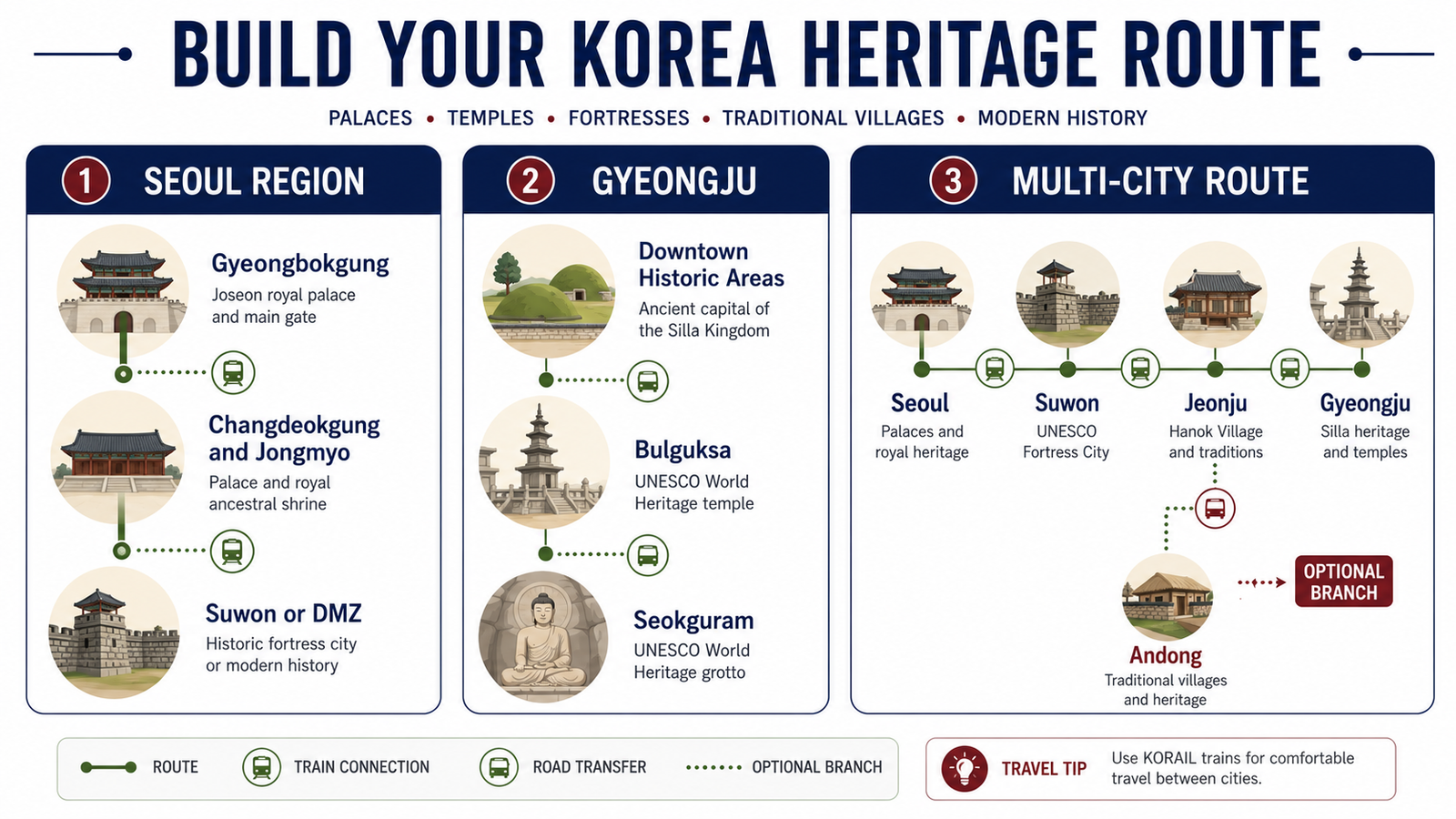
Three Days Based in Seoul
Day 1: Gyeongbokgung Palace, Gwanghwamun and Insadong
Day 2: Changdeokgung, Huwon and Jongmyo
Day 3: Suwon Hwaseong or a DMZ tour
This route works for travelers who want historical context without leaving the Seoul region for several nights.
Two Days in Gyeongju
Day 1: Daereungwon, Cheomseongdae, Gyerim, Woljeonggyo Bridge and Donggung Palace and Wolji
Day 2: Bulguksa Temple and Seokguram Grotto
Gyeongju deserves an overnight stay. Treating it as a rushed day trip from Seoul leaves too little time for both the downtown heritage zone and the mountain sites.
Four-City Heritage Route
Several landmarks require intercity trains or buses rather than a single Seoul day trip. Use our South Korea transportation guide to compare rail services, bus terminals, booking systems and transport cards.
A longer trip can follow:
Seoul → Suwon → Jeonju → Gyeongju
Andong can be added between Seoul and Gyeongju if Hahoe Village is a priority.
For wider transport and destination planning, use our South Korea Travel Guide.
Visiting Seoul’s Royal Palaces
Seoul has five principal royal palaces, but most first-time visitors do not need to enter all five.
Choose:
- Gyeongbokgung for scale and a clear introduction;
- Changdeokgung for architecture and Huwon;
- Deoksugung for a shorter central visit;
- Changgyeonggung for a quieter palace experience.
Gyeongbokgung and Changdeokgung are normally closed on different weekdays, which makes checking the calendar important.
A combined palace ticket is available through the Royal Palaces and Tombs Center. The official price listed in July 2026 is ₩6,000 and covers the four principal palaces and Jongmyo, excluding Huwon. Confirm the current terms before buying.
Tickets, Closures and Reservations
Do not copy opening times from Google Maps without confirming them. Heritage sites can change access because of:
- restoration projects;
- ceremonies and cultural events;
- extreme weather;
- wildfire risk;
- national holidays;
- military restrictions;
- seasonal operating hours.
The most important advance reservation in this guide is Huwon at Changdeokgung. DMZ tours also need to be arranged in advance, although the booking does not guarantee that every restricted stop will remain open.
For other sites, the main concern is usually checking the closing day and the final admission time.
Respectful Heritage Travel
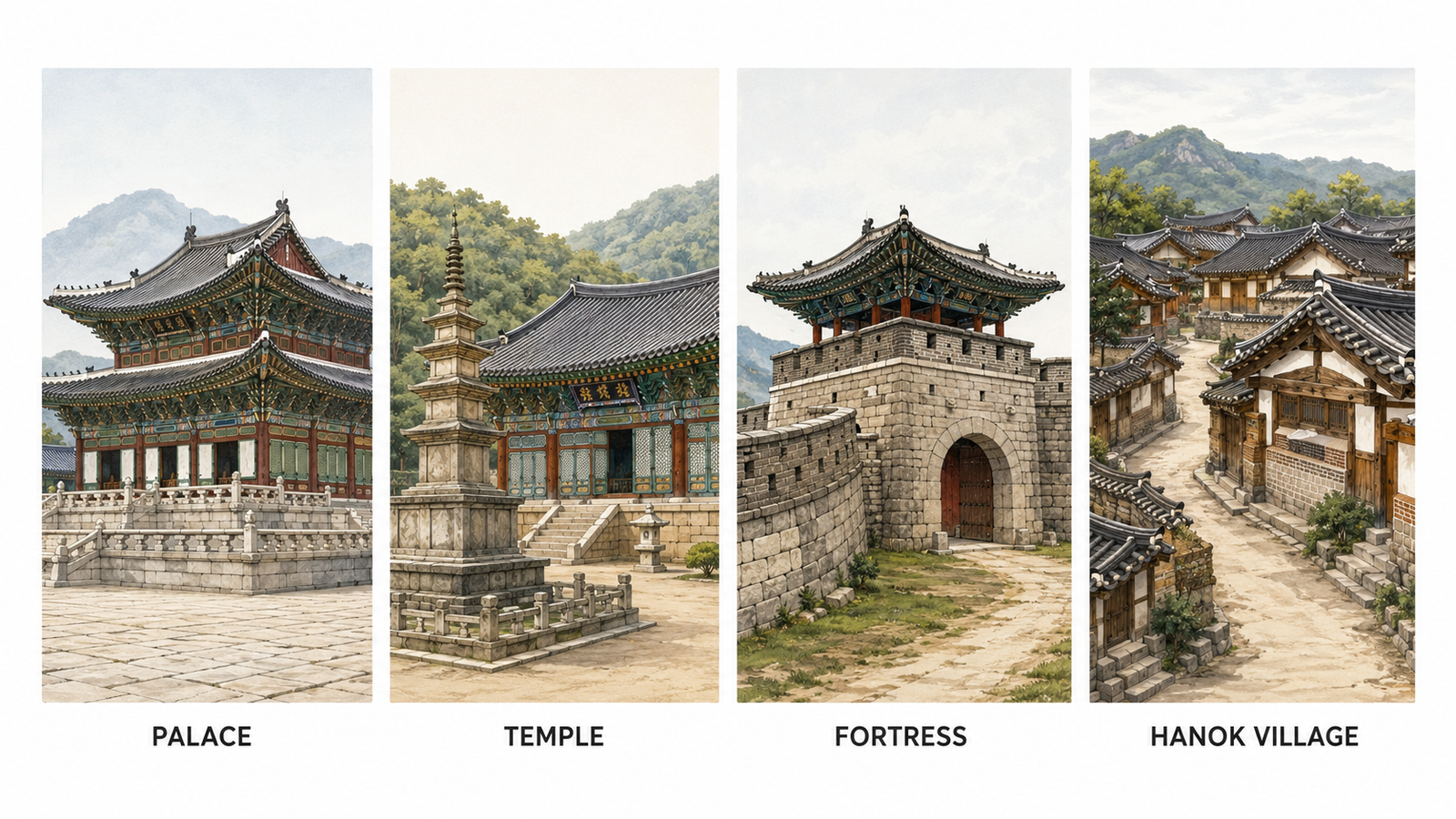
Several sites remain active religious spaces, private communities or places connected with conflict.
Visitors should:
- speak quietly inside temples and shrines;
- follow photography restrictions;
- avoid entering private hanok courtyards;
- keep drones away unless explicit permission exists;
- avoid climbing walls or architectural elements;
- wear clothing suitable for walking and religious sites;
- treat the DMZ as a place of unresolved human history rather than only a themed attraction.
Traditional clothing rental can make a palace visit more engaging, but hanbok does not turn the palace into a private photography studio. Avoid blocking gates, ceremonial spaces and narrow paths.