
Explore Globe’s coverage of South Korea is changing. Instead of publishing broad articles that simply describe a destination, we are rebuilding the collection around practical questions travellers need to answer before a trip.
The first stage of this work includes seven substantially updated guides covering shopping, nightlife, Korean popular culture, temple stays, sustainable travel, contemporary art and wellness.
Each article has been reorganised around a clearer search intent and supported with current transport information, prices where they can be verified, official resources, maps, comparisons and realistic planning advice. When an experience has not been tested personally, it is presented as researched information rather than firsthand experience.
This update provides a quick overview of the seven rebuilt guides and helps you choose the right place to start.
For broader destination planning, begin with the South Korea Travel Guide.
Update — July 2026: The next stage of Explore Globe’s South Korea revision is now complete. Eight additional guides covering trip planning, food, festivals, hiking, historical landmarks, architecture, technology and surfing are included in the second South Korea content update.
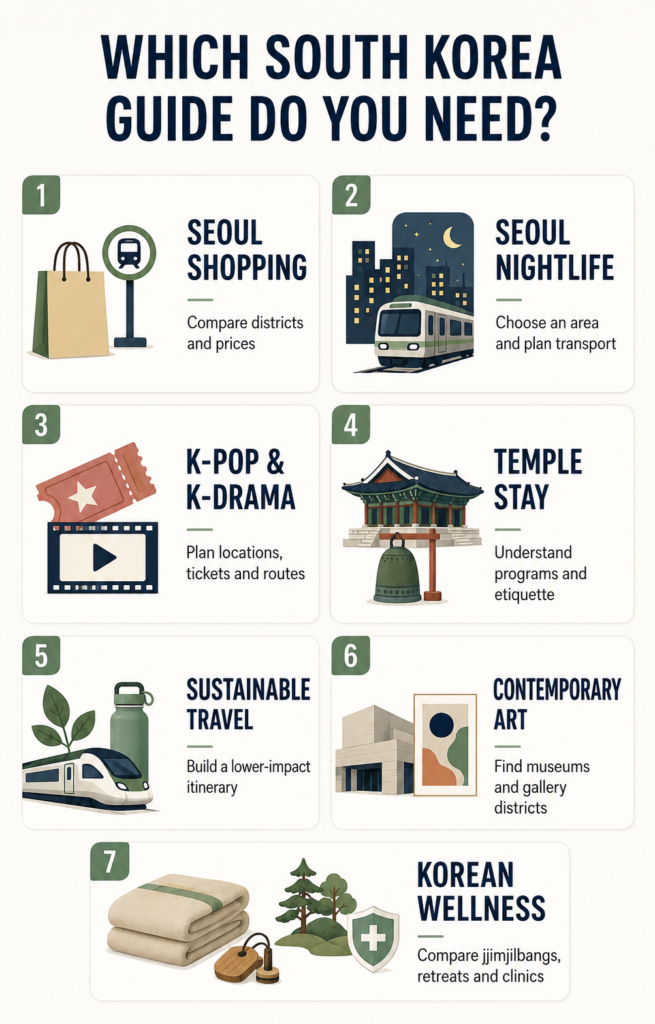
Which South Korea Guide Do You Need?
| If you want to… | Start with… |
|---|---|
Compare Seoul’s main shopping districts |
Seoul Shopping Guide |
Understand districts, costs and transport after dark |
Seoul Nightlife Guide |
Plan a K-pop or K-drama-focused day |
K-Pop and K-Drama Travel Guide |
Choose and prepare for a temple program |
Temple Stay in South Korea |
Reduce the impact of your trip |
Sustainable Travel in South Korea |
Visit museums, galleries and biennales |
Korean Contemporary Art Guide |
Understand jjimjilbangs, retreats and beauty services |
South Korea Wellness Guide |
1. Where to Shop in Seoul
Seoul’s shopping areas serve different purposes. Myeongdong works well for convenient K-beauty shopping, Hongdae for affordable fashion and youth culture, Insadong for traditional gifts, Dongdaemun for fabrics and fashion markets, Gangnam for department stores and Seongsu for pop-ups and Korean designer brands.
The rebuilt guide compares six areas using practical information instead of presenting them as one general shopping district. It includes approximate price ranges, nearest subway stations, typical opening patterns and the limitations of each location.
It also explains tax refunds, card payments, returns and why visitors should check the operating hours of a specific Dongdaemun building rather than relying on the idea that the entire area shops through the night.
Read the Seoul Shopping Guide.
Best for: K-beauty products, clothing, souvenirs, design and trip budgeting.
2. Seoul Nightlife Guide
Seoul does not have one nightlife centre. Hongdae, Itaewon, Gangnam, Euljiro and Jongno attract different crowds and require different approaches to transport, pricing and venue selection.
The updated nightlife guide now focuses on practical planning:
- which district matches a particular kind of evening;
- approximate costs for drinks, clubs, karaoke and late-night food;
- subway closing times and alternatives after the last train;
- identification and entry expectations;
- nightlife etiquette;
- common safety considerations;
- how to avoid crossing the city repeatedly in one night.
It also covers non-club activities, including noraebang, night views, gaming cafés and late-night food.
Read the Seoul Nightlife Guide.
Best for: First-time visitors choosing where and how to spend an evening in Seoul.
3. K-Pop and K-Drama Travel Guide
Korean popular culture creates a large number of travel attractions, but not every place promoted online is official, permanent or open to visitors.
This guide separates reliable public attractions from temporary pop-ups, ticketed performances and filming locations that may have little to see outside the screen.
It explains:
- what visitors can do at HiKR Ground;
- where to look for official K-pop merchandise;
- how concert ticketing works;
- why unofficial resale requires caution;
- how to plan a K-pop-themed day in Seoul;
- when a K-drama studio or filming-location day trip is worth the additional travel.
The article also includes a map and two example itineraries: one focused on K-pop and another on K-drama atmosphere and filming destinations.
Read the K-Pop and K-Drama Travel Guide.
Best for: Hallyu fans who want a realistic route rather than a list of loosely connected locations.
4. Temple Stay in South Korea
A temple stay is not a hotel visit, wellness resort or conventional sightseeing tour. It is a structured cultural program that may include meditation, chanting, communal meals, early mornings and Buddhist etiquette.
The rebuilt guide compares the principal program formats and explains:
- what a typical schedule may include;
- how experience-oriented and rest-oriented programs differ;
- expected accommodation and meals;
- clothing and behaviour;
- booking through the official Templestay platform;
- costs and language availability;
- who may not enjoy a highly structured overnight program.
It is designed to help travellers decide whether a temple stay fits their interests before committing to a reservation.
Read the Temple Stay in South Korea Guide.
Best for: Travellers interested in Buddhist culture, quiet routines and participatory experiences.
5. How to Travel Sustainably in South Korea
Sustainable travel is more useful when it informs actual decisions rather than providing a generic list of reusable items.
The updated guide concentrates on the parts of a South Korea trip with the greatest practical impact:
- using rail and public transport;
- choosing fewer accommodation bases;
- reducing unnecessary domestic flights and taxi journeys;
- respecting mountain and coastal environments;
- avoiding wildlife disturbance;
- recognising vague environmental marketing;
- managing waste in a country where disposal systems may differ from those at home.
The objective is not to present a perfectly impact-free holiday. It is to show how transport, accommodation and itinerary design can make a trip more efficient and less wasteful.
Read How to Travel Sustainably in South Korea.
Best for: Travellers building a slower route around public transport, cities and natural areas.
6. Korean Contemporary Art
South Korea’s contemporary art scene extends beyond a single museum or the commercial galleries of Seoul.
The rewritten guide introduces the country through:
- major museums;
- Seoul gallery districts;
- contemporary art in Busan;
- the Gwangju and Busan biennales;
- practical museum and gallery etiquette;
- admission and reservation considerations;
- an example Seoul art route;
- a custom map for planning visits.
The article also distinguishes permanent museums from commercial galleries and time-limited biennales, helping visitors understand what can be planned at any time and what depends on exhibition dates.
Read the Korean Contemporary Art Guide.
Best for: Museum visitors, design travellers and readers interested in modern Korean culture beyond K-pop.
7. South Korea Wellness Guide
Wellness travel in South Korea can refer to several very different experiences: a public jjimjilbang, hotel spa, non-medical facial, scalp treatment, forest program, temple stay or medical skin clinic.
The new guide separates these categories instead of treating them as one general beauty trend.
It includes:
- a first-visit jjimjilbang walkthrough;
- bathing and sauna etiquette;
- current examples in the Seoul area, Incheon and Busan;
- distinctions between beauty services and medical procedures;
- forest and hot-spring destinations;
- traditional Korean medicine in cultural context;
- guidance for verifying clinics through official Medical Korea resources.
The article does not recommend a particular medical procedure or present beauty treatment as casual sightseeing.
Read the South Korea Wellness Guide.
Best for: Travellers comparing jjimjilbangs, K-beauty experiences, retreats and medically regulated services.
What Comes Next
These seven guides are the first completed stage of Explore Globe’s South Korea update. Additional existing pages will continue to be reviewed, while new articles will be selected according to practical travel demand rather than published simply to increase the size of the category.
Future research is likely to concentrate on questions such as:
- how much a South Korea trip costs;
- how to build a 7-, 10- or 14-day itinerary;
- where first-time visitors should stay in Seoul;
- how trains, buses and T-money work;
- how to choose a SIM card or eSIM;
- how to travel between Seoul and Busan.
Not every topic will become a separate page. Before publishing, each idea will be checked against existing content to avoid repeating the same information across multiple articles.
Start Planning Your South Korea Trip
Start with the South Korea Travel Guide if you are still deciding when to visit and which regions to include.
If your itinerary is already taking shape, choose one of the seven specialist guides above according to the decision you need to make next.
Explore Globe will continue updating its South Korea collection with clearer sourcing, more useful comparisons and practical information that can be checked before a trip.